Recently, AI + biotechnology company Enveda announced that it has received financing from Sanofi. Currently, the company has cumulatively obtained$150 Million Series C Financing。(Approximately RMB 1.092 billion) The company stated that this investment once again confirms the industry's confidence in Enveda's pioneering drug discovery platform and its ability to deliver differentiated drugs. As early as November 2024, Enveda's Series C financing reached 130 million US dollars, which means that Sanofi has increased its investment by 20 million US dollars.Enveda。 Current C-round investors includeKinnevik、FPV、Sanofi,Baillie Gifford, Premji Invest, Lingotto Innovation, Lux Capital, Dimension Capital, True Ventures, Cresset Partners, etc. The company recently developed its own drug ENV-294 Advanced to clinical trials for the treatment of atopic dermatitisand the classification of asthmaThis financing will also be used to help it develop more AI-powered therapies. As of now, Enveda'sThe total financing amount has reached 380 million US dollars.
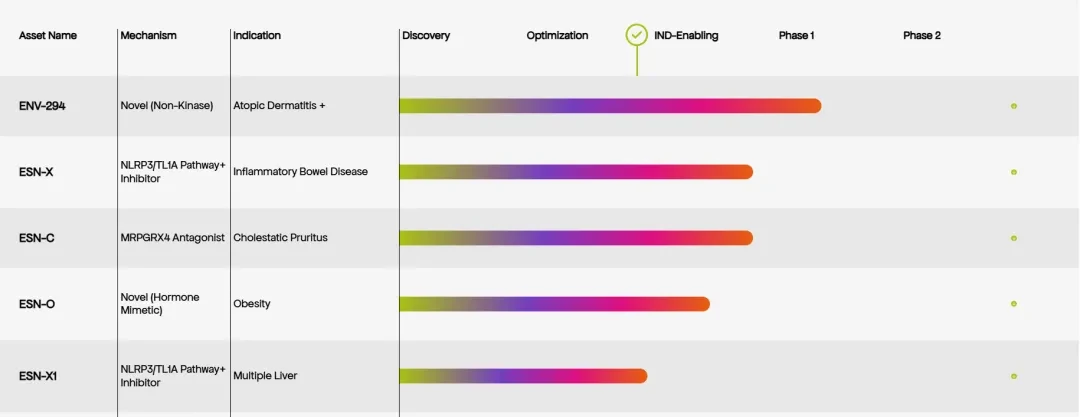
Spun off from a listed AI pharmaceutical company Enveda Founded in 2019, the founderViswa ColluruOnce served as the Product Manager at Recursion Pharmaceuticals. Recursion is one of the earliest AI pharmaceutical companies to go public globally, leveraging machine learning and high-throughput cell imaging and measurement to transform the phenotypic screening process for new drug discovery.Has garnered significant market attention. Viswa Colluru's experience as a product manager at Recursion taught him to bridge computational processes with drug development, but he has a preference for using natural bioactive substances to develop drugs. Viswa Colluru believes that people nowadays have overlooked the chemical space of natural products and their derivatives. Natural products are generally heavier than synthetic ones, containing more oxygen and less nitrogen, although they violate many rules used for small molecule drugs.Chemical rules, but still able to become a drug. Therefore,Viswa ColluruThe core idea is to reinvigorate the pharmaceutical industry's focus on natural product discovery, as many of the world's greatest drugs are derived from nature. In order to advance this mission,Viswa Colluru wants to start aEnveda Biosciences, Inc., leveraging large-scale metabolomics and artificial intelligence to significantly accelerate the discovery process of natural products. Fig.: Viswa Colluru FirstPipeline enters clinical stage Founder Viswa Colluru said, "We developed our platform to rapidly expand access to natural chemistry, obtaining drug candidates at about four times the speed." The company's core platform is PRISM, trained on over 1 billion unlabeled mass spectrometry data.It is not only the first foundational model specifically built for natural chemistry but also the world's largest searchable library of natural products. Enveda Through Core Sampling Technology IsLiquid Chromatography-Tandem Mass Spectrometry(LC-MS/MS) technology, collecting natural active substances in plants. Enveda currently claims to have establishedThe world's largest plant-derived natural molecular sample library, linking 38,000 plants to 12,000 human diseases and symptoms. By analyzing the database, the drug with the highest therapeutic potential is identified. Then, through deep learning, Enveda can directly predict chemical structures based on raw measurement data. Enveda also builds high-throughput screening processes to conduct in vitro and in vivo tests on compounds in its chemical library. These subsequent empirical measurements help rapidly assess critical drug properties, such as their functional characteristics and ultimate distribution in the body. The company's first pipeline has entered the clinical stage,ENV-294 is a first-in-class oral small molecule drug for the treatment of atopic dermatitis, which has entered Phase 1 clinical trials, with the first patient dosed in late October. Figure: Part of Enveda's pipeline In addition, the company will also advance its deep pipeline of 10 development candidates and multiple discovery projects, with INDs expected to be obtained and enter clinical trials between 2025 and 2026. —The End— Recommended Reading