

Recent Approvals and Clinical Advances: Sinocelltech's Anti-PD-1 Combination Therapy for Liver Cancer, Sichuan Baili Tianheng's GNC-038 Enters Autoimmune Indication, and Johnson & Johnson’s Guselkumab Approved in China for Crohn’s Disease

Sinocelltech
Innovative Biopharmaceutical R&D Developer

Biokin Pharmaceutical
Pharmaceutical R&D Developer

Johnson & Johnson
Medical Device R&D and Manufacturer
Sinocelltech Group Limited's Anti-PD-1 Monoclonal Antibody Combination Therapy Approved for First-Line Treatment of Liver Cancer
February 28China's National Medical Products Administration (NMPA) announced on its official website that the marketing authorization application for the combination therapy of Fenolimab Injection (SCT-I10A) and Bevacizumab Injection (SCT510), submitted by Sinocelltech Group Limited's controlling subsidiary Sinocelltech Engineering, has been approved. According to a previous press release from Sinocelltech, the approved indication for this drug is: for patients with unresectable or metastatic hepatocellular carcinoma who have not received prior systemic treatment.

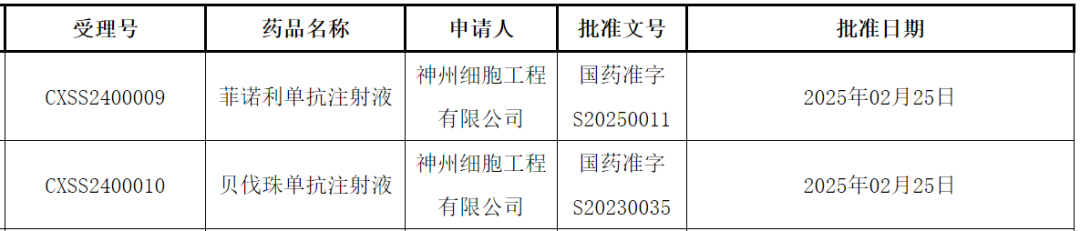
Screenshot source: NMPA official website
According to statistics from the International Agency for Research on Cancer (IARC) of the World Health Organization, primary liver cancer was the sixth most common malignant tumor globally in 2020. The IARC predicts that by 2040, the number of new cases and deaths from liver cancer will further increase. Hepatocellular carcinoma (HCC), the predominant subtype of liver cancer, accounts for 85%-90% of primary liver cancer cases. HCC is highly malignant, and current treatment options do not provide long-term survival benefits, indicating a significant unmet clinical need.
Finolimab is a recombinant humanized anti-PD-1 IgG4 monoclonal antibody injection independently developed by Sinocelltech Group Limited. Its first indication, squamous cell carcinoma of the head and neck, was approved by the NMPA in February 2025.ApprovalListed.
SCT510 is a recombinant humanized anti-VEGF monoclonal antibody injection independently developed by Sinocelltech Group Limited. It is a biosimilar to Bevacizumab Injection. Specific VEGF-targeted antibody drugs can reduce the formation of new blood vessels within tumors by blocking the binding of free VEGF to VEGF receptors (VEGFRs), thereby depriving the tumor tissue of the nutritional environment needed for survival and proliferation, and enhancing the tumor immune activation environment. SCT510 has been approved in China for the treatment of metastatic colorectal cancer, advanced, metastatic or recurrent non-small cell lung cancer, recurrent glioblastoma, hepatocellular carcinoma, epithelial ovarian cancer, fallopian tube cancer or primary peritoneal cancer, and cervical cancer.
Biokin GNC-038 Tetravalent Antibody InjectionSlaughter IntoAutoimmune Field
On February 27, the Chinese Drug Clinical Trial Registry and Information Disclosure Platform showed that BiokinRegistered aGNC-038 Tetravalent Antibody Injection inSystemic Lupus ErythematosusPhase I Clinical Study in China(CTR20250677). This is alsoThis drug has made its first breakthrough from the oncology field into the autoimmune field.。
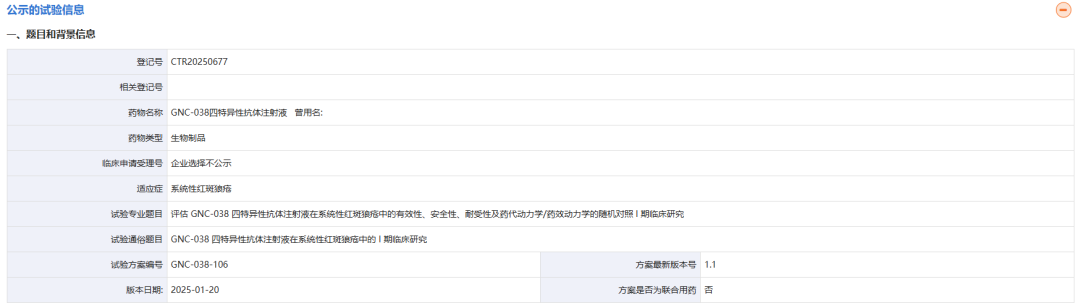
Screenshot source: China Drug Clinical Trial Registration and Information Disclosure Platform
This is a randomized controlled Phase I clinical study aimed at evaluating the efficacy, safety, tolerability, and pharmacokinetics/pharmacodynamics of GNC-038, a tetravalent antibody, in systemic lupus erythematosus. The primary endpoints include dose-limiting toxicity (DLT), maximum tolerated dose (MTD), incidence and severity of treatment-emergent adverse events (TEAEs), pharmacokinetic (PK) parameters, recommended Phase II dose (RP2D), and the SRI-4 response rate at 12 weeks post-treatment in both the experimental and placebo groups.
GNC-038 is a "targeted immunotherapy" antibody with a tetravalent structure developed by Biokin based on the GNC (Guidance & Navigation, Control) platform. It contains domains targeting four antigens: CD19, CD3, PD-L1, and 4-1BB, which can activate the first and second signals of T cells. Through the CD19 and PD-L1 domains, it targets and kills tumor cells.
This drug first applied for clinical trials in June 2020 and initiated its first clinical trial in October of the same year, making it the world's first tetra-specific antibody to enter the clinical stage. The drug has previously registered five clinical trials, all targeting hematological tumors. The Phase I clinical trial for systemic lupus erythematosus registered this time represents the drug’s first autoimmune indication.
Johnson & Johnson's Guselkumab Approved for Crohn's Disease in China
On February 25, Johnson & Johnson announced that its innovative drugs Tremfya Dose® (Guselkumab Injection (Intravenous Infusion)) and Tremfya® (Guselkumab Injection) have been approved in China for the treatment of adult patients with moderate to severe active Crohn's disease who have had an inadequate response, lost response, or were intolerant to conventional therapy or biologics. This marks the world's first approval of Guselkumab for the indication of Crohn's disease, bringing new hope to Crohn's disease patients in China.
Guselkumab is a fully human interleukin-23 (IL-23) inhibitor that selectively neutralizes the p19 subunit of IL-23, blocking its binding to the receptor and thereby suppressing inflammatory responses. IL-23 is a key cytokine that plays a crucial role in the pathogenesis of Crohn's disease by promoting the differentiation and proliferation of Th17 cells, which in turn produce various pro-inflammatory cytokines such as IL-17 and IL-22, leading to inflammation and damage of the intestinal mucosa. By precisely targeting IL-23, guselkumab inhibits inflammatory responses at the source, offering a new therapeutic target and approach for the treatment of Crohn's disease.
Editor: Yu Yuanze
Reviewed by: Ma Fei, Zhang Lanfei, Zhang Song


www.yyjjb.com.cn
Insight into Industry Trends

《China Prescription Drug》
Academic Official Account
Focus on Pharmaceutical Academics and Evidence-Based Research

Terminal Official Account