

AbbVie and Gubra Announce $2.225B Licensing Deal for Long-Acting Amylin Analog GUB014295 in Obesity Treatment

Gubra
A privately held biotechnology company

AbbVie
Innovative Drug Developer
On March 3, AbbVie and Gubra announced a licensing agreement to jointly develop GUB014295, a potential long-acting amyloid peptide analog for the treatment of obesity. AbbVie has been committed to researching and developing innovative drugs in multiple key therapeutic areas, and this entry into the obesity treatment market represents an important strategic move to expand its business scope.
Under the terms of the agreement, AbbVie will lead the development and commercialization activities of GUB014295 globally. Gubra will receive an upfront payment totaling $350 million (approximately RMB 2.55 billion) and is eligible to receive up to $1.875 billion (approximately RMB 13.67 billion) in development, commercial, and sales milestone payments, as well as tiered royalties on global net sales.
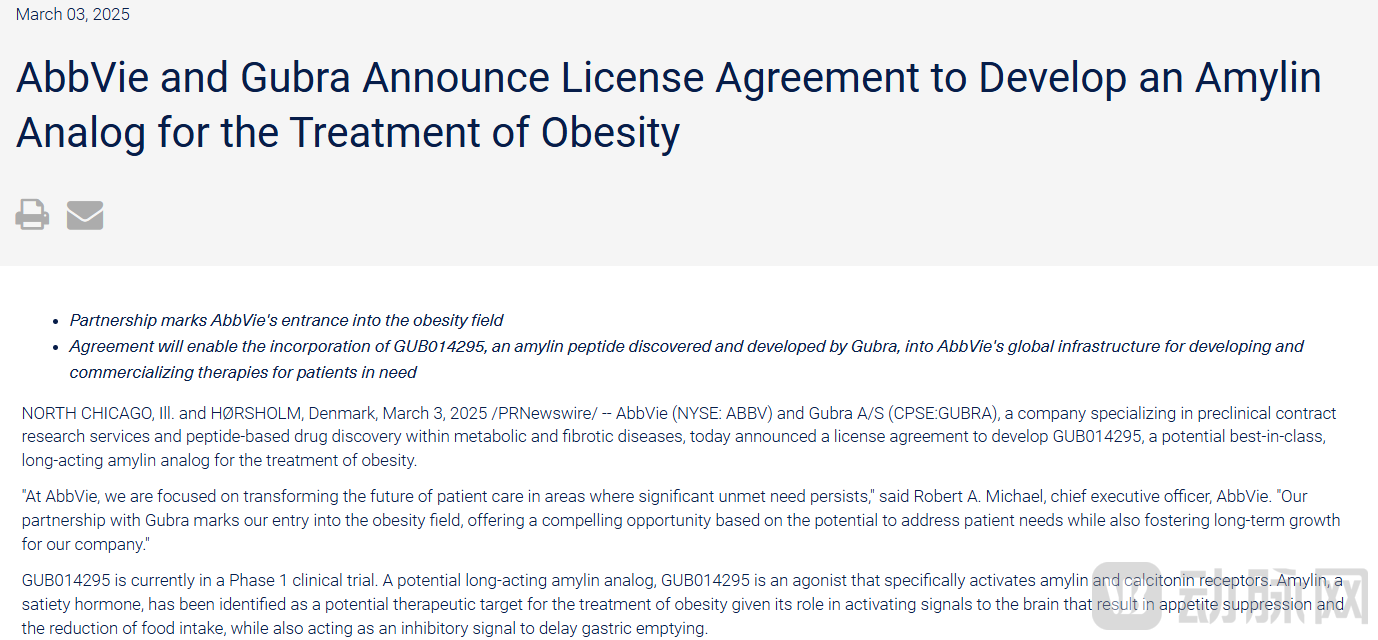
Source: AbbVie
The half-life of the core pipeline reaches 11 days.
Supports once-weekly dosing
Gubra is a company listed on the Nasdaq Copenhagen Stock Exchange, focusing on preclinical contract research services in the fields of metabolic and fibrotic diseases, as well as peptide-based drug development. This collaboration with AbbVie, leveraging AbbVie's strong development and commercialization capabilities, can accelerate the development process of GUB014295. At the same time, Gubra, with its professional expertise in peptide drug development, will provide strong support for the project.
Currently, GUB014295 is in Phase 1 clinical trials.It is an agonist that can specifically activate amylin and calcitonin receptors. Amylin, as a satiety hormone, can suppress appetite and reduce food intake after activating brain signals, and it can also delay gastric emptying. Therefore, it has become a potential key target for the treatment of obesity. GUB014295 works based on this principle.
In November 2024, Gubra announced positive results from the Phase 1 clinical trial of single ascending doses (SAD) of the drug: GUB014295 was well-tolerated, with adverse events mostly related to the gastrointestinal tract, mild in severity, and brief in duration.GUB014295 has good pharmacokinetic characteristics, with a half-life of up to 11 days, supporting once-weekly dosing.A single dose can achieve dose-dependent weight loss, an effect that persisted throughout the 6-week trial period. The high-dose group (3.5 - 6.0 mg) experienced an average weight reduction of approximately 3%, while the placebo group saw an average weight increase of about 1%. Currently, a multiple ascending dose (MAD) trial is underway, with interim results expected to be announced in the first half of 2025.
Regarding this collaboration, AbbVie CEO Robert A. Michael stated, "At AbbVie, we are committed to transforming the future of patient care in areas where there are still significant unmet needs. Our partnership with Gubra marks our entry into the obesity field, which not only provides us with an excellent opportunity to meet patient needs but also contributes to the long-term growth of our company."
Roopal Thakkar, Ph.D., Executive Vice President of Research and Development and Chief Scientific Officer at AbbVie, stated, "Obesity is a significant global health issue, with approximately 900 million adults worldwide affected by the condition, many of whom struggle to adhere to current treatment options. Based on Gubra's expertise in novel peptide-based therapeutic discovery, we look forward to advancing the development of the GUB014295 program."
Gubra CEO Henrik Blou said, "We are very pleased to collaborate with AbbVie due to their strong capabilities in the development and commercialization of life-changing drugs. The collaboration between Gubra and AbbVie will accelerate the development of GUB014295 and build on the promising data demonstrated in the Phase 1 single ascending dose (SAD) trial. Our team is highly impressed by AbbVie and their commitment to driving this important collaboration forward. We look forward to working hand in hand throughout the entire development process of the GUB014295 project."
Obesity drugs with pharmaceutical "cash" capabilities,
The Market Grew Tenfold in a Decade
With the increase in the global obese population, the demand for effective weight-loss drugs is also growing. According to data from medical professionals, in 2024, the global anti-obesity drug market exceeded USD 30 billion in size, having grown tenfold over the past decade.
In the global weight-loss craze, Novo Nordisk and Eli Lilly currently dominate the field with their weight-loss drugs.According to Novo Nordisk's Q3 2024 financial report, the weight-loss version of semaglutide, Wegovy, achieved sales of 38.34 billion Danish kroner, equivalent to $5.513 billion, marking a 77% year-on-year increase and is expected to become the new "blockbuster drug" of 2024. Eli Lilly's Q3 2024 financial report showed that the weight-loss version of tirzepatide, Zepbound, generated sales of $1.26 billion, falling short of the analysts' previous forecast of $1.7 billion. Eli Lilly attributed this to production capacity constraints and announced ongoing efforts to expand output. As tirzepatide rapidly gains market share, the product is also expected to compete with semaglutide for the top position in the pharmaceutical market.
However, this craze has not yet reached its end. In 2024, the supply chain for anti-obesity drugs will be in short supply throughout the year, allowing U.S. compounding pharmacies to aggressively capitalize on the supply gap. To alleviate the supply-demand imbalance, Novo Nordisk spent a staggering $16.5 billion acquiring CDMO giant Catalent, while Eli Lilly also invested heavily to expand production. Despite these efforts, market demand continues to consume supply like a black hole. In the European market, the "cash power" of self-paying patients has been fully demonstrated. Germany has over 100,000 self-paying patients, Denmark has more than 100,000 Wegovy users, and the UK sees 400,000 people purchasing the drug out of pocket. This phenomenon indicates that “weight loss first” is rewriting the logic of healthcare consumption—health is no longer just about treating illnesses but has become an investment in lifestyle.
Seeing this blue ocean, not only AbbVie, but also Roche, GSK, Boehringer Ingelheim, Novartis, Amgen, AstraZeneca and other major MNCs are scrambling to enter this field, attempting to break the current duopoly of Novo Nordisk and Eli Lilly, and bring a new competitive landscape to the obesity market.
In China, a large number of domestic generic drug companies and innovative drug companies, such as Huadong Medicine, Renhui Biotech, Innovent Biologics, Zhibiao Biotech, BrightGene Bio-Medical, Hansoh Pharmaceutical, Chengdu Better, CSPC, Livzon Group, United Labs, Shenzhen Hanmi, Huisen Pharmaceuticals, Jiuyuan Gene, Wanbang Medicine, Gan & Lee, Hongyun Huaning, Derui Therapeutics, Hengrui Medicine, and Shenzhen Dongyangguang, have already entered this field and are about to enter the commercial competition stage.
It is foreseeable that the obesity track is about to witness a fierce competition.
References:
①Antibody Circle, "Major Collaboration! AbbVie Bets $2.225 Billion on New Obesity Drug"
②Medical colleagues, "The 2025 Anti-Obesity Drug Market Explosion! These Five Trends Will Reshape the Billion-Dollar Track, Who Will Become the Next Blockbuster Drug?"