

Nurovis Medical Completes China's First Functional Visual BCI Validation in Cynomolgus Monkeys, Pioneering Global Implantable Vision Restoration

Nanochap
Core Chip Developer in the Biomedical Field
When hailed as“National-Level”InnovativeDeepSeekSuddenly emerging and dramatically reshaping the global large model market landscape, withDeepSeekCore DeepQuest“Hangzhou Six Little Dragons”CollectiveOutbreak,Rise to Prominence!Showcased to the world“The Mysterious Power from the East”。
Among these six unicorn companies, there is a striking commonality – three of the founders, including Liang Wenfeng, the founder of DeepSeek, come from the prestigious "Zhejiang University Entrepreneurship Squad." This phenomenon not only highlights Zhejiang University's innovative DNA but also signals the unstoppable rise of China's hardcore technology power.
Of course, as a century-old prestigious university rooted in Hangzhou, the energy and influence contained in Zhejiang University go far beyond that. Recently, the "ZJU Entrepreneurship Team" once again delivered good news.Nanochap Electronics Co., Ltd. (hereinafter referred to as "Nanochap"), founded by Dr. Yang Jiawei, an alumnus of Zhejiang University, announced the completion of China's first functional animal experiment validation on cynomolgus monkeys for visual brain-computer interfaces, successfully implanting Nanochap’s high-resolution visual brain-computer interface.on cynomolgus monkeys, achieving a historic leap from "complete blindness" to "seeing." This is also one of the most significant advancements in the global visual brain-computer interface field in recent years.
Nanochap, a hardcore technology startup specializing in the research, development, production, and sales of brain-computer interfaces and neuro-bio chips, was founded by Yang Jiawei, whose academic and research career spanned two of the world's top universities, laying a solid professional foundation for his personal development and subsequent entrepreneurial journey.
After obtaining his bachelor's degree from Zhejiang University, one of China's top universities, Yang Jiawei received a full scholarship from the University of Melbourne to further his studies in Australia, where he successfully earned his doctorate. The University of Melbourne, a prestigious institution with over a century of profound research heritage, has produced eight Nobel laureates and holds a significant position in the international academic community, exerting far-reaching influence.
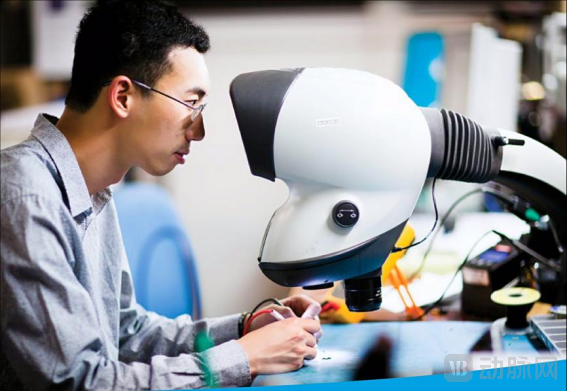
Dr. Yang Jiawei, Founder of Nanochap
After obtaining his Ph.D., Dr. Yang Jiawei joined the NeuroEngineering Center at the University of Melbourne, a leading research institution in the field of brain-computer interfaces and neuroengineering, as a researcher.
The NeuroEngineering Laboratory at the University of Melbourne was established by Professor Graeme Clark in the 1970s to provide a critical platform for foundational research into various brain-computer interface technologies. In 1978, Professor Graeme Clark successfully developed the world's first multi-channel cochlear implant system, significantly enhancing hearing restoration outcomes.
Based on this disruptive innovation, Cochlear Ltd., the world's largest research, development, and manufacturing company for cochlear implants, was established in 1981. It has since transformed the lives of nearly a million hearing-impaired individuals across more than 180 countries and regions globally.
Not only that, but the core technology of Synchron, one of the most well-known brain-computer interface companies globally, also originates from the NeuroEngineering Center at the University of Melbourne. Its founder, Thomas Oxley, and Dr. Yang Jiawei worked in different research groups at the center during the same period, laying a strong foundation for their subsequent innovative practices in the brain-computer interface field.
During his time working at the Melbourne Centre for Neural Engineering, Dr. Yang Jiawei, based on a profound understanding of the intersection between brain science and engineering technology, took notice of the then-nascent field of implantable visual brain-computer interface technology. He keenly realized that this would be an important direction for future technological development.Driven by a relentless pursuit of fundamental innovations in brain-computer interface technology, Dr. Yang Jiawei has achieved significant breakthroughs in the field of high-resolution visual brain-computer interfaces multiple times, becoming one of the few scientists globally to master the core technologies in this domain. This has also provided critical technical support and directional guidance for Nanochap's research and development efforts.
From DeepSeek, to the "Hangzhou Six Dragons," and to Nanochap, which has raised hundreds of millions in financing over a decade of entrepreneurship, the Zhejiang University-affiliated entrepreneurs rooted in Hangzhou seem to hold a certain key to innovation—they always manage to tear open cracks of industrial transformation in cutting-edge fields through breakthroughs in foundational technologies.This time, Dr. Yang Jiawei and his team at Nanochap have spent a decade building a bridge connecting silicon-based and carbon-based life for blind patients at the intersection of brain neural electrical signals and the digital world.
Data from the World Health Organization in 2020 shows that approximately 1.2 billion people worldwide suffer from some form of visual impairment, including at least 43 million who are blind and 238 million with low vision. Visual impairments impose a heavy burden on patients, their families, and society. The "visual brain-computer interface," which has the potential to restore vision to blind patients, has become a highly sought-after technological frontier for countries around the globe. Against this backdrop, Dr. Yang Jiawei returned to China in 2014 and officially began his entrepreneurial journey in Hangzhou, leading his team.
"Visual Brain-Computer Interface" is mainly divided into the retinal implant pathway and the visual cortex implant pathway.Among them, the retinal implant approach helps patients restore vision by stimulating functional neurons in the retina. This technical approach is relatively mature, having been in clinical use for nearly a decade, accumulating a large amount of safety-related clinical data. Moreover, from the perspective of surgical operation, the implantation risk in ophthalmic surgery is significantly lower than that of subdural brain implants. At the same time, this technical approach also avoids major challenges such as ethical issues, privacy concerns, and long-term safety risks associated with deep brain implants.
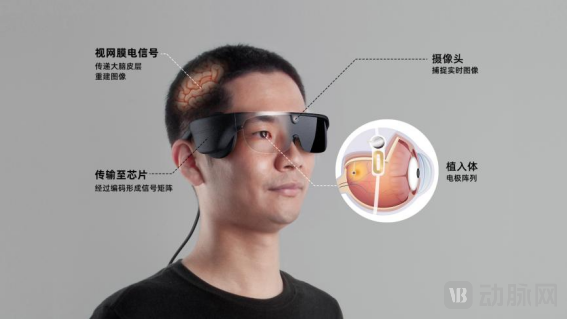
Nanochap's First-Generation Visual Brain-Computer Interface Product Form
Photo provided by Nanochap
Currently, all technical indicators of the first-generation implantable visual brain-computer interface product independently developed by Nanochap have reached world-leading levels and have long been selected for the National Key Research and Development Program under the Ministry of Science and Technology. Meanwhile, the company's second-generation visual brain-computer interface product directly competes with Neuralink’s Blindsight, which has received FDA Breakthrough Device Designation. In key metrics such as signal processing and the precision of neural electrical stimulation, the second-generation product demonstrates superior performance compared to Blindsight, surpassing Neuralink's progress in the same field.
These continuous innovative achievements will bring unprecedented improvements in visual function to blind patients worldwide, significantly enhancing the autonomy and safety of daily life. Moreover, they fill the technical gap in this field in China, break the monopoly of foreign technologies, and achieve "overtaking on a curve."
It is reported that Nanochap's first-generation visual brain-computer product completed medical device type inspection in the second half of 2024 and successfully conducted nearly a hundred animal experiments, including those on primates. The product’s safety, efficacy, and other indicators fully comply with the relevant standards for "active implantable medical devices," which are the most stringent compliance standards for Class III medical devices.
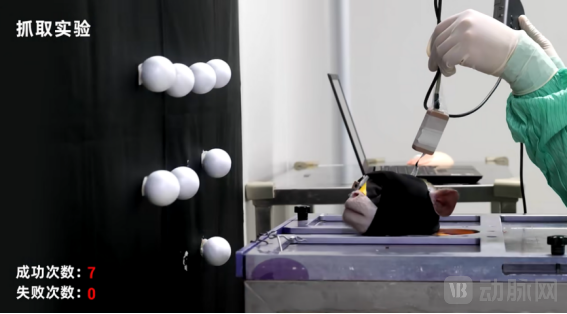
Cynomolgus Monkey Grasping Task
Photo provided by Nanochap
In recently completed crab-eating macaque animal experiments, Nanochap's visual brain-computer interface product achieved groundbreaking functional validation results. The product successfully reproduced multiple instances of accurate target ball grasping by the macaques while the visual brain-computer interface was activated. However, under identical experimental conditions with the visual brain-computer interface turned off, the macaques did not exhibit corresponding behavioral responses to the target ball.Achieved a milestone breakthrough and innovation in the functional verification of vision restoration.
As a non-human primate, the cynomolgus monkey shares high similarities with humans in terms of physiological structure, organ function, and metabolic systems. Based on the current research achievements, Nanochap is making all-out efforts to accelerate the related work of human clinical trials, striving to bring the hope of regaining sight to more patients in the near future.
Brain-computer interface, as a globally leading scientific and technological hotspot, has attracted a large amount of research resources and capital investment. However, its underlying technology involves interdisciplinary fields such as neuroscience, computer science, and materials science, and there are many unresolved challenges in areas like precise signal acquisition and interpretation, efficient bidirectional interaction of brain-computer interfaces, and long-term biocompatibility of implants.
In response, Dr. Yang Jiawei led the Nanochap team through a decade of meticulous efforts, successfully overcoming several underlying technical challenges in implantable visual brain-computer interface products. They achieved five key innovative breakthroughs, building a strong moat of foundational technology.
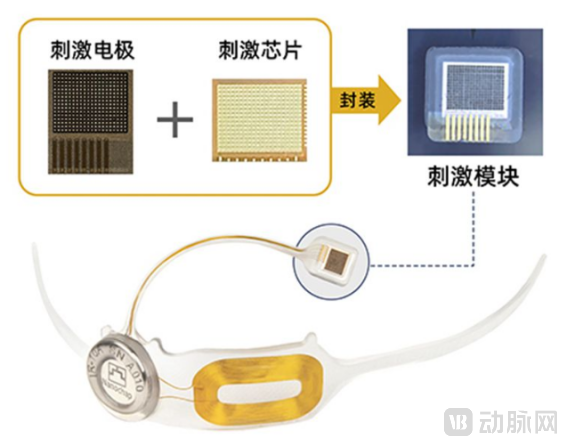
Implantable Visual Brain-Computer Interface
Photo provided by Nanochap
Limited by electrode density, signal processing capability, and the extremely narrow space of the macular region at the fundus, traditional visual brain-computer interfaces typically have a resolution of only several dozen pixels, allowing patients to merely perceive light spots or simple outlines. Therefore, to enable visual brain-computer interfaces to present better images, it is necessary to adopt several times the number of channels compared to traditional visual brain-computer interfaces within the same area to truly achieve visually restorative effects usable in daily life.
In response, Nanochap has innovated in the research and development of high-density electrode array design and manufacturing processes.Successfully integrated 320 programmable electrical stimulation channels and 320 neural signal recording channels within an extremely small area of 3mm×3mm in the macular region of the retina, reaching the highest number of channels among similar products globally.
Nanochap Achieves Breakthrough with Biocompatible Materials and Flip-Chip Technology, Overcoming the Physical Limitation of Traditional One-to-One Electrode-to-Chip Channel Connections, Enabling Wireless Bonding Between Chips and Electrodes. This "Back-to-Back" Wireless Connection Method Not Only Significantly Enhances Chip Stability and Durability but Also Greatly Reduces Implant Size, Effectively Lowering Surgical Risks. Currently, Nanochap is the Only Company in China Mastering This Cutting-Edge Technology.
In the design of implantable visual brain-computer interface products, the hermetic sealing of internal circuits, chips, leads, connectors, and other components must meet the stringent standard of absolute airtightness.StillMust meet the special requirements for implantation in the human body simultaneously.Otherwise, under the immersion environment of human body fluids, active medical device products will fail quickly.. Nanochap team relies onFor many yearsTechnical沉淀与Innovation探索,Independently developed a "hermetic sealing process for ultra-small volume bio-glass" based on ultra-short pulse laser.Successfully achieved hermetic encapsulation of bioactive glass material within a tiny area of less than 20mm², providing a strong guarantee for the long-term stable operation of this active device product in the human body.
According to the accelerated aging test,Nanochap Visual Brain-Computer Implant Lasts Over 10 Years, far exceeding the industry average of about one year. Moreover, in the medical field, this unique packaging technology adopted by Nanochap is only similarly possessed by the German glass giant Schott Group, which acquired such technology.
Due to variations in the degree of retinal degeneration and neuronal response characteristics among visually impaired patients, precisely customizing treatment plans according to the needs of different patients has become a key challenge in the field of visual rehabilitation. In response, Nanochap's self-developed visual brain-computer interface product allows for arbitrary adjustment of multiple key parameters, such as...Stimulation Current Amplitude, Waveform, Pulse Interval, Width, etc., breaking the limitations of traditional products' fixed stimulation patterns by precisely stimulating nerve cells to meet diverse treatment needs.
At the same time, Nanochap uses advanced neural network algorithms to decode visual evoked potentials, adjust stimulation parameters in a closed loop, and achieve..."Collection + Decoding" and "Stimulation + Encoding" Operate Alternately and SynchronouslyThe real-time complete closed-loop control mode significantly enhances the persistence and stability of visual recovery effects.
To further enhance the safety and effectiveness of the product during the implantation cycle, the Nanochap team has developed a proprietary charge balancing technology.Charge mismatch rate as low as approximately 0.5%, reaching the international minimum level, which can effectively reduce the potential damage of residual electrical stimulation charge to the human body. This technology has successfully applied for multiple international patents.
Currently, Nanochap has passed the ISO13485 system audit and obtained certification, meeting the globally recognized international standards for medical device quality management. It is about to launch multi-center human clinical trials, which is undoubtedly a critical milestone step taken by Chinese implantable visual brain-computer interface companies.
Ten years to sharpen a sword, Nanochap has been continuously refining its core product — the implantable visual brain-computer interface — while also focusing on the key components of brain-computer interfaces —Neurobiological Chip, this field, which is also "strangled" by foreign countries, has gained a foothold and achieved large-scale commercial application.
In the process of continuous innovation and breakthrough, Nanochap has built up technological barriers and brand moats with its core competitiveness, continuously promoting the scaled commercial implementation of technological products.In September 2024, based on its hard-tech innovation attributes, key position in the industrial chain, and market-first advantages, Nanochap successfully earned the honor of being named a Sixth Batch National-Level Specialized, Fine, Distinctive, and Innovative "Little Giant" enterprise, becoming a leader in China's brain-computer interface and neurobiological chip fields.
According to data from CCID Consulting, the global biochip market size was approximately 112 billion yuan in 2020, demonstrating tremendous development potential. However, with the escalating international chip competition in recent years and increasingly fierce strategic rivalry among countries in the chip sector, the industrial landscape has become highly unstable. As a cutting-edge product of the deep integration of modern life sciences and information technology, neurobiochips play an irreplaceable and critical role in the healthcare field. Nevertheless, the current global biochip market is mainly monopolized by developed countries in Europe and America, and domestic companies face numerous restrictions in their development.
Against this challenging backdrop, Nanochap has broken through long-standing foreign technological blockades via independent innovation, successfully achieving the scaled application of domestically produced neuro-bio chips. It can continuously provide technical support and innovative momentum to downstream equipment enterprises such as bio-signal detection and smart wearables, marking a key breakthrough in China’s biochip industry’s journey toward self-reliance and controllability. This showcases the rise and responsibility of Chinese hard-tech companies in cutting-edge technology fields.
From DeepSeek's general artificial intelligence to Nanochap's visual brain-computer interface and neurobiochip family, in Hangzhou, this "innovation hotspot" of China, the "Zhejiang University entrepreneurial group" is demonstrating another possibility of hard-core technological innovation—reconstructing the rules at the foundational technology level and redefining an entirely new ecosystem for the relationship between life and machines. As technology iterates and application scenarios continue to expand, Nanochap is expected to become a core force driving the transformation of the global implantable brain-computer interface industry, bringing more surprises and breakthroughs to China’s technological innovation.