NeuroSkull Medical, Led by 985 University Professor, Reshapes the Transcranial Focused Ultrasound Landscape with Integrated Industry-Academia-Clinical Innovation
Mental, neurological, and developmental brain diseases impose an extremely heavy burden on society and the economy. A study released by the WHO showed that in 2021, the number of people with neurological disorders alone exceeded 3 billion globally, making it a leading cause of illness and disability—far surpassing well-known conditions like cancer and cardiovascular diseases.
At present, the circuits and mechanisms of the intracranial nervous system, as well as the pathogenesis of many neuropsychiatric diseases, have not been fully elucidated. Moreover, treatment methods such as drugs and stem cells often have limitations when dealing with these complex conditions.In this situation, a new non-invasive neuromodulation treatment technology that has emerged in recent years—transcranial focused ultrasound stimulation (TUS)—has brought new hope for overcoming these complex brain diseases.
Compared with traditional non-invasive neuromodulation technologies, transcranial focused ultrasound stimulation has obvious advantages: stronger penetration ability, capable of targeting deep brain regions; higher spatial resolution, precise to the millimeter level; fewer adverse reactions, and compatibility with neuroimaging technologies such as MRI.
However, to achieve millimeter-level spatial resolution, TUS must be equipped with a navigation system costing over a million yuan. This high cost makes it unaffordable for most hospitals, especially grassroots hospitals, significantly hindering the promotion and popularization of TUS technology in clinical practice.
Against this backdrop, Cranium Medical Devices (Jiaxing) Co., Ltd. (hereinafter referred to as "Cranium Medical") has taken an innovative approach by launching the "Head-worn Focused Transcranial Ultrasound Neuromodulation Solution." This solution consists of a "stereotactic helmet" based on 3D printing technology and advanced intelligent algorithms, along with the company's self-developed "focused transcranial ultrasound therapy device," completely eliminating reliance on neuro-navigation systems. This breakthrough significantly lowers the application threshold for TUS and is expected to promote the widespread clinical adoption of related technologies and products.
In contrast to the enormous demand from billions of patients, the number of players in the global Transcranial Ultrasound (TUS) track is currently very limited. Especially for the Chinese market, it is still in the early stages of development. From a research and development perspective, the R&D difficulty of transcranial focused ultrasound is extremely high, requiring solutions to challenges such as local overheating of the skull, beam propagation distortion caused by tissue heterogeneity, and the heterogeneity between individuals and intracranial tissues. On the market level, the high R&D costs borne by companies and the millions of yuan investment required for hospitals to purchase equipment have jointly driven up the price of TUS products and services, leading to generally low market awareness of TUS-related products and services in China.
In this regard, Professor Jian Gang Chen, founder and CTO of Lusen Medical, stated, "Although the TUS track faces numerous technical and promotional challenges, we have sufficient confidence to overcome these obstacles."
First, in the construction of the core team, represented by founder Professor Chen Jiangang, Lushen Medical has gathered a group of senior industry experts and professional technical talents.Professor Chen Jiangang is a researcher at the School of Communication and Electronic Engineering, East China Normal University. He focuses on research in medical ultrasound, artificial intelligence, wearable medical devices, and other fields, with over 50 academic papers published. He studied under Professor Elisa Konofagou, a member of the US National Academy of Medicine and professor at Columbia University (a pioneer in the field of using ultrasound to open the blood-brain barrier), conducting research on low-intensity ultrasound therapeutic technologies. He has also served as a senior scientist at Philips Research Asia, working on ultrasound equipment and algorithm development; as a senior researcher at Oxford Suzhou Centre for Advanced Research, leading the Medical Ultrasound Artificial Intelligence Lab, focusing on ultrasound cavitation technology research. Professor Chen has accumulated extensive experience in the ultrasound field and is a serial entrepreneur who developed a wireless handheld 4D ultrasound device that was implemented in Cixi, Ningbo, China.
TUS, as a cutting-edge technology, has its principles and applications deeply rooted in neuroscience.Professor Guoyuan Yang, Co-founder and Chief Scientist of Lushen Medical, is an expert in neurobiology, neurosurgery, and neurology. He has published a series of cutting-edge research achievements in the field of neuroscience and was elected as a Fellow of the American Institute for Medical and Biological Engineering, earning widespread acclaim in the international academic community.
Led by Professors Guoyuan Yang and Jianguang Chen, Cranium Medical has gathered professional talents from various fields. Team members have rich research and practical experience in medicine, ultrasound technology, electronic engineering, computer science, and artificial intelligence, providing strong support for the innovation of TUS field technical products in China.
Secondly, as an advanced treatment strategy that integrates medicine and engineering technology, the expansion and popularization of TUS from theory to clinical practice cannot be achieved without extensive repeated verification through clinical practice, as well as active participation of doctors in optimizing and promoting treatment plans. In this regard, Cranium Medical andRuijin Hospital Affiliated to Shanghai Jiao Tong University, Huashan Hospital Affiliated to Fudan University, Sixth People's Hospital Affiliated to Shanghai Jiao Tong University School of Medicine, Yueyang Hospital of Integrated Traditional Chinese and Western Medicine Affiliated to Shanghai University of Traditional Chinese Medicine, Tongren Hospital Affiliated to Shanghai Jiao Tong University School of MedicineA long-term and stable cooperative relationship has been established with the three top-grade hospitals, and Professor Chen Jiangang also serves as a flexibly introduced professor at Shanghai University of Traditional Chinese Medicine and a part-time professor at the Ultrasound Diagnosis and Treatment Engineering Technology Research Center of Shanghai Tenth People's Hospital.
Finally, Professor Chen Jiangang also served asVice Chairman of the Critical Care Ultrasound Branch of the Chinese Medical Education Association, Vice President of the Neonatal Critical Care Medicine Branch of the Beijing Integrated Medicine Society, Deputy Secretary-General of the Eurasian Pediatric and Neonatal Critical Ultrasound Research Society, Standing Committee Member of the Medical Device Innovation and Application Branch of the Chinese Medical Equipment Association, and Deputy Leader of the Orthopedic Medical Engineering Transformation Expert Group...and other important positions, will start from the industry dimension, grasp the direction of technology research and development, inject momentum into the development of Cranium Medical, and also bring more possibilities for breakthroughs in the TUS field.
Based on the above advantages, Lusen Medical has achieved phased results in technology research and development and achievement transformation. On one hand, the company has applied for multiple invention patents related to hardware and algorithms, completed the prototype production of the first-generation transcranial ultrasound neuromodulation system, and successfully commercialized it in the scientific research market; on the other hand, the 3D-printed personalized device has obtained the medical device production and sales license, and has been applied to hundreds of patients in cooperative hospitals. The clinical auxiliary positioning effect is good and has been fully verified.
The brain is one of the most intricate and complex organs in the human body, with a structure that can be divided into more than 100 functional areas, the smallest of which is only about the size of a pea. Therefore, for TUS technology, which is characterized by high precision in the field of deep brain modulation, the key and core to its clinical value lies in how to accurately and precisely target the ultrasound beam to the intended brain region.
Traditional TUS achieves precise localization and regulation of specific brain regions by combining optical navigation technology with transcranial ultrasound stimulation devices. However, as previously mentioned, this method is expensive and operationally complex, and only a very few hospitals in China have the capability to implement this technology.
To address this challenge, Lushen Medical's self-developed stereotactic helmet not only achieves millimeter-level spatial resolution comparable to optical navigation systems but also, with its cost in the thousands, makes it easily affordable for more medical institutions and patients. It can also be used in scientific research settings, greatly enhancing the feasibility of popularizing TUS technology.
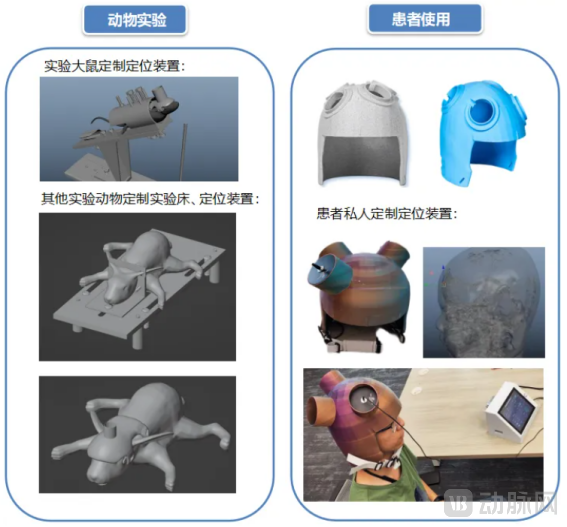
Stereotactic Helmet
Photo provided by Lushen Medical
Professor Chen Jiangang introduced: "Before treatment, the core intelligent algorithm independently developed by Cranium Medical will automatically generate a 3D helmet model to assist in treatment based on the patient's head imaging data collected via MRI and the doctor’s treatment plan. Next, using 3D printing technology, a customized helmet model is printed for each patient. During treatment, medical staff simply need to install the ultrasound probe into the preset holes on the helmet, eliminating the need to hold it manually, allowing targeted treatment of specific brain regions. This effectively enhances the precision, targeting, convenience, and accessibility of TUS technology."
Secondly, Lushen Medical's self-developed transcranial ultrasound stimulation therapy device has also made several breakthroughs. "Compared with similar products currently on the global market, the company's developed transcranial focused ultrasound therapy device has reached a world-class level in all parameters and performance," said Professor Chen Jiangang.
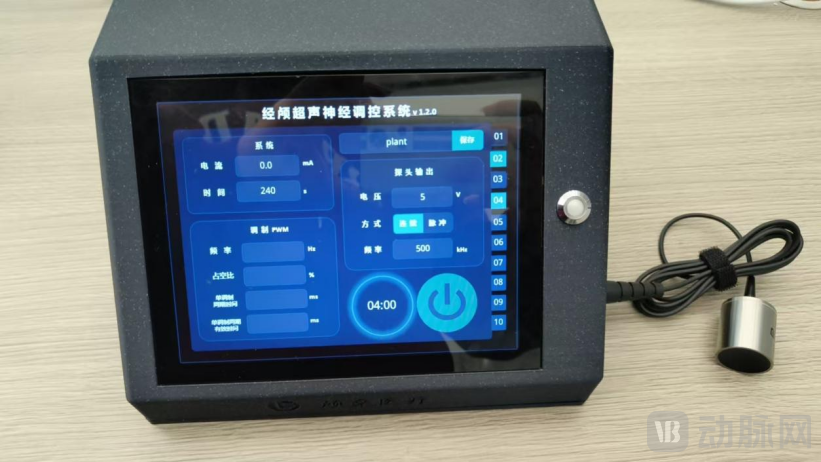
Transcranial Ultrasound Stimulation Device and Probe
Photo provided by Lushen Medical
Specifically, the frequency range of this domestically produced transcranial focused ultrasound therapeutic device reaches 0.3-3MHz, which, compared to the general range of 0.5-1MHz in existing products, can adapt to more complex treatment scenarios. Moreover, the modulation pulse duty cycle is adjustable, and the acoustic pressure is within 0-2MPa, comparable to the relevant performance of existing products.
"At present, the existing transcranial focused ultrasound therapy devices on the market are limited by expensive navigation systems and can only achieve single-channel treatment. However, neurological and psychiatric disorders often involve multiple brain regions. To address this, Kranus Healthcare has developed a transcranial focused ultrasound therapy device equipped with various neuromodulation ultrasound probes of different center frequencies. Depending on the application scenario, these probes can be selected to precisely target multiple areas. Combined with a 3D-printed precision positioning helmet, this forms an integrated solution that provides patients with more effective personalized treatment methods, meets diverse treatment needs, and shortens the treatment cycle," said Professor Chen Jiangang.
Based on this innovative solution, TUS not only eliminated the purchase costs of imported and domestically produced high-end navigation software and hardware equipment but also reduced the operational threshold for medical staff, facilitating further exploration of the clinical application value and potential of precision localization treatment technology.
Moreover, due to the low cost, portability, and ease of use of the stereotactic helmet, Cranium Medical's wearable focused transcranial ultrasound neuromodulation solution has the potential to expand into broader outpatient and home markets, truly promoting the accessibility of high-quality medical resources. At the same time, the treatment openings of the helmet can also integrate various neuromodulation technologies such as transcranial magnetic stimulation, forming a comprehensive treatment plan that optimizes existing brain disease treatments and advances the development of brain disease therapy technologies.
TUS, as a non-invasive treatment for brain diseases, has significant clinical value. However, existing TUS products cannot dynamically adjust in real-time based on patients' neural activity feedback, making it difficult to meet the actual needs of individual patients at different stages, thereby affecting the precision and stability of treatment outcomes. Therefore, closed-loop control technology and products for real-time dynamic neuromodulation have become a research trend in the TUS field.
Driven by demand, the team at Lusen Medical is developing a next-generation integrated device for transcranial ultrasound neuromodulation and intelligent monitoring. This industry-first product combines three key core technologies: non-invasive transcranial ultrasound neuromodulation, ultrasound cerebral blood flow monitoring, and personalized precision positioning, enabling closed-loop treatment for brain disorders.
Currently, the device has beenRuijin Hospital Affiliated to Shanghai Jiao Tong University, Huashan Hospital Affiliated to Fudan UniversityCollaborative research conducted by multiple organizations. With its innovative and leading technology, breakthrough progress is expected in the treatment of brain-related diseases such as depression, autism, Alzheimer's disease, and stroke rehabilitation, significantly improving patients' quality of life and recovery prospects.
At the finals of the 8th "Red Boat Cup" Jiaxing Global Entrepreneurship Competition in 2024, thousands of projects from around the world gathered. Lusen Medical's next-generation integrated transcranial ultrasound neuromodulation and intelligent monitoring device stood out with a series of advantages such as strong directionality, deep penetration, precise positioning, efficacy monitoring capability, low cost, and ease of operation, successfully winning the third prize and ranking among the 24 award-winning entrepreneurial projects.
"Focused on the research and development of transcranial ultrasound neuromodulation technology, we have been committed to transforming cutting-edge science into practical medical achievements. This award not only represents high recognition of Cranium Medical's innovation capabilities in intelligent manufacturing and healthcare, but also marks substantial progress in the company’s efforts to deeply integrate advanced technologies with medical practice," said Professor Chen Jiangang.
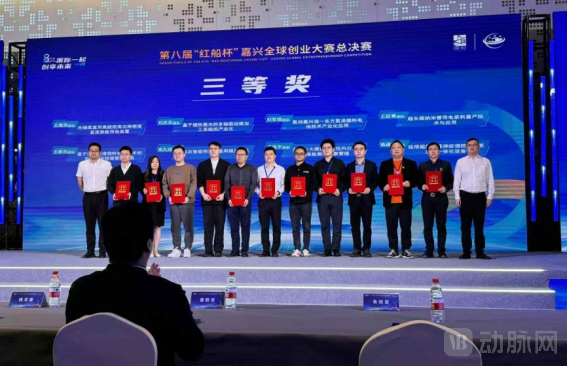
The Final of the 8th "Red Boat Cup" Jiaxing Global Entrepreneurship Competition
Photo provided by Cranium Medical
Currently, Lushen Medical's "Stereotactic Helmet" and "Transcranial Focused Ultrasound Therapy Device" have secured multiple orders in the research market from institutions such as the Breast Surgery Department of Shuguang Hospital affiliated with Shanghai University of Traditional Chinese Medicine. Additionally, these innovations are making headway into the burgeoning pet market, offering novel solutions for diagnosing and treating brain diseases in pets, thereby further expanding the application boundaries of cutting-edge medical technologies.
Speaking of the future, Professor Chen Jiangang said, "Transcranial focused ultrasound is a versatile tool for exploring the neural mechanisms of cognitive functions and intervening in the treatment of neurological diseases. Although it currently faces some challenges, non-invasive neuromodulation technology, with its advantages of low cost, high reliability, and ease of operation, is expected to play a more critical role in the fields of neuroscience and medicine. As a university teacher and serial entrepreneur, I will lead Cranium Medical to continue focusing on technological innovation and clinical research, fully promote the registration and market launch process of core products, and contribute to the development of the global brain health cause, making advanced medical technology accessible!"
Recently, in order to accelerate the advancement of R&D and product launch, Cranium Medical has opened its first round of external financing. Investment institutions or other potential partners interested in Cranium Medical are welcome to scan the QR code below.Contact Us。