Lilly and Incyte Announce Breakthrough Efficacy of Baricitinib in Adolescents with Severe Alopecia Areata in Phase 3 BRAVE-AA-PEDS Trial

Incyte
Small Molecule Drug Developer

Eli Lilly
Global Pharmaceutical R&D and Production Company

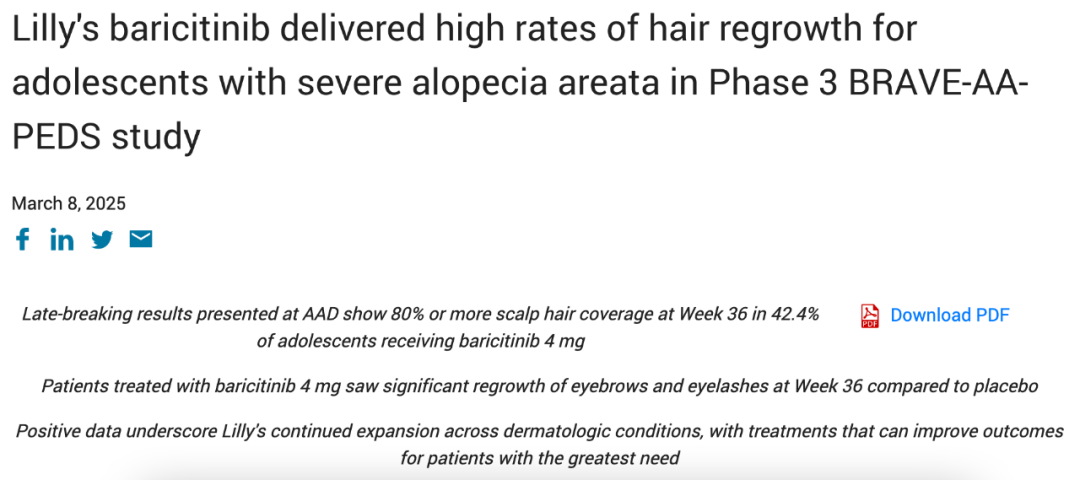
On March 8, 2025, Eli Lilly and Company and Incyte Corporation announced that in the Phase 3 clinical trial BRAVE-AA-PEDS for adolescent patients with severe alopecia areata (AA), baricitinib demonstrated significant hair regrowth effects. After 36 weeks of treatment, 42.4% of adolescent patients receiving baricitinib 4 mg achieved 80% or greater scalp hair coverage, a result showcased as a late-breaking research finding at the American Academy of Dermatology (AAD) Annual Meeting.
Alopecia Areata is an autoimmune disease that causes patchy hair loss on the scalp, face, and even other parts of the body, and the condition may worsen over time. About 40% of patients with alopecia areata experience their first onset before the age of 20, and early-onset alopecia areata tends to be more severe, leading to extensive hair loss, often unresponsive to first-line treatments such as topical medications or corticosteroids.
Clinical Trial Results
In the BRAVE-AA-PEDS study, a total of 257 adolescent patients aged 12 to under 18 were randomized to receive once-daily oralTreatment with baricitinib 4 mg, 2 mg, or placebo. The primary endpoint of the trial was the proportion of patients achieving a score of ≤20 on the Severity of Alopecia Tool (SALT) after 36 weeks of treatment (indicating scalp hair coverage of 80% or more). At the start of the study, patients had an average scalp hair loss of 89% (nearly complete alopecia), 65% had sparse or absent eyebrows, and 57% had sparse or absent eyelashes.
After 36 weeks of treatment,Both the baricitinib 4 mg group and the 2 mg group demonstrated significant efficacy:
Scalp Hair Regrowth:In the baricitinib 4 mg group, 60.0% of patients, in the 2 mg group, 36.9% of patients, showed at least 50% improvement in their condition (measured by SALT score), compared to only 5.7% in the placebo group (p=0.001).
42.4% of patients in the 4 mg group and 27.4% of patients in the 2 mg group achieved 80% or greater scalp hair coverage, compared to only 4.5% in the placebo group (p=0.001).
In the 4 mg group, 36.5% of patients, and in the 2 mg group, 21.4% of patients achieved 90% or greater scalp hair coverage (SALT ≤ 10), compared to only 2.3% in the placebo group (p = 0.001).
Regrowth of Eyebrows and Lashes:In the baricitinib 4 mg group, 50.0% of patients, and in the 2 mg group, 24.1% of patients achieved significant eyebrow regrowth (ClinRO score 0 or 1 with an improvement of ≥2 points from baseline), compared to 0% in the placebo group (p<0.01).
42.9% of patients in the 4 mg group achieved significant eyelash regrowth, 25.5% of patients in the 2 mg group showed improvement in eyelash growth, and 14.0% in the placebo group (4 mg group p=0.002, 2 mg group p=0.097).
In addition, the hair regrowth effects achieved by adolescent patients within 36 weeks were comparable to those seen in adults after 52 weeks of treatment, suggesting that hair regrowth may occur faster in adolescents than in adults. In the previous BRAVE-AA1 and BRAVE-AA2 studies, participants receiving...40.9% of adult patients treated with baricitinib 4 mg and 21.2% of those receiving 2 mg achieved 80% or greater scalp hair coverage after 52 weeks of treatment.
Safety
In the BRAVE-AA-PEDS study,The safety of baricitinib is consistent with the safety observed in previous clinical trials conducted in adolescent patients, such as those with adolescent atopic dermatitis and juvenile idiopathic arthritis. The most common treatment-related adverse events included acne, influenza, and upper respiratory tract infections. The frequency of serious adverse events was higher in the placebo group than in the baricitinib group. No deaths, opportunistic infections, major adverse cardiovascular events, venous thromboembolic events, or malignancies were reported during the trial.
Eli Lilly is excited about this breakthrough and looks forward to making further progress in future research and regulatory approvals, bringing new treatment hope to adolescent patients with severe alopecia areata.