Over 150 VCs Deploy RMB 4.38B in China's Medical Hard Tech Sector; Qiming Ventures and SoftBank Lead Investments

StairMed
Developer of Implantable Brain-Computer Interface Technology

At the start of 2025, China's healthcare industry continues to demonstrate resilience amidst a capital winter.
According to the PharmaCube InvestGo investment and financing database, even under the influence of the Spring Festival holiday,In February, more than 150 institutions were still active in China's healthcare primary market, with a total of 80 financing events occurring, and the disclosed total amount reaching 4.38 billion yuan.
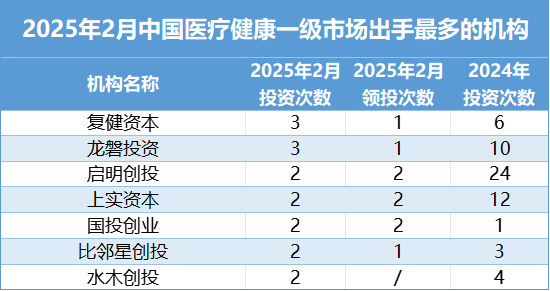
Among these active institutions, Rehabilitation Capital, Longpan Investment, Qiming Venture Partners, Shanghai Industrial Capital, SDIC Venture Capital, StarVest Capital, and Waterwood Venture Capital made the most investments in February. Among them, Qiming Venture Partners, Shanghai Industrial Capital, and SDIC Venture Capital led a total of six financing rounds.
Notably, compared to over 80 institutions in January, the number of institutions participating in February doubled. Among them, state-owned capital and corporate venture capital (CVC) were significant players, contributing to multiple financing rounds exceeding 100 million yuan while actively participating.
From the fields these institutions have invested in, innovative drugs and medical devices remain the two major financing areas, collectively securing 2.63 billion yuan in funding, accounting for over 60% of the total amount. In February, there were six financing events in the AI healthcare sector. Compared to the soaring stock prices in the secondary market, the fire of AI healthcare in the primary market has yet to be fully ignited.

Specifically,In February, the financing situation in the medical device field has significantly surpassed that of innovative drugs, with a total of 32 financings amounting to approximately 2.01 billion yuan, representing year-on-year growth of 14% and 75%, respectively.This means that investors have greater market confidence in the medical device sector, which offers more stable growth.
In recent years, with the support of policies and the boost of capital, domestically produced medical devices in China have been accelerating to break the monopoly of imports while also advancing towards technological frontiers and precision treatment.Relying on three major characteristics—hardcore technology, internationalization, and domestically-produced alternatives—nine projects in the medical device field secured over 100 million yuan in financing, accounting for 56%.
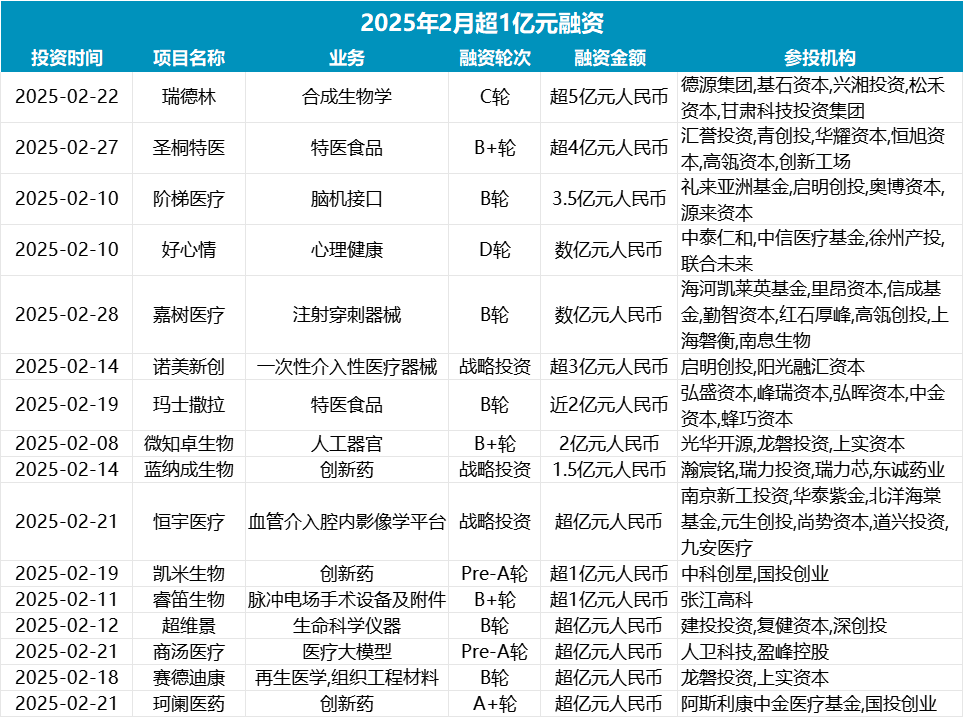
The two project financings participated in by Qiming Venture Partners both exemplify these characteristics. Among them, Qiming Venture Partners, Lilly Asia Ventures, and Orbimed led the investment inStairMed, securing 350 million yuan in B-round financing to rank among the top three financings in February. This round of financing also marks the largest investment in the history of China's invasive brain-computer interface industry.
StairMed's ability to secure such a massive financing round is related to the rapid development of the brain-computer interface track it operates in. Like Musk's Neuralink, StairMed has chosen the most technically challenging invasive brain-computer interface path and has developed China's first high-throughput invasive brain-computer interface system that complies with medical device standards, as well as China's first invasive brain-computer interface product to complete registration testing.
Another project led by Qiming Venture Partners isLeno MedicalOn February 14, the company secured over 300 million yuan in financing, focusing on the research and development of ENT and craniocervical surgical medical devices. In the era of Instrumentation 4.0, integration and innovation have become the main themes of the industry. After a decade of development and undergoing four strategic mergers and acquisitions, Leno Medical Technology(Shanghai)Co., Ltd. has gradually grown into a "trendsetter" in today's highly competitive market.
Currently, Leno Medical Technology (Shanghai) Co., Ltd.'s products are畅销全球40多个国家和地区, covering more than 3000 hospitals, most of which are ENT specialty hospitals and tertiary hospitals. The market share of its main products exceeds 30%. Hu Xubo, managing partner of Qiming Venture Partners, previously stated in an interview,They are optimistic about medical device companies with innovative capabilities, products with a global layout, and teams actively exploring globalization.. Leno Medical Technology undoubtedly aligns with Qiming Venture Capital's aesthetic.
Longpan Investment and Shanghai Industrial Capital jointly led the over 100-million-yuan Series B financing round for SideraMed.Both institutions have shown obvious interest in the field of regenerative medicine.In addition to SinoRegenerative, which focuses on the development of tissue engineering scaffold materials, Shanghai Biomedical Fund under Shanghai Industrial Investment Corporation also led the RMB 200 million Series B+ financing round for MicroHealth Bio, with existing shareholder LongPan Investment continuing its support.
In recent years, as a key technology at the forefront of biotechnology, the regenerative medicine industry has received significant attention from governments at all levels and strong support through national industrial policies. Relevant departments have successively introduced a number of policies to encourage the development and innovation of the regenerative medicine sector. With this backing, regenerative medicine companies have successfully completed financing rounds, including BioRegeneration Medicine securing hundreds of millions in its Series C funding round in 2024.

In the field of innovative drugs that have not yet fully recovered, the "cautious" institutions prefer the CGT track.Out of the 17 innovative drug financing events in February, six institutions invested in six CGT track projects.
This trend seems to continue the heat of the CGT track in 2024. The pharmaceutical database InvestGo shows,In 2024, cell therapy ranks among the top investment tracks with the most investments by institutions both in and outside of China.
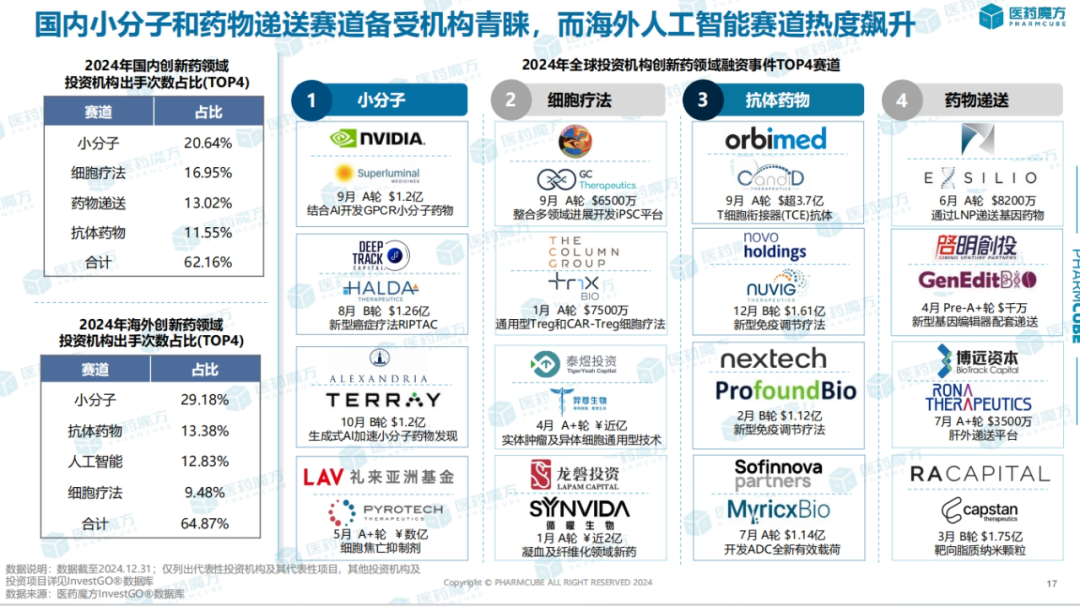
FigureSource of the image:"2024 Annual Review of Investment and Financing in the Healthcare Sector"
Among them,SoftBank, the institutional giant, has also set its sights on this track., and invested 80 million yuan in a company namedYou Kai ZePharmaceutical companies。Notably, since 2021, SoftBank has not invested in China's innovative drug sector—this "return to the scene" specifically targets YouKaize, driven by the promising market outlook for universal CAR-T, which can address bottlenecks such as high production costs and long manufacturing times associated with autologous CAR-T.
However, unlike conventional financing methods, SoftBank's entry this time is more akin to a domestic version of "NewCo." According to the agreement at that time, CARsgen Therapeutics granted Youkaize the rights to its universal BCMA CAR-T cell product and universal CD19/CD20 CAR-T cell product in mainland China. Zhuhai SoftBank Xinchuang invested 80 million yuan to subscribe for registered capital. After the investment was completed, CARsgen Therapeutics' equity in Youkaize was diluted to 92%, while Zhuhai SoftBank Xinchuang obtained an 8% stake in Youkaize.
Influenced by the news that YouKaize received a bet from SoftBank, the stock price of CARsgen Therapeutics rose 22.83% in the morning session on the same day. In fact,In the secondary market, the CGT track also continuously receives "good news."——Amoytop Biotech's wholly-owned subsidiary Poseidon Gene acquired part of SkyGen's assets to accelerate the development and application of innovative gene therapy products. Wuxi AppTec, on the other hand, increased the capital of its wholly-owned subsidiary Shanghai Wuxi ATU Bio-pharmaceutical Technology Co., Ltd., raising the registered capital from 100 million yuan to 600 million yuan at once.
However, compared with the medical device field, there were only three innovative pharmaceutical companies that made it to the list of financing over 100 million yuan in February: CoreLan Pharma, Kaimi Bio, and LanNaiCheng Bio. The common feature of these three projects is that they not only have sufficient market space but also use technological innovation to solve key bottlenecks in these fields or fill unmet clinical needs.
The number of moves in February ranked among the top.SDIC Venture Capital, it has invested in two of them — Colan Medicine and Kaimi Bio, and it is the lead investor in both. SDIC Venture Capital was established in 2016 as a fund management company independently operated by SDIC Group in a market-oriented manner, with a current management scale of 30 billion yuan.This institution's investment rounds are concentrated in Series A and earlier, adhering to the philosophy of investing early, small, and in hard technology.
Focusing on specific projects, CoreLipid Pharmaceuticals is at the forefront of scientific research in the field of glycolipid metabolism. It focuses on highly druggable innovative targets within the cholesterol metabolism pathway to develop novel drugs for major metabolic diseases such as hyperlipidemia, obesity, diabetes, atherosclerosis, and MASH.
It is reported that the original research project of Keran Pharmaceuticals was transformed from the laboratory of Academician Song Baoliang. Academician Song has been deeply engaged in the field of metabolism for over two decades and is an internationally recognized expert in the field of glycolipid metabolism. Many of his academic research achievements have been included in classic textbooks for advanced disciplines, and a large number of articles have been published in top academic journals such as Nature, Science, and Cell.
The logic behind Kaimi Biotech winning capital bets is similar to that of CoreLan Pharmaceuticals. SDIC Venture Capital once stated that the dual explosion of regulatory dividends and clinical demand for cancer therapeutic vaccines, along with breakthroughs in cold tumor immunotherapy, represent the industry's pinnacle. Kaimi Biotech’s SynNeogen® platform, which taps into the underlying logic of "cold tumor immune activation," is expected to address two major development challenges for therapeutic vaccines: antigen delivery and immune tolerance.

The performance of SDIC Venture and Shanghai Industrial Capital in February is merely a microcosm of the entry of China's national team and CVC into the biopharmaceutical industry.
According to the statistics from PharmaCube Invest, among the more than 150 institutions that invested in February, 37 were national teams and CVCs, collectively investing in 36 projects.
National Team,SDIC Venture and Shanghai Industrial Capital are the two most active investors, with the rest being mainly local government funds., including Qingchuang Investment, Gansu Science and Technology Investment Group, Xuzhou Industrial Investment, Pudong Venture Capital, and Xichuang Investment, among 26 institutions. However, from the perspective of the invested projects, the "aesthetic" preferences of each national team differ, covering projects from early to later rounds.
Among them, Gansu Science and Technology Investment Group participated in the investment of a synthetic biology company.Redlin's over 500 million yuan Series C financing round.And Reddylin's financing also took the largest amount of financing disclosed in February.Qingchuang Investment participated in the over 400 million yuan B+ round financing of special medical food company Shengtong Special Medical. Xuzhou Industrial Investment participated in the several hundred million yuan D round financing of Haixinqing, a company in the mental health track.
Meanwhile, among these 80 financings,The presence of CVC is equally remarkable.Lenovo Bio, Jiuan Healthcare, Dongcheng Pharmaceutical, and Catalent all participated in financing projects exceeding 100 million yuan, with investment directions mainly determined by each company's business layout.
Among them, Cai Leying contributed 300 million yuan to the Haihe Cai Leying Fund and Nanxi Bio, which participated in the hundreds of millions of yuan B-round investment in Jia Tree Medical. This company, which develops "advanced self-administration device" overall solutions, serves pharmaceutical enterprises both in and outside China. Currently, it has entered the listing application stage together with innovative products from multiple pharmaceutical enterprises both in and outside China.
Lanatch Bio's 150 million yuan strategic financing is related to the radiopharmaceuticals business of its controlling parent company, Dongcheng Pharmaceuticals. Since 2015, Dongcheng Pharmaceuticals, which started with active pharmaceutical ingredients, has built a full radiopharmaceuticals industry chain network through the acquisition of Yunke, Andico, and the establishment of innovative radiopharmaceutical Lanatch Bio.
While the performance of active pharmaceutical ingredients (API) is under pressure, the nuclear medicine business has become a new growth point for Dongcheng Pharmaceutical. By increasing its investment in Lanachi Bio, Dongcheng Pharmaceutical is banking on the fact that its innovative diagnostic and therapeutic nuclear medicines have entered the harvest phase, which is expected to bring significant earnings elasticity to Dongcheng Pharmaceutical.
Once a "miracle stock," Jiuan Medical has made another strategic move within its investment empire, betting on the next multi-billion-dollar market. Hengyu Medical, in which Jiuan invested, is committed to providing an integrated vascular solution based on imaging products for doctors and patients. In recent years, precision diagnosis and treatment technologies for vascular intervention have developed rapidly in China. Hengyu Medical is a leading domestic enterprise that owns both ultrasound and optical technology platforms and continuously develops innovative products based on these.
In fact, it once experienced a surge in performance due to the pandemic.Andon MedicalNowadays, in the face of a decline in performance, there is an urgent need to find new growth points.In addition to product development and market expansion, its another key strategy is investment.
In recent years, having received the "unexpected fortune" brought by the COVID-19 pandemic, it has been gradually building up an investment empire. In June 2023, Jiuan Medical decided to turn Jiuan (Hong Kong) Co., Ltd. into a dedicated investment subsidiary. At the same time, it began to intensively collaborate with external professional institutions to establish private equity funds, venture capital funds, and equity investment funds. The direction of its investments is also very clear: technological innovation – hard technology, healthcare, AI, biomanufacturing, new energy, and more are all areas where it is placing its bets.
Today, we can see the presence of companies like Xiaomi Group, XPeng Motors, and Hengyu Medical in Jiuan Healthcare's investment portfolio. Such an investment landscape has indeed brought returns to Jiuan Healthcare. In 2024, investment business revenue has become a significant factor in the improvement of Jiuan Healthcare's performance.
In fact, judging from the investments made by investors in February and even January, in the current market environment that has yet to recover and is still full of uncertainties, betting on hard technology fields with innovative potential has become an industry consensus, whether due to institutional "preferences" or the respective business needs of CVCs. The 1 trillion yuan national venture capital guidance fund that China is promoting the establishment of also follows this route. It can be foreseen that as more institutions firmly invest, a more vibrant industrial spring may emerge even amidst the winter.
Recommended Reading