

Nearly 90% of Patients Remain Cancer-Free at 3 Years: AstraZeneca's Osimertinib Shows Durable Benefit in Early-Stage EGFR-Mutant NSCLC

AstraZeneca
Biopharmaceutical Manufacturer
▎WuXiEdited by Kant Content Team
Recently, researchers published AstraZeneca(AstraZeneca)The heavy-duty EGFR inhibitor osimertinib (English trade name Tagrisso) has shown the latest data analysis results from the Phase 3 clinical trial ADAURA, where it was used as an adjuvant therapy to treat early-stage (IB, II, and IIIA) non-small cell lung cancer (NSCLC) patients with EGFR mutations. The data analysis shows that osimertinib significantly improved disease-free survival in early-stage lung cancer patients. Using sensitive detection based on circulating tumor DNA, researchers found,In the subgroup of patients who received adjuvant treatment with osimertinib after surgical resection of the tumor, 86% of patients showed no molecular residual disease (MRD) or disease recurrence detected by conventional imaging techniques at 36 months. Compared with the placebo group, the risk of disease recurrence was reduced by 77% (HR=0.23, 95% CI: 0.15-0.36).
ADAURA is a randomized, double-blind, placebo-controlled global Phase 3 clinical trial involving 682 patients with EGFR-mutated non-small cell lung cancer at stages IB, II, and IIIA.After complete tumor resection,Patients received osimertinib or placebo for three years or until disease recurrence. Previously announcedClinical Trial ResultsDisplay,Osimertinib significantly improves patient survival, with a 5-year survival rate of 88%.
This study is an exploratory post-hoc analysis of 220 patients (112 in the osimertinib group and 108 in the placebo group) from the ADAURA trial, aiming to determine whether MRD detection based on circulating tumor DNA can predict cancer recurrence and guide personalized treatment for patients.
The study found that among all 220 patients, 68 patients were identified with MRD during the study analysis phase through circulating tumor DNA-based testing.In the osimertinib group, 87% (97/112) of patients did not have detectable MRD at the time of analysis, compared with 51% (55/108) in the placebo group. Of the 15 patients in the osimertinib group who developed MRD, the majority (67%) were found to have MRD some time after interrupting or completing osimertinib treatment.
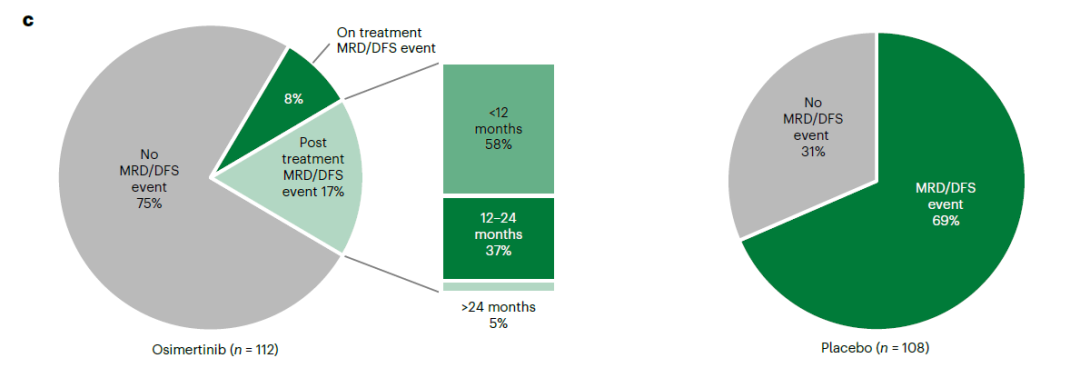
▲Impact of Osimertinib Treatment on MRD Events and Clinical Disease Recurrence Events in NSCLC Patients (Image Source: Reference [2])
This study also analyzed whether MRD detection could be used to predict clinical disease recurrence in patients. The study found that among all 220 patients, 62 experienced clinical disease recurrence and were found to have MRD in the MRD test. Among these patients,MRD was detected an average of 4.7 months (95% CI: 2.2-5.6) earlier than clinical disease recurrence.。
Researchers stated that in this analysis, osimertinib significantly extended patients' recurrence-free survival, supporting that adjuvant treatment with osimertinib after surgery may help eliminate residual microscopic lesions in certain patients, leading to long-term benefits after discontinuation of adjuvant therapy.
In addition,This study supports MRD detection based on circulating tumor DNA as a means to predict clinical disease recurrence.Monitoring of MRD may provide a powerful analytical tool for individualized adjuvant therapy after surgery.In patients with detectable MRD, the risk of disease recurrence may be further reduced by extending the treatment duration of osimertinib or adopting a strategy of intensified adjuvant therapy through combination treatments. However, researchers also noted that this personalized adjuvant treatment strategy still requires prospective clinical trials to accurately evaluate its benefit/risk ratio.

Osimertinib is a third-generation, irreversible EGFR tyrosine kinase inhibitor that has been clinically proven to be effective in NSCLC.The approved indications for Osimertinib include the treatment of locally advanced or metastatic EGFR-mutated NSCLC, as well as adjuvant therapy for early-stage EGFR-mutated NSCLC. In February 2024, the combination therapy of Osimertinib and chemotherapy was approved by the FDA for the treatment of adult patients with locally advanced or metastatic EGFR-mutated non-small cell lung cancer.

▲To learn more about the application of cutting-edge technologies in the biopharmaceuticals industry, please long press and scan the QR code above to access "WuXi Live Studio" and watch live discussions and exciting replays on related topics.


Share,PointLike,In View,Focusing on Global Biomedical Health Innovation