

Abbott's IVL System Receives FDA IDE Approval Amid Intensifying Competition from Boston Scientific, Philips, and Others in the Coronary Lithoplasty Arena

Johnson & Johnson
Medical Device R&D and Manufacturer

Abbott
Diagnostic and pharmaceutical product manufacturers
Abbott Announces FDA Approval for IDE Study of Its Coronary Intravascular Lithotripsy (IVL) System. This approval allows Abbott to evaluate itsThe Effect of IVL Products in Treating Severe Coronary Artery Calcification. Abbott's IDE Study (TECTONIC coronary artery disease (CAD) IVL ) will recruit 335 subjects at 47 centers in the United States.

PI Evaluation
"For patients with coronary artery disease, severe calcification increases the difficulty of treatment and often limits the effectiveness of standard interventional methods such as angioplasty or stent placement. This trial will evaluate a novel pre-treatment regimen aimed at optimizing vessel preparation before stent placement and improving stent positioning accuracy."
---Eric Secemsky Beth Israel Deaconess Medical Center
Executive Evaluation
"As a leader in the field of coronary artery disease treatment, we provide optimal solutions for calcification detection and treatment at all stages. With a comprehensive portfolio of therapeutic products, we are committed to enhancing the safety and efficacy of interventional treatments for patients who need it most. By collaborating with clinical experts to evaluate the coronary artery IVL system, we are exploring next-generation calcification modification technologies and continuously advancing innovative upgrades in coronary artery disease treatment solutions."
---Jennifer Jones-McMeans Vice President of Global Clinical Affairs, Abbott Vascular
IVL has now become one of the fastest-growing segments in the medical device field, and the clinical efficacy of IVL has also been confirmed by a large amount of clinical data. Last year, Johnson & JohnsonLifeat a price of $13.1 billionShockwave Medical, Making WavesIVL has become even more popular. At the beginning of this year, Boston Scientific also announced its entry into the IVL market ($6.64 Billion AcquisitionBolt Medical), whileExcimer Laser Coronary Angioplasty (ELCA) LeaderPhilips also launched a fusion laserIVL. Compared to Johnson & Johnson, Boston Scientific, and Philips, which have deliberately laid out IVL, Abbott's success could be described as "an unintentional achievement.". In 2023, in order to acquire Cardiovascular Systems' advancedRotational Atherectomy, Cost$8.9 billionIVL, as an add-on to this acquisition, was included. At the time,Cardiovascular Systems has just started its IVL research with a low level of technical maturity, but subsequent studies have validated its technical feasibility. As Johnson & Johnson, Boston Scientific, Philips, Abbott, and a group of smaller companies (FastWave Medical, Vantis Vascular, and Amplitude Vascular, etc.) allowIVL is bustling with activity.
Recently, Johnson & Johnson announced a new IVL study, through a comparisonA Comparative Clinical Study of Rotational Atherectomy (RA), Excimer Laser Coronary Angioplasty (ELCA), and Intravascular Lithotripsy (IVL) in the Treatment of Coronary Artery Calcified Stenosis. FindingsIn terms of stent expansion, IVL and RA are superior to ELCA; there were no significant differences among the three groups in minimum stent area, procedural success rate, and complication rate, butThe incidence of complications in the IVL group was numerically the lowest.. ShowsIVL Relative toRA andClinical Advantages of ELCA.
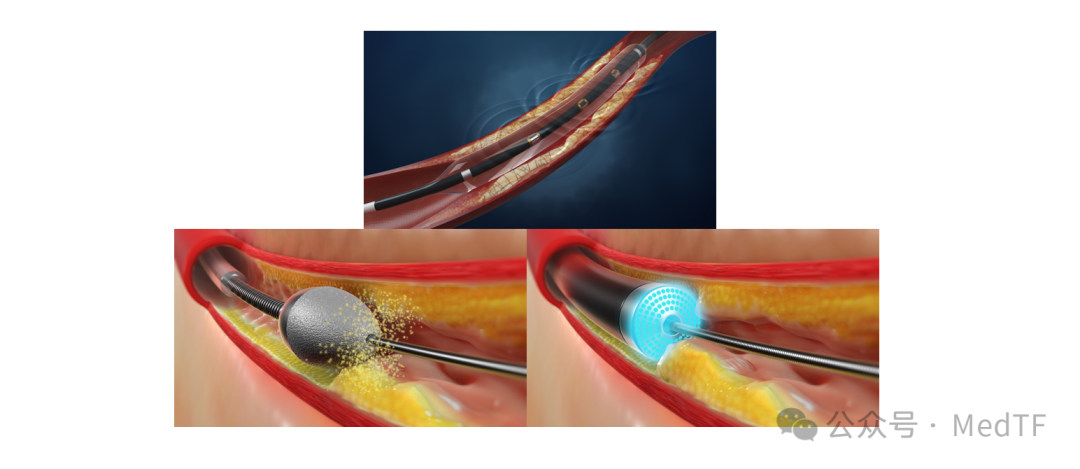
In addition to the obvious clinical effects,Johnson & Johnson IVL commercialization is proceeding very rapidly. Last year, IVL revenue reached 5.64 billion US dollars (Johnson & Johnson completed in JuneShockwave Medical Acquisition). In half a year, there was 560 million US dollars in revenue, maintaining a 40% growth rate compared to last year.
Faced with this rapidly growing market, European and American companies are a bit slower compared to the quick response of Chinese companies. Currently, NMPA has approved IVL products from more than 10 companies for marketing, while the FDA has only approved Johnson & Johnson.The slow response of European and American companies (in breaking through intellectual property) is also the reason why Johnson & Johnson is willing to pay a high price for the acquisition.
As companies like Boston Scientific and Abbott break through patents and enter clinical research, various IVLs will also gradually receive FDA approval for marketing in the coming years. The IVL market will enter an era of fierce competition similar to PFA. Of course, Johnson & Johnson has an absolute first-mover advantage and will therefore capture the vast majority of the market share. However, due to the enormous size of the coronary and peripheral markets (with a large patient population), they can still easily accommodate multiple players.Boston Scientific, Abbott, Philips and many other competitors. Latecomers who want to gain a better position need to demonstrate their technical advantages in order to capture a larger market share from Johnson & Johnson.