Source: Pharma News Express
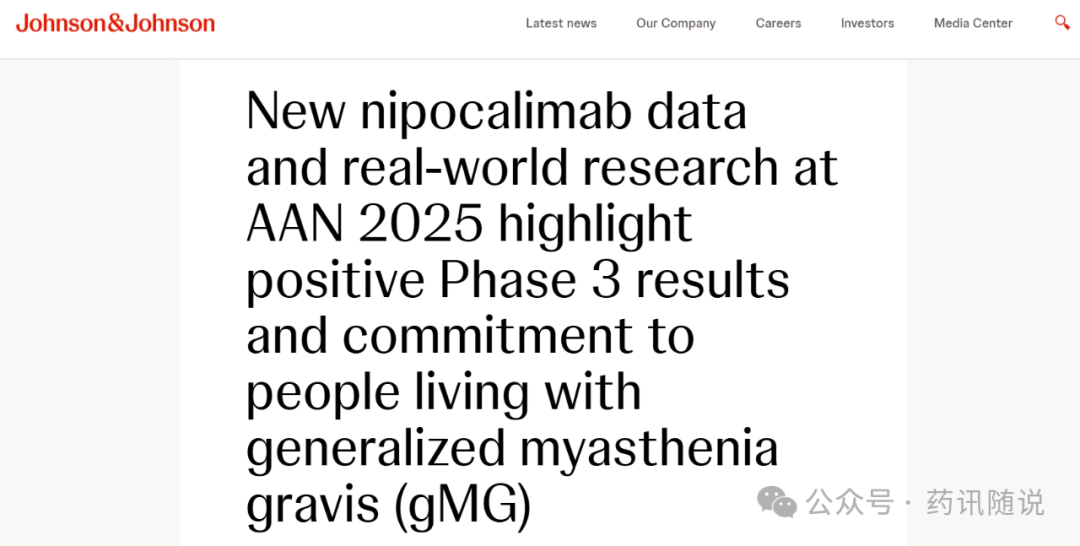
On March 26 (local time), Johnson & Johnson announced that it would disclose itsFcRn Monoclonal Antibody NipocalimabTreatmentMyasthenia Gravis (gMG)Phase III Clinical Trial (Vivacity-MG3) Long-term Results.1. Vivacity-MG3 Long-term Study ResultsVivacity-MG3 Study (NCT04951622) aims to evaluate sustained efficacy and safety. A total of 199 adult gMG patients who were autoantibody-positive or -negative with an insufficient response to standard-of-care (SOC) therapy (MG-ADL≥6) (including 153 antibody-positive patients) entered the 24-week placebo-controlled double-blind study phase, receiving either Nipocalimab + SOC (30mg/kg IV loading dose, followed by 15mg/kg every two weeks) or placebo + SOC in a 1:1 ratio.The primary endpoint of the study was the change in MG-ADL (Myasthenia Gravis Activities of Daily Living) scores from baseline at weeks 22, 23, and 24 in patients positive for autoantibodies. Key secondary endpoints included QMG (Quantitative Myasthenia Gravis) score. Long-term safety and efficacy were derived from the open-label extension study (OLE).Results to be announced at the 2025 AAN: | | | |
| Change in QMG from Baseline at Weeks 22-24: LS (SE) | | | |
| 2 Weeks (First Assessment) QMG Change from Baseline: LS (SE) | | | |
| | | |
| Proportion of QMG3 Patients at the Start of 8 Weeks | | | |
| Proportion of Patients with QMG3 ≥ 8 Weeks | | | |
Note: QMG3: QMG score improvement ≥3Secondly,The odds ratio (OR) of patients in the Nipocalimab group with QMG3 ≥16 weeks and 20 weeks compared to the placebo group were 4.31 (95% CI: 1.93-9.66) and 4.53, respectively.95%CI:1.93-10.62)。2) Long-term Safety and Effectiveness137 patients with positive autoantibodies progressed from the double-blind study phase to the OLE phase, receiving Nipocalimab + SOC treatment.OLE Study at 24 Weeks, 48 WeeksThe change in MG-ADL total score from the double-blind study baseline was [LS (SE)]: -5.73 (0.401, n=81),-5.97(0.681,n=37)。NipocalimabIt is a potential "best-in-class" monoclonal antibody targeting the neonatal Fc receptor (FcRn). By binding to FcRn, it prevents autoantibodies taken up by monocytes and endothelial cells from being released back into the bloodstream, instead degrading them within the cells.
Disclaimer:
The content of the article is for reference only and does not constitute investment advice. Investors who take actions based on this information bear their own risks. The article maintains a neutral stance on the statements and viewpoints presented, and does not provide any explicit or implicit guarantees regarding the accuracy, reliability, or completeness of the content included. Readers are advised to use it solely as a reference and assume full responsibility for their actions.

The Only One in China!
Top盛会 in the Fields of Polypeptides, Metabolism, and Weight Loss Drugs!
Booths are booking up fast!
Scan to consult immediately
Phone: 13816031174
(Same as WeChat)
Sponsorship forms include but are not limited to speaking slots, exhibition booths, color pages in the conference brochure, dinner sponsorship, and promotional materials for the conference.
Click here"Read the full text"Consult for more exciting content!