

XTAL Tech's AI-Powered Robotics Platform Drives Cross-Industry Innovation Beyond Pharma
XtalPi
Computation-Driven Innovative Drug R&D Provider


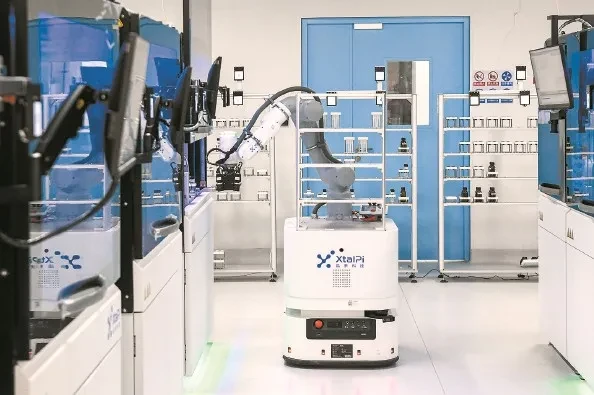
■ XtalPi, an "AI robot experiment team" with a smart brain and deft hands, is already capable of executing over 80% of common pharmaceutical reaction types, accumulating more than 200,000 reaction process data points each month.

'%20fill='%23FFFFFF'%3E%3Crect%20x='249'%20y='126'%20width='1'%20height='1'%3E%3C/rect%3E%3C/g%3E%3C/g%3E%3C/svg%3E)
In Zhangjiang, Shanghai, within XtalPi's cluster of automated robotic workstations, more than a hundred robot workstations are operating simultaneously, performing tasks such as temperature-controlled stirring reactions, sampling, dilution, and filtration... At first glance, it all seems much the same as when this reporter visited a year ago.
Change is quietly present. XtalPi, the "unicorn" enterprise renowned for pharmaceuticals, continues to amplify the empowering effects of AI, sparking brilliant innovation through collaboration with various industries. Recently, XtalPi announced partnerships in chemical engineering, energy, and new materials sectors, unveiling a blueprint brimming with infinite possibilities.
AI Revolutionizes Development Pathway
This is an emerging technology company that is difficult to define with traditional models. Ma Jian, co-founder and CEO of XtalPi, said: "You can understand us as a substance and material discovery company."
As we all know, the development of a new drug, especially small molecule drugs, requires a large number of experiments in the early R&D stage. The synthesis process alone involves the synthesis and validation of a large number of new compound molecules. The traditional R&D approach is: manual experimentation, continuous trial and error, and sifting through countless options; XtalPi, on the other hand, brings AI and robots into the process, replacing simple repetitive manual operations with 7×24-hour uninterrupted, high-throughput, and highly efficient parallel robotic experimentation.
An internationally renowned pharmaceutical company is developing new drugs for aging-related diseases that currently have no treatment, but after screening nearly ten thousand molecules using conventional methods, they failed to find a suitable candidate compound. Ultimately, the XtalPi team leveraged the advantages of its AI robotic R&D platform, modeled from scratch, and selected several promising binding modes. Using high-precision algorithms, they identified a molecule with potential strong activity. The results of laboratory synthesis also matched expectations, surprising the client with this "from 0 to 1" drug discovery capability.
At the end of 2024, XtalPi emerged victorious among dozens of participating teams worldwide in the globally renowned CSP Blind Test, a prestigious competition for material structure prediction. Material structure prediction is considered one of the "Holy Grail" problems in the field of physics, and this competition enjoys high international recognition and prestige.
One of XtalPi's dreams is "to make AI a standard tool in new drug research and development," and now, the dream has come true.
Data Flywheel Empowers Scientific Research
"The 2024 Nobel Prizes in Physics and Chemistry were both awarded to AI. This serves as a widespread educational moment for the entire industry and even society as a whole. We are no longer debating whether AI is useful, but rather discussing where it should be applied," said Wang Mingtai, Vice President of XtalPi.
At the beginning of the year, the outstanding performance of large models in China made the tech community realize that the gap in algorithm level between large models inside and outside China is not as big as people had anxiously anticipated. In the future, the main battleground for AI competition might be high-quality corpora — whoever has more data, and better data, will be able to train a more powerful specialized large model.
Through the "AI + robotics" innovative R&D platform model, XtalPi has created a unique "high-throughput experimentation—high-quality data—highly intelligent models" flywheel in the industry, driving a paradigm shift in drug and material research and development. Reportedly, XtalPi's "AI robotic experimental team," equipped with a smart brain and deft hands, is now capable of executing over 80% of common pharmaceutical chemical reaction types, accumulating more than 200,000 reaction process data entries each month.
More excitingly, the data does not "only report good news and hide bad news." The "negative samples" in the experiments — those "failed experiences" that could not complete the experiment — are becoming a "shortcut" to success.
Wang Mingtai revealed that XtalPi regularly organizes "AI Scientist" competitions against human scientists. In the most recent contest evaluating AI's reaction prediction capabilities, XtalPi's self-developed AI vertical model achieved an accuracy rate of over 80% for predicting successful reactions of two specific reaction types, on par with human scientists. Moreover, in identifying failed reaction predictions, the AI significantly outperformed its human counterparts.
Multi-field Technology Implementation
Last year, XtalPi successfully went public on the Hong Kong Stock Exchange, becoming the first company to be listed under Hong Kong's Rule 18C and earning the title of "China's First AI Drug Discovery Stock." Today, they are striving to become a technology company that values both social and commercial impact: on one hand, by developing new drugs to extend human lifespan, allowing people to live longer; on the other hand, by researching new materials to expand humanity's reach, enabling people to go further.
"Looking back at the historical path of technological development and industrial implementation, this year might be the critical year for AI for Science paradigm to achieve industrial-level breakthroughs," said Wang Mingtai.
Just two weeks ago, XtalPi officially signed a commercial cooperation agreement with the Office of Sheikh Hamad of the UAE, reaching an initial cooperation of 30 million US dollars – this is the first automated traditional drug modernization R&D experimental platform in the Middle East, creating a new paradigm for traditional medicine R&D in the region.
Since the beginning of the Year of the Snake, XtalPi has been making continuous "official announcements." They are actively seizing the strategic opportunities in the new materials industry upgrade, further deepening the empowerment of materials science through "AI + robotics" technology, and have already achieved technical implementation and established collaborations in fields such as materials science, agriculture, and consumer goods.
Those who work on "AI + Pharmaceuticals" and then invest in "AI + Materials", can they succeed? XtalPi's response is that, whether in materials science or future consumer goods fields, it is essentially in line with the biopharmaceuticals where XtalPi started. That is, through its self-developed innovative R&D platform that integrates quantum physics, artificial intelligence, and robotic experimental technologies, to precisely design and develop high-value innovative molecules, including drug molecules and material molecules. Meanwhile, compared with drug development, these "newborn" businesses do not require lengthy clinical trial processes, allowing them to be implemented faster and help humanity solve practical problems.
Source: Xinmin Evening News
Previous Review
2025-04-03
2025-04-02
2025-04-01