

ABL Bio Announces $2.7B Global Licensing Deal with GSK to Advance CNS Therapies Using Grabody-B Platform
ABL Bio
Developer of Immunooncology and Neurodegenerative Disease Therapeutics

GSK
Pharmaceutical R&D Manufacturer
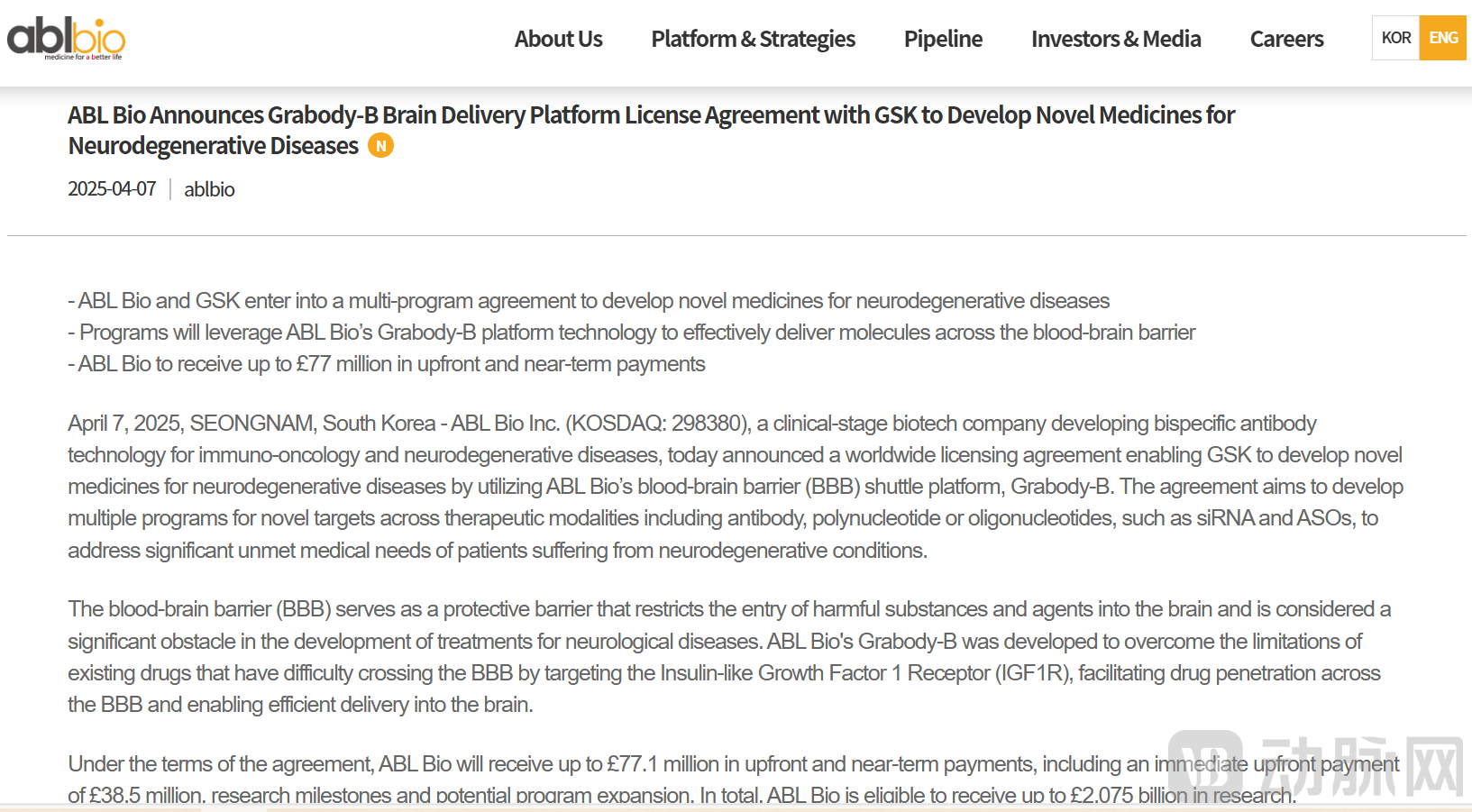
Just now, the largest cooperation in the CNS field this year in terms of amount[1]Birth. On April 7, ABL Bio, a biotechnology company dedicated to developing bispecific antibody technologies for immuno-oncology and neurodegenerative diseases, announced a global licensing agreement with GSK. Under the agreement, GSK will be able to use ABL Bio's blood-brain barrier (BBB) shuttle platform, Grabody-B, to develop new drugs for neurodegenerative diseases. The agreement aims to develop multiple projects targeting new pathways for various therapeutic modalities, including antibodies, polynucleotides, or oligonucleotides such as siRNA and ASO, to address significant unmet medical needs of patients with neurodegenerative diseases.
Source: ABL Bio Official Website
Under the terms of the agreement, ABL Bio will receive upfront and near-term payments of up to £77.1 million, including an immediate upfront payment of £38.5 million, research milestones, and potential project expansion. ABL Bio is eligible to receive up to £2.075 billion (approximately 19.584 billion yuan, or about $2.678 billion) in research, development, regulatory, and commercialization milestone payments, covering multiple potential projects. If the product is successfully commercialized, ABL Bio will receive tiered royalties on net sales. As part of the agreement, ABL Bio will transfer Grabody-B-related technology and proprietary knowledge to GSK, and GSK will be responsible for its preclinical and clinical development, manufacturing, and commercialization.
Repeatedly recognized by MNCs,
Collaborates with WuXi Biologics, I-Mab Biopharma, and GenScript.
ABL Bio, Inc. was founded in 2016 and is a biotech company based in Seoul, South Korea. Through internal research and global collaborations, the company has developed several bispecific antibody platforms, including "Grabody-T," "Grabody-I," and "Grabody-B." Based on the "Grabody" platform, ABL Bio has developed various clinical and non-clinical assets, with over 15 clinical projects across seven pipelines, including ABL301, ABL001 (tovecimig), ABL111 (givastomig), ABL503 (ragistomig), ABL105, ABL202, and ABL103. These projects are currently undergoing clinical trials in multiple countries, including the United States, China, Australia, and South Korea.
Among them, ABL001 (tovecimig) has been granted Fast Track designation by the FDA to support the rapid development of this new drug candidate. ABL001 is also the first bispecific antibody drug produced by a South Korean domestic Biotech company to enter clinical trials. Meanwhile, ABL Bio is preparing to initiate clinical trials for ABL104. In addition, ABL Bio is continuously researching and developing several other candidate products, including bispecific antibody-drug conjugates (ADCs).
Notably, ABL111 (Gevamab), co-developed by ABL Bio and I-Mab Biopharma, is expected to release top-line data from its Phase 1b clinical trial in 2025, evaluating a triple therapy combining nivolumab with chemotherapy. ABL111 is a bispecific antibody targeting Claudin18.2 and 4-1BB, activating the 4-1BB pathway only when bound to Claudin18.2, thereby triggering T-cell activation and enhancing anti-tumor immunity while minimizing toxicity. In animal model systems, ABL111 demonstrated stronger anti-tumor activity than either Claudin18.2 alone, Claudin18.2 plus 4-1BB individually, or the combination of Claudin18.2 and 4-1BB, with immune memory to resist any potential recurrence of cancer cells.
ABL Bio, as one of the earliest biotechnology companies in South Korea to focus on bispecific antibodies, has numerous collaborations with Chinese enterprises. These include adopting Wuxi Biologics' WuxiBody technology (heterologous heavy chain and light chain) to construct CD3 bispecific antibodies, utilizing GenScript Biotech’s SMAB technology to develop bispecific antibodies based on nanobodies (homologous heavy chain), and leveraging its Grabody bispecific antibody technology platform to partner with I-Mab Biopharma. Together, they are co-developing three bispecific antibodies: ABL503 (PD-L1/4-1BB), ABL501 (PD-L1/LAG-3), and ABL111 (4-1BB/PD-L1), which is coded as TJ-CD4B by I-Mab Biopharma.
In addition to having cooperated with Chinese companies several times in the past, ABL Bio has repeatedly gained recognition from leading multinational corporations (MNCs). In January 2022, ABL Bio also reached a collaboration with Sanofi for the development and commercialization of ABL301.Under the terms of the agreement, ABL Bio received an upfront payment of $75 million. Additionally, based on the achievement of development, regulatory, and commercialization milestones, ABL Bio is eligible to receive up to $985 million in income. If the collaborative products are commercialized, ABL Bio is also entitled to receive royalties on net sales. Meanwhile, Sanofi has obtained global exclusive rights for the development and commercialization of ABL301.
ABL301 is a bispecific antibody targeting α-synuclein and IGF1R, utilizing Grabody-B platform technology to effectively enhance the ability to penetrate the blood-brain barrier (BBB). It can be used for the treatment of Parkinson's disease and other potential indications. According to the agreement between both parties, ABL Bio will lead the preclinical development and Phase 1 clinical trial of ABL301. Thereafter, Sanofi will be responsible for the further clinical development, regulatory approval, and commercialization of ABL301 globally.
CSK Continues to Increase Investment in CNS Products,
A Track of Tens of Billions is About to Explode at Any Time
In fact, this is not the first time that GSK has reached a collaboration in the CNS field. Not long ago, in December 2024, GSK entered into a research collaboration with Muna Therapeutics to discover and validate innovative drug targets for the treatment of Alzheimer's disease using Muna’s MiND-MAP platform.
According to the terms of the agreement, Muna will receive an upfront payment of 33.5 million euros from GSK. In addition, for each target discovered by Muna, it is eligible to receive milestone payments of up to 140 million euros, and Muna will have the right to receive tiered royalties on any commercialized products. Muna will expand and strengthen its existing MiND-MAP dataset and lead the discovery and validation of innovative Alzheimer's disease targets. GSK will lead drug development and be responsible for preclinical activities, clinical development, manufacturing, and commercialization related to the collaboration’s discovered and validated targets.
In addition to GSK, in recent years, several multinational corporations (MNCs) and global pharmaceutical companies such as AbbVie, Takeda, Novartis, Roche, Sumitomo, and Merck have successively made high-profile investments in the CNS field. The significant investment corresponds to the vast unmet patient needs. According to WHO predictions, within 20 years, CNS diseases will become the second leading cause of death. In China, one-sixth of the population suffers from neurological-related disorders. The aging population has led to a continuous rise in neurodegenerative diseases; reportedly, China has over 2.5 million Parkinson's disease patients and nearly 10 million Alzheimer's disease patients. However, existing treatments for CNS diseases such as schizophrenia, addiction, depression, and AD show less than 50% effectiveness, indicating substantial clinical demand and market potential.
According to Frost & Sullivan statistics, the global CNS drug market size was $124.5 billion in 2019, making it the fourth-largest drug market. In the next 15 years, the global CNS drug market is expected to maintain steady growth, reaching $172.1 billion by 2034. The Chinese CNS drug market size was $29.6 billion in 2019. In the next 15 years, China's CNS drug market is expected to achieve rapid growth, reaching $57.1 billion by 2034. Based on China's pharmaceutical sales revenue in 2019, the market share of the central nervous system disease treatment sector accounted for 12.5% of that year's pharmaceutical market share.
Although the scientific study of the human brain has a history of several hundred years, it was only in the past 20 years that significant breakthroughs were made due to limitations in science and technology. Nevertheless, the brain contains billions to tens of billions of neurons, which interact with each other to form neural networks that mediate signal transmission. Our understanding of the human brain is still less than 10% of its entire structure and function.
Given the complexity of the CNS system and the difficulty in drug development, many CNS diseases have significant unmet clinical needs, such as stroke, drug addiction, severe depression, schizophrenia, and Alzheimer's disease. Their vast market potential is obvious. With the continuous upgrading of advanced instruments, the industry now has the capability to study individual neurons and synapses, and basic research has reached a critical threshold for breakthroughs.
Therefore, it is expected that in the next 5 to 10 years, more diseases in the CNS field will be effectively treated with drugs. Within the industry, once someone takes the lead in finding a breakthrough, they will achieve a milestone breakthrough in the field and quickly occupy the blue ocean of niche diseases.
[1]Note: The cooperation mentioned in this article refers only to two or more entities working together to achieve a common goal by sharing resources and complementing each other's strengths through certain agreements or cooperative relationships to jointly carry out business activities. For example, two companies jointly developing a new product, each contributing technology, manpower, and other resources, and sharing the results and benefits according to an agreed proportion. It does not include acquisitions, such as when one company (the acquirer) purchases part or all of another company’s (the target company) equity or assets to gain control or significant influence over the target company. For instance, on January 13, 2025, Johnson & Johnson announced a cash acquisition of $132 per share, with a total value of approximately $14.6 billion, to acquire Intra-Cellular Therapies, a biopharmaceutical company focused on CNS disease treatment. Therefore, according to publicly available information, ABL Bio's recent collaboration with GSK (worth £2.075 billion, approximately RMB 19.584 billion) is the largest cooperation deal in the CNS field so far this year.