

Drug Hunter Unveils 2024 Top 10 'Molecule of the Year' List Featuring Groundbreaking Therapeutics
Vertex
Breakthrough Small Molecule Drug Developer
WuXi AppTec
New Drug R&D and Production Service Provider

Protagonist Therapeutics
Developer of Novel Therapies

Johnson & Johnson
Healthcare Product Manufacturers, Health Service Providers

AstraZeneca
Biopharmaceutical Manufacturer

Novartis
Drug Development and Manufacturing

Bayer
Pharmaceutical Product R&D Developer

Genentech
Pharmaceutical R&D Manufacturer

Sanofi
Pharmaceutical R&D Developer

Nurix Therapeutics
Small Molecule Drug Developer
▎WuXi AppTecWuXi AppTec Content Team EditorEditor's Note:Recently, Drug Hunter, a well-known industry media platform, released its 2024 list of standout molecules. From tens of thousands of research papers, Drug Hunter selected ten standout molecules for the list based on dimensions such as technological innovation, scientific contribution, potential clinical value, and originality, while incorporating comprehensive feedback from readers and expert reviewers. After a reader vote, Vertex Pharmaceuticals' "first-in-class" painkiller, suzetrigine, ranked at the top. Among these ten standout molecules, WuXi AppTec’s chemistry services platform is proud to have provided enabling services for several of them, helping to advance innovation. Looking ahead, we look forward to further supporting more partners in accelerating the development of innovative therapies and providing more treatment options for patients worldwide.
Editor's Note:Recently, Drug Hunter, a well-known industry media platform, released its 2024 list of standout molecules. From tens of thousands of research papers, Drug Hunter selected ten standout molecules for the list based on dimensions such as technological innovation, scientific contribution, potential clinical value, and originality, while incorporating comprehensive feedback from readers and expert reviewers. After a reader vote, Vertex Pharmaceuticals' "first-in-class" painkiller, suzetrigine, ranked at the top. Among these ten standout molecules, WuXi AppTec’s chemistry services platform is proud to have provided enabling services for several of them, helping to advance innovation. Looking ahead, we look forward to further supporting more partners in accelerating the development of innovative therapies and providing more treatment options for patients worldwide.
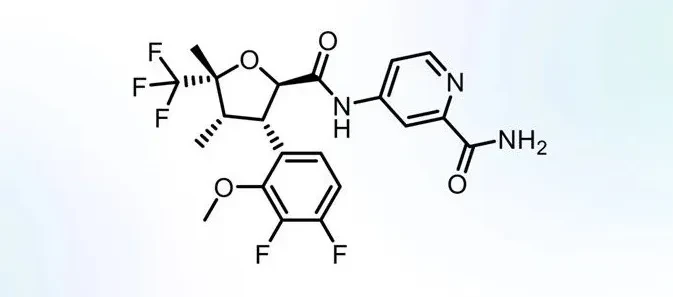
Image Source:Hunter Drug Official Website
Suzetrigine is a "first-in-class" oral NaV1.8 ion channel selective inhibitor developed by Vertex Pharmaceuticals.Voltage-gated sodium channels are crucial ion channels that mediate the release of action potentials in neurons. Human genetic studies have shown that loss-of-function mutations in the gene encoding NaV1.8 render individuals insensitive to pain, while gain-of-function mutations lead to persistent pain.Researchers at Vertex discovered new potential binding sites by analyzing the rapid conformational changes that occur during the ion channel switching process.Suzetrigine's selectivity for the NaV1.8 ion channel is ultimately 30,000 to 40,000 times higher compared to other NaV channels.
Suzetrigine received U.S. approval in January this year.FDA Approval(Product name Journavx), used to treat moderate to severe acute pain in adults. Vertex's press release stated,Journavx is the first new mechanism drug approved by the FDA for the treatment of acute pain in over 20 years.It is expected to alleviate patients' pain while reducing the potential side effects and addiction risks associated with taking opioid painkillers.
Zoldonrasib (RMC-9805): KRAS G12D Mutant-Selective Covalent Inhibitor
'%20fill='%23FFFFFF'%3E%3Crect%20x='249'%20y='126'%20width='1'%20height='1'%3E%3C/rect%3E%3C/g%3E%3C/g%3E%3C/svg%3E)
Image Source: PharmaHunter Official Website
RMC-9805 is a KRAS G12D mutant-selective covalent inhibitor developed by Revolution Medicines.It is based on the company's proprietary Tri-Complex inhibitor platform, which, after binding with the chaperone protein cyclophilin A, can form a tri-complex with high affinity to KRAS mutants in the active state.RMC-9805 can simultaneously form a crosslink with the 12th aspartic acid in the KRAS G12D mutant, thereby inhibiting the activity of the KRAS G12D mutant.
Last October, Revolution Medicines announced the firstClinical Trial Results. In carryingKRASIn G12D-mutant treated pancreatic ductal adenocarcinoma (PDAC) patients,The objective response rate (ORR) for patients treated with RMC-9805 at the recommended Phase 2 clinical trial dose was 30%, with a disease control rate (DCR) of 80%.
Daraxonrasib (RMC-6236): Non-covalent Pan-KRAS Molecular Glue Inhibitor
The latest published in December last yearClinical Trial DataShow that, in carriersKRASG12X MutationMetastaticIn PDAC patients,The median progression-free survival (PFS) for patients receiving RMC-6236 at a once-daily dose of 300 mg was 8.8 months, regardless of any type carried.RASIn patients with mutations, the median PFS was 8.5 months.KRASThe 6-month survival rate for patients with G12X mutations reached 100%, regardless of the type carried.RASThe 6-month survival rate for patients with mutations was 97%. Currently, RMC-6236 is being evaluated in two Phase 3 clinical trials for the treatment of PDAC and non-small cell lung cancer (NSCLC) patients.
Icotrokinra: Oral IL-23 Receptor Peptide Inhibitor
Image Source: PubChem
Icotrokinra is an oral peptide inhibitor of the IL-23 receptor jointly developed by Protagonist Therapeutics and Johnson & Johnson.Icotrokinra is capable of binding to the IL-23 receptor with single-digit picomolar affinity and exerts potent selective inhibition of IL-23 signaling in human T cells.
Recently announced pivotalPhase 3 Clinical Trial ResultsResults show that once-daily icotrokinra significantly improved skin condition in patients with moderate to severe plaque psoriasis and demonstrated a favorable safety profile.At week 16, 65% of patients in the icotrokinra group achieved an Investigator Global Assessment (IGA) score of 0/1 (clear or almost clear skin), and 50% achieved at least a 90% improvement in the Psoriasis Area and Severity Index (PASI 90), compared to only 8% and 4% in the placebo group for these two measures, respectively.By week 24, the patient remission rate further improved, with 74% of patients achieving an IGA score of 0/1 and 46% achieving an IGA score of 0; 65% of patients achieved PASI 90, and 40% achieved PASI 100.
Laroprovstat (AZD0780): Oral PCSK9 Small Molecule Inhibitor
Image Source:Hunter Drug Official Website
AZD0780 is a potential “first-in-class” oral PCSK9 small molecule inhibitor developed by AstraZeneca.PCSK9 is a validated target for lowering low-density lipoprotein cholesterol (LDL-C), but currently approved therapies require patients to receive regular injections. An oral PCSK9 modulator may offer patients a more convenient treatment option.
In May last year, AstraZeneca announced the first human trial of AZD0780.Clinical Trial Results. Data shows,In patients with untreated hypercholesterolemia, AZD0780 demonstrated a significant 52% (95% CI: 57%, 45%) reduction in LDL-C levels on the basis of rosuvastatin treatment, with an overall LDL-C reduction of 78% compared to baseline.In addition, preliminary data comparing fed and fasting conditions suggest that AZD0780 has flexibility with food intake. No serious adverse events were reported, and AZD0780 demonstrated good tolerability. AZD0780 is currently in Phase 2 clinical development.
HRO761: Allosteric WRN Inhibitor
Image Source:Hunter Drug Official Website
HRO761 is a non-covalent allosteric WRN inhibitor developed by Novartis.WRN is a member of the RecQ family of DNA helicases. DNA helicases are a class of biological enzymes that catalyze the unwinding of double-stranded DNA or RNA during DNA or RNA replication. They participate in cellular metabolic processes such as DNA replication, repair, transcription, recombination, and telomere maintenance, playing a crucial role in maintaining chromosomal stability.
Previous studies have found a synthetic lethal relationship between WRN and microsatellite instability-high (MSI-H) cancers.HRO761 allosterically binds to the interface of the D1 and D2 helicase domains of WRN, locking WRN in an inactive conformation.HRO761 inhibits the activity of WRN, which selectively leads to DNA damage in MSI-H cancer cells and suppresses the growth of cancer cells. Additionally, HRO761 can also induce the degradation of WRN in MSI-H cells.Currently, the Phase 1 clinical trial of HRO761 for the treatment of solid tumors is underway.
VVD-214: Covalent Allosteric WRN Inhibitor
Image Source:PharmaHunter Official Website
VVD-214 is a covalent allosteric WRN inhibitor jointly developed by Vividion Therapeutics, a subsidiary of Bayer, and Roche.WRN is a synthetic lethal target for MSI-H tumors. Researchers used a chemoproteomics-enabled discovery approach to screen for this WRN inhibitor. It demonstrated potent anticancer activity in MSI-H colorectal cancer cell lines and xenograft tumor models. Roche is currently evaluating it in a Phase 1 clinical trial for the treatment of MSI-H cancers.
Inavolisib: OralPI3KαMutant-Selective Inhibitors and Degraders
Image Source:Hunter Drug Official Website
Inavolisib is a PI3Kα inhibitor developed by Genentech, a subsidiary of Roche. It exhibits high selectivity for PI3Kα mutants and is capable of specifically triggering the degradation of mutant PI3Kα proteins.Through this unique dual mechanism of action, inavolisib may provide a new treatment option for hormone receptor (HR)-positive/human epidermal growth factor receptor 2 (HER2)-negative,PIK3CAProviding well-tolerated, durable disease control and potentially improved outcomes for patients with mutant advanced breast cancer.
It was obtained in October 2024.FDA Approval(Product name Itovebi), used in combination with the CDK4/6 inhibitor Ibrance (palbociclib) and fulvestrant, for the treatment of tumors carryingPIK3CAMutations, endocrine therapy resistance, HR-positive, HER2-negative locally advanced or metastatic breast cancer in adult patients whose disease has recurred during or after adjuvant endocrine therapy. Roche stated,It has the potential to become a "best-in-class" PI3Kα inhibitor.
KT-474 (SAR444656): Oral IRAK4-Targeted Protein Degrader
Image Source:Hunter Drug Official Website
KT-474 (SAR444656) is a potential "first-in-class" IRAK4 degrader jointly developed by Kymera Therapeutics and Sanofi.IRAK4 is a key component of the myddosome protein complex and participates in the regulation of immune response signaling processes through interleukin-1 (IL-1) and toll-like receptors (TLRs). IL-1 and toll-like receptors play critical roles in initiating immune responses against invading pathogens. IRAK4, as a scaffold kinase, stands at the intersection of innate and adaptive immune responses, exerting multiple functions through its kinase activity and scaffolding capabilities.
KT-474 utilizes targeted protein degradation to completely eliminate IRAK4, affecting both its kinase and scaffold functions, thereby potentially achieving broad and well-tolerated anti-inflammatory effects, offering new therapeutic avenues for various immune-inflammatory diseases.Previously published Phase 1 clinical trial results showed that KT-474 demonstrated promising activity in the treatment of atopic dermatitis.Patients with moderate to severe symptoms experienced a 63% reduction in itching after 28 days of treatment.Eczema Area and Severity Index (EASI) ScoreDecreased by 36%.
Sanofi plans to expand ongoing studies in hidradenitis suppurativa and atopic dermatitisPhase 2 Clinical Trial, in order to accelerate the advancement of this innovative therapy into the pivotal clinical research phase.
NX-5948: Oral Bruton's Tyrosine Kinase (BTK) Degrader
Image Source:PharmaHunter Official Website
NX-5948 is a BTK-targeted protein degrader developed by Nurix Therapeutics. It can cross the blood-brain barrier and degrade both wild-type and mutant BTK proteins.
Published in October last yearEarly Clinical Trial ResultsDisplay,Among 9 patients with relapsed/refractory Waldenström macroglobulinemia (WM) treated with NX-5948, 7 patients (77.8%) achieved objective responses, and 2 patients (22.2%) had stable disease.All seven remissions were observed at the first assessment at 8 weeks, with five patients still on treatment and two patients having been treated for over a year. Regardless of the patient baseline,MYD88AndCXCR4Regardless of the mutation status, a response was observed.
References:
Share,PointLike,In ViewFocusing on Global Biomedical Health Innovation