

Eli Lilly Announces Three-Year Clinical Data for Zepbound Showing Sustained Weight Loss with Continued Use

Eli Lilly
Global Pharmaceutical R&D and Production Company
Intelligent Finance APP learned that a study on long-term users of Eli Lilly and Company's (LLY.US) weight-loss injection Zepbound showed that patients who regularly used the drug typically regained no more than 5% of their weight loss within three years, and the majority regained less than 5%.
A study funded by Eli Lilly found that patients reached their lowest weight after an average of nearly two years, followed by an average rebound of about 3.7% over the next 18 months. The conclusion is based on a new analysis of 690 patients, and the findings will be presented next month at the European Congress on Obesity in Spain.
Eli Lilly last year unveiled preliminary data from this three-year trial (the longest study on Zepbound to date), showing that patients receiving the highest 15-milligram dose lost an average of 23% of their body weight. A new analysis led by Louis Aronne of Weill Cornell Medicine found that, after accounting for weight regain, the actual average weight loss was close to 19%.
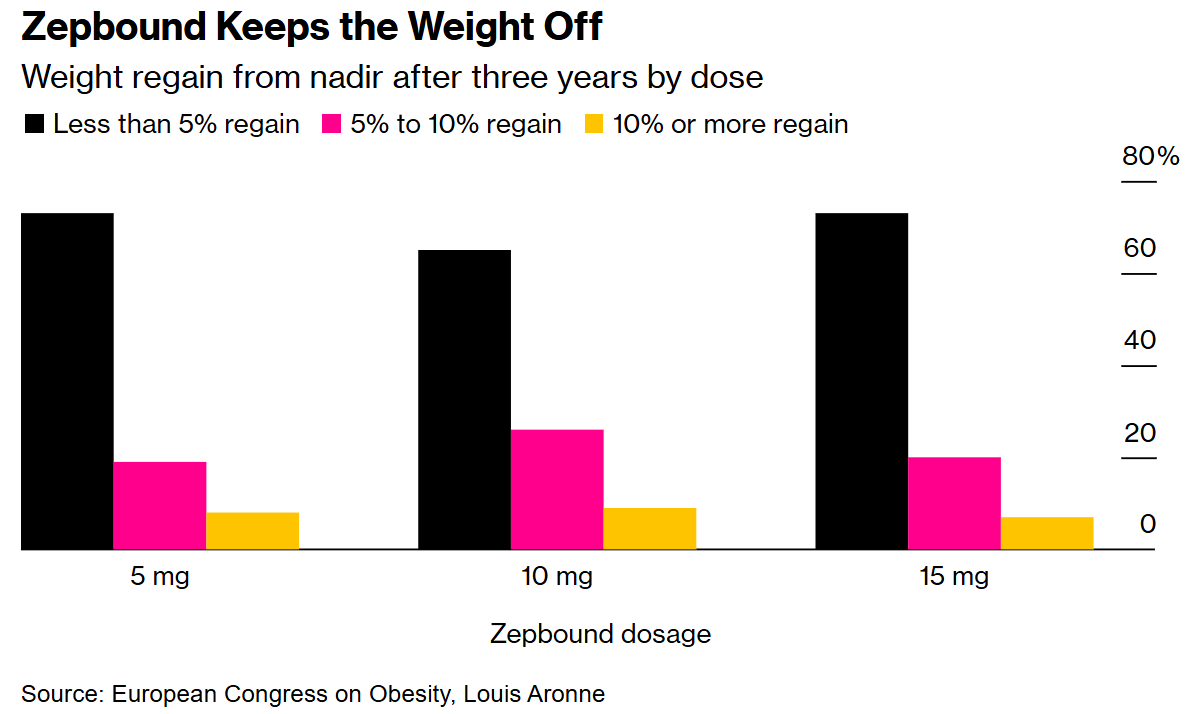 Since maintaining weight loss is the main challenge in obesity treatment, doctors and patients are eager to know whether the efficacy of these blockbuster new drugs will diminish over time. Research results indicate that continuous use of drugs like Zepbound as prescribed can achieve long-term effectiveness. Similarly, a study of Novo Nordisk's competitor product Wegovy, involving 17,000 participants, also showed stable weight maintenance after three years of medication.
These drugs may have more lasting effects compared to other interventions. Controlled studies show that patients who undergo bariatric surgery regain an average of about 13% of their weight after three years (data from a large prospective cohort study).
Justin Ryder, an associate professor of surgery and pediatrics at Northwestern University's Feinberg School of Medicine in Chicago who was not involved in the study, noted that the initial weight loss phase lasted nearly two years. However, he also pointed out that some patients regained weight even when using the highest dose, indicating they may need additional support.
Continuous medication required
However, adherence to medication is key. Previous studies have shown that patients who completely discontinue Zepbound experience significant weight regain. "It's like taking antihypertensive or hypoglycemic drugs," Aronne said in an interview. "If you stop taking them, your body will return to its original state. Chronic diseases require long-term treatment."
In the real world, patients often struggle to maintain continuous medication due to issues like supply shortages, side effects, and insufficient insurance coverage. Aronne mentioned that research is currently underway to explore the impact of reducing dosage or decreasing the frequency of medication, which will help identify the optimal maintenance treatment plan.
Another study to be presented at the European Congress on Obesity found that overweight adults at risk of diabetes who took medication were divided into three groups, with overall weight loss of 10%, 20%, and 30%, respectively. The study showed that patients typically stopped losing weight after six months, with the most significant weight loss observed in women and those without obesity-related complications.