

19-Year-Old Epilepsy Patient Achieves Precise 'Mind-Control' Gameplay of 'Black Myth: Wukong' Using NeuroXess BCI Platform

NeuroXess
Invasive Brain-Computer Interface Developer
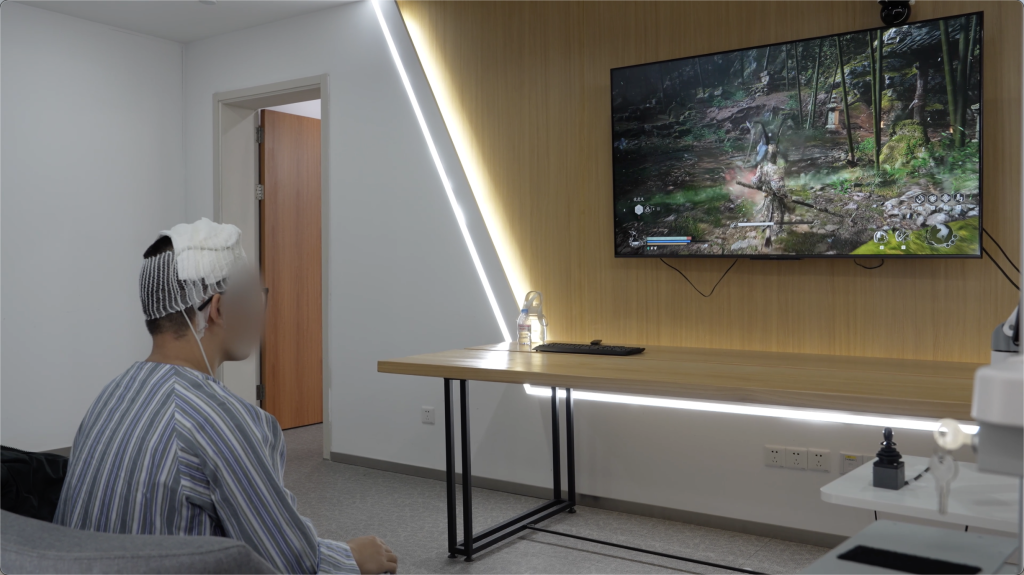
Subjects control the game "Black Myth: Wukong" with their minds. (Photo provided by the interviewee)
A 19-year-old epilepsy patient, after undergoing a brain-computer interface surgery, is not only able to control basic computer games like "Pac-Man" with his brain, but also achieved precise brain control operation of large and complex games such as "Honor of Kings" and "Black Myth: Wukong."
Reporter from The Paper Tech learned on April 17 that NeuroXess, a brain-computer interface startup company based in Shanghai (referred to as NeuroXess), has made new progress in its clinical trials of high-throughput flexible brain-computer interface motion decoding. Subjects were implanted with the company's self-developed 256-channel flexible brain-computer interface, which, by integrating an efficient deep learning model and training paradigm, can perform daily self-optimization based on the subject’s EEG characteristics. This effectively overcomes the challenge of neural signal drift, achieving precise brain-controlled operations. Tao Hu, founder and chief scientist of NeuroXess, revealed that the next-generation wireless version of the company’s brain-computer interface product has completed its research and development design, with related clinical trials expected to be carried out within this year.
It is reported that the XessOS brain-computer interface operating system, which is used in conjunction with this brain-computer interface, was independently developed by NeuroXess. Through millisecond-level feature extraction and motion intention analysis, it accurately translates into computer control commands. Based on this system, subjects can smoothly browse the internet, operate various apps, control smart wheelchairs, and manage smart home devices, all through thought alone.
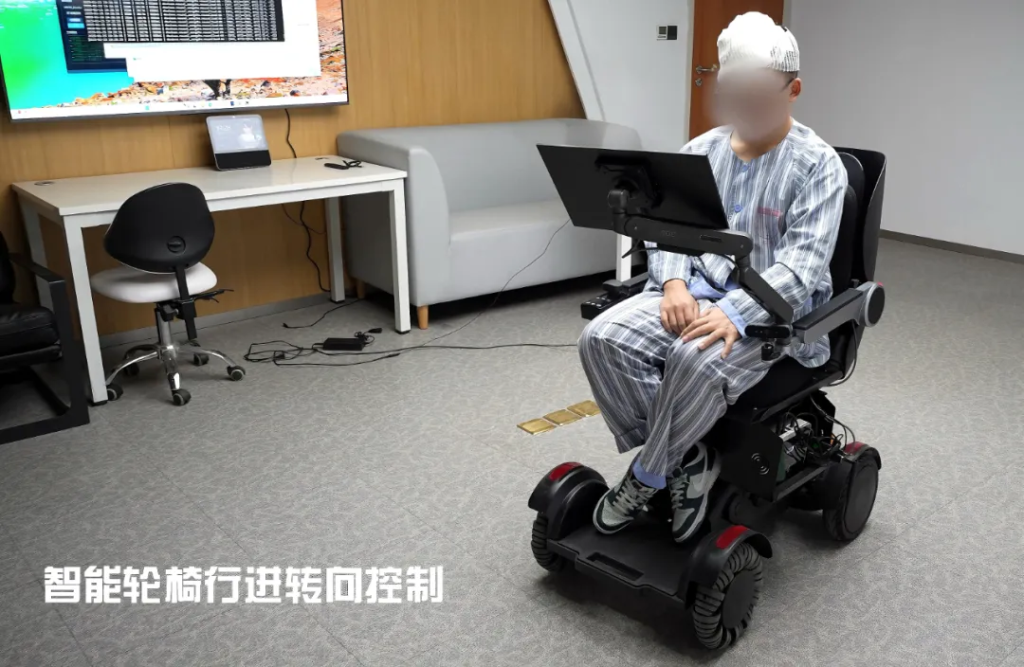
Subjects control the intelligent wheelchair's movement and steering through thought. (Photo provided by the respondent)
Bits per second is a unit of data transmission rate. According to reports, after a cumulative 19.87 hours of training, the aforementioned subject achieved a cursor brain-control performance of 4.07 bits/second under the enhanced user interface. In comparison, Nolan, the first subject of Neuralink, the company co-founded by Musk, reached a performance of 4.6 bits/second under the enhanced user interface after 60 hours of training. Zhou Zhitao, a researcher at the Shanghai Institute of Microsystem and Information Technology, Chinese Academy of Sciences, introduced that, "(4.07 bits/second) this response speed gradually approaches the operational level of a normal person using a traditional mouse, strongly verifying the feasibility of brain-computer interface technology in complex scenario applications."
In December 2024, NeuroXess, in collaboration with Professor Wu Jinsong's team from the Department of Neurosurgery at Huashan Hospital, conducted the first clinical trial in China on real-time synthesis of Mandarin using a high-throughput implantable flexible brain-computer interface. The patient recovered well after the surgery, achieving a decoding accuracy rate of 71% for 142 commonly used Mandarin syllables within five days, with a single-character decoding latency of less than 100 milliseconds, offering hope for restoring language function in patients with speech impairments.