Johnson & Johnson's Cardiovascular Segment Surges with $2.1 Billion in Q1 2025 Sales

Johnson & Johnson
Medical Device R&D and Manufacturer
Recently, the Q1 earnings season has kicked off, with multiple medical device companies submitting their results. In the latest earnings report, Johnson & Johnson showed significant business growth, once again demonstrating its strong resilience.
Multi-business growth slows down
Cardiovascular Segment Raises the Revenue Banner
Recently, Johnson & Johnson released its Q1 2025 financial report, which showed that in the first quarter, Johnson & Johnson's revenue reached $21.9 billion (approximately RMB 160.4 billion), a year-on-year increase of 2.4%, with a net profit of approximately $11 billion, surging by 237.91% year-on-year.

Image Source: Johnson & Johnson Official Website
Among them, Johnson & Johnson Medical Technologies reported a revenue of $8.02 billion in Q1, representing a year-on-year increase of 2.5%. According to Johnson & Johnson, the growth drivers of the medical device business in Q1 mainly came from Abiomed and wound closure products. However, the relatively weak performance of spine, sports, and other orthopedic products offset the excellent performance in cardiovascular and other businesses.
In each business segment:
Cardiovascular business propels Johnson & Johnson Medical's revenue, with sales reaching $2.1 billion (approximately RMB 15.3 billion), a year-on-year increase of 16.4%, accounting for about 26% of total revenue.
Orthopedic sales were $2.241 billion, representing reported growth of 4.2%;
Surgical business sales reached $2.396 billion, with reported growth of 0.8%, including approximately 3% growth in biosurgery, approximately 2% growth in endoscopic cutting and stapling devices, and an approximately 3% decline in energy devices.
Ophthalmology sales were $1.279 billion, increasing 1.7% year-on-year.
In recent years, among Johnson & Johnson Medical's business segments, the growth rates of the Trauma and Spine departments have significantly declined. In 2024, the orthopedic divisions of major medical device companies are facing some challenges, and Johnson & Johnson Medical's orthopedic business is also in a situation where it needs to seek new growth points to stabilize through this period of sluggish growth.
To this end, Johnson & Johnson Medical proposed a two-year plan in 2023 to restructure its DePuy Synthes orthopedic business. The plan aims to divest lower-profit markets and product lines within the orthopedic business, with an acceleration of the restructuring expected to be announced in 2024.
The plan has preliminarily shown some results in Johnson & Johnson Medical's 2024 fiscal year annual report. In 2024, Johnson & Johnson Medical's orthopedic business revenue reached $9.158 billion, a year-on-year increase of 2.4%. In this Q1 earnings report, orthopedics also achieved certain growth but still needs continuous "transformation."
Notably, in Johnson & Johnson's recently disclosed financial report, it was specifically mentioned that due to the recent impact of tariffs, the company expects to face approximately $400 million in additional costs for the year. The tariffs primarily affect the medical technology segment of the company's business.
Over 30 billion US dollars
Heavy Investment in Cardiovascular Field
From Johnson & Johnson's major initiatives in recent years, it is unsurprising that the cardiovascular business of Johnson & Johnson Medical has demonstrated strong resilience and maintained a growth trend. In recent years, Johnson & Johnson Medical has repeatedly invested heavily to pave the way for its cardiovascular business. In just three years, Johnson & Johnson has acquired four medical device companies in the cardiovascular field, strengthening its presence in this area. So far, Johnson & Johnson's acquisitions in this field have exceeded 30 billion US dollars.
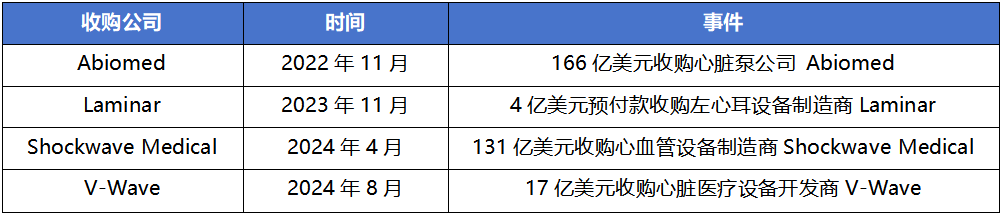
Source: Compiled from public information
Among the four acquisitions, two involved expenditures exceeding 10 billion yuan each, making their scale remarkably rare in the history of mergers and acquisitions within the medical device field.
Abiomed, acquired for $16.6 billion in 2022, is a formidable player in the cardiovascular field, possessing the world's only FDA-approved interventional artificial heart—Impella, known as "the world's smallest artificial heart." The product can effectively deliver blood and oxygen throughout the body by temporarily assisting the heart's pumping function, allowing the heart to rest and recover, and has already received FDA approval. According to publicly available data, this series of products has few rivals in the global interventional cardiac pump field.
Shockwave, acquired in April 2024, had already attracted competition from giants like Johnson & Johnson, Boston Scientific, and Medtronic in 2023. After the acquisition, Johnson & Johnson exclusively gained Shockwave's IVL technology. With the addition of Shockwave, Johnson & Johnson will expand its cardiovascular product portfolio into two of the fastest-growing and innovation-driven fields in cardiovascular interventions—coronary artery disease (CAD) and peripheral artery disease (PAD).
Aside from the gains brought by large-scale acquisitions, Johnson & Johnson Medical has also had numerous significant products approved for market in recent years. Among them, Johnson & Johnson's first PFA product — the Varipulse pulsed field ablation system — was approved for marketing by the U.S. Food and Drug Administration (FDA) in November 2024, and can be used to treat drug-refractory paroxysmal atrial fibrillation. Moreover, the system received NMPA approval for marketing on January 27 this year.
Through precise mergers and acquisitions and technological innovation, Johnson & Johnson Medical not only achieved explosive growth in its cardiovascular business but also reshaped its competitive landscape in the global medical device market.
Moreover, Johnson & Johnson announced a significant strategic decision on March 21 this year, which is to invest more than 55 billion US dollars in its pharmaceutical and medical technology businesses in the United States over the next four years.
Conclusion
Although the current tariff policies have brought uncertainties and some challenges to the global medical device industry, Joseph Wolk, Chief Financial Officer of Johnson & Johnson, stated: Despite macroeconomic uncertainties, Johnson & Johnson's leading position in innovative drugs and medical technology will help it maintain an advantage in future market competition. We look forward to the continued excellent performance of Johnson & Johnson Medical.
References:
1. "2025Q1 | Johnson & Johnson Revenue 160 Billion, Cardiovascular Business Surges 16.4%" Medical Poetry


Editor: Mu Mian
Disclaimer: The views expressed in this article are solely those of the author and do not represent the position of Pharma Intelligence Network. We welcome discussions and additional insights in the comment section; for reprints, please be sure to credit the author and source. If there are any issues related to the content, copyright, or other aspects of the article, please leave a message on this platform, and we will address it promptly.