

MNCs Respond to U.S. Tariff Storm with Over $150 Billion in Onshoring Investments

Roche
Oncology Drug Research, Development, and Manufacturing

Johnson & Johnson
Healthcare Product Manufacturers, Health Service Providers
Eli Lilly
Global Pharmaceutical R&D and Production Company

MSD
Pharmaceutical R&D and Manufacturer

Novartis
Drug Development and Manufacturing
The first to be hit by the tariff storm wasMNC. And they have already started to fight back. The way they are fighting back is by striving to relocate pharmaceutical production capacity back to the United States, or at least that is the case based on the latest released future investment plans.
A few days ago, Roche, headquartered in Basel, Switzerland, stated that it would invest in the United States over the next five years.500billion dollars. This huge investment will be used to build1R&D Center and2A manufacturing base, and upgrade a series of existing manufacturing, distribution, and R&D bases. Specifically, Roche will build a new R&D center in Massachusetts, focusing on artificial intelligence (AI) research, serving as the core hub for the company’s cardiovascular, renal, and metabolic disease research programs; constructing a gene therapy manufacturing plant in Pennsylvania, while expanding and upgrading pharmaceutical and diagnostic product manufacturing, distribution, and R&D facilities in Kentucky, Indiana, New Jersey, Oregon, Arizona, and California; building a continuous glucose monitoring technology production base in Indiana, and establishing a weight-loss drug manufacturing center at an undisclosed location.
Previously, Roche had in the United States13Production base and15A research and development base covering pharmaceuticals and diagnostics.Roche pointed out that once all the newly added and expanded production capacities are put into use,Roche's exports of pharmaceuticals from the United States will exceed its imports.
1. Will the American Dream of Over $150 Billion Come True?
In fact, Roche's move is not an isolated case. In just a few months, several companies headquartered in the U.S. and outside the U.S.MNC, successively announced hefty investment plans for the future in the United States, involving amounts exceeding1500Billion US dollars.
At the very beginning, it was a few companies headquartered within the United States.MNCAnnounced the news of investment return.
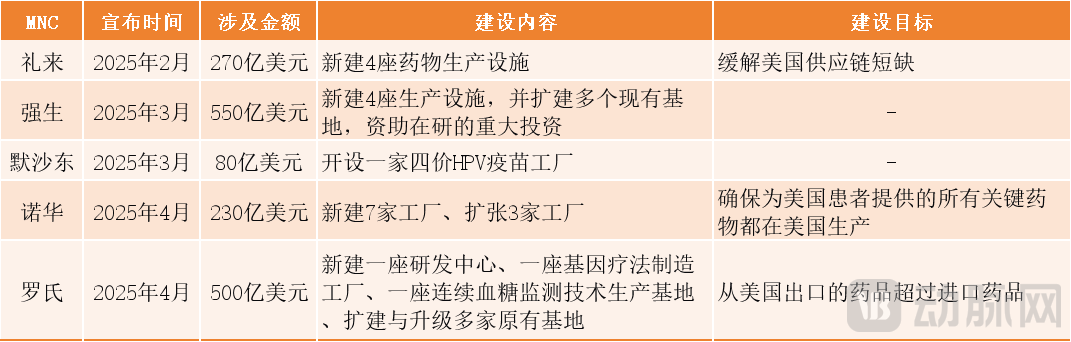
2025Year2In the month, Eli Lilly, headquartered in Indiana, USA, took the lead in showing signs of fatigue and announced an investment.270Four new drug manufacturing facilities will be built in the United States with an investment of billions of dollars. According to the official website, among the four planned production bases, three will focus on producing active pharmaceutical ingredients and further strengthening the supply chain to alleviate shortages in the U.S. supply chain, such as those for weight-loss drugs.ZepboundAnd diabetes treatment drugsMounjaroThe active ingredient tirzepatide, while the fourth production base focuses on future injection therapies. That is to say, Eli Lilly has fired the first shot of "Investing in America."
Next is Johnson & Johnson, headquartered in New Jersey, USA.2025Year3In the coming years, Johnson & Johnson announced that it will invest more than550billion dollars. Compared with the previous four years, this means an increase in investment.25%, and build on2017On top of the increased U.S. investment levels by companies after the passage of the Tax Cuts and Jobs Act.
Among them, Johnson & Johnson has officially broken ground on a new biologics manufacturing plant in Wilson, North Carolina. The planned total investment is...20billion dollars. This factory will support the production of next-generation therapies for treating cancer, autoimmune diseases, and neurological disorders.
Moreover, MSD, whose headquarters is also located in New Jersey, the United States, is3Announced in the month, a production facility for quadrivalent vaccines will be opened in North Carolina.HPVVaccine Factory. MSD Plans to Expand on the Existing Factory with Additional Investment Expected10Billion USD, Target production capacity to cover global demand30%MSD stated that this factory was originally built in2004Year, currently has1000Multiple employees, produced last year7000Millions of doses of vaccines, including vaccines for the prevention of chickenpox, measles, rubella and other vaccine products. At the same time, MSD plans to...2028Year, Invested in the U.S.80Billion US dollars.
Time is up4Month, headquartered outside the United StatesMNChave also announced similar layouts.
In addition to the aforementioned Roche announcement500Billion-dollar investment plan, in addition,4At the beginning of the month, Novartis, also headquartered in Basel, Switzerland, announced a significant investment plan focused on the United States. According to the plan, Novartis will...5Within the year, invest in the United States230Hundreds of millions of dollars to build infrastructure, enabling production capacity to cover active pharmaceutical ingredients (APIs) and biologic APIs, as well as secondary production and packaging, etc.,Ensure that all critical drugs provided by Novartis for American patients will be manufactured in the United States.
Specifically, Novartis plans to build a new facility in the United States.7Home factory, including3A focus on biologics active pharmaceutical ingredients, formulation products, medical device assembly and packaging,1A focus on chemical active pharmaceutical ingredients, oral solid dosage forms, and packaging,2A radioligand therapy (RLT) Production Base,1A Biomedical Research and Innovation Center. Among them, the newly built Biomedical Research and Innovation Center in San Diego, California, is planned to be invested in.11Billion US dollars, expected2028Year-2029Completed during the year, it will serve as Novartis' biomedical research center on the U.S. West Coast, forming a synergy with the existing centers in Cambridge, Massachusetts, and Basel, Switzerland. Additionally, Novartis will also upgrade its existing...3Factories in Indianapolis, Indiana; Millburn, New Jersey; and Carlsbad, California, are undergoing expansion.3IndividualRLTProduction Base.
The reason is that, under the guidance of the U.S. new policy aimed at bringing manufacturing back, those heavily invested in the U.S. are almost seen by outsiders as...MNCThe letter of commitment. Since the new U.S. President Trump took office, he has been pressuring pharmaceutical companies to shift drug production to the United States. According to a report by Bloomberg,2Month22Trump Warns Pharmaceutical Companies in Private Meeting: Tariffs Are Coming. He Suggests Firms Should Bring Overseas Manufacturing Back to the U.S.
However, in the aforementioned total amount exceeding1500In the investment plan of hundreds of millions of dollars, apart from the parts involving the upgrading and expansion of existing production bases that can be implemented relatively quickly, most of it will not be realized until2028It will not be realized until the end of the year. Except for Johnson & Johnson's new biologics manufacturing plant in Wilson, North Carolina, which has already broken ground, most research and development centers and factories are still in the site selection stage. In other words, compared to the actual impact on the global pharmaceutical production capacity landscape, these investment plans mainly representMNCHigh Attention to the U.S. Market.
2. Potential Profound Transformation
Notably, this epic-scale global pharmaceutical production capacity migration plan is occurring against several significant backdrops. These contexts have profoundly influenced the global pharmaceutical industry landscape and will continue to do so for many years.
First, driven by market rules, global pharmaceutical production capacity continues to flow out of the United States.Previously, the United States was the world's largest producer of active pharmaceutical ingredients (APIs). With declining profit margins, rising environmental standards, and increasingly stringent regulatory requirements, API production capacity has gradually shifted to China, Ireland, Germany, India, and other regions. Currently, China has become the world's largest exporter of APIs, accounting for a significant portion of the U.S. API supply.73%. Especially in the U.S. generic drug market, the dependency on imported active pharmaceutical ingredients (API) is as high as90%。
In this process, but in the past20During the period, multinational pharmaceutical companies have successively closed their manufacturing plants in the United States, outsourcing the R&D and production of some high-end drugs to other markets. For instance,2007In that year, Pfizer closed its operations in New York and Nebraska.2Factories and R&D institutions in Michigan,3After the year, it closed again in the United States and Puerto Rico.8A factory; Novartis, on the other hand, in2014Shut down a factory located in the United States that year, along with the cardiovascular drugs at the time.DiovanAnd antimalarial drugsCoartemProduction capacity relocation.
The outflow of pharmaceutical production capacity from the United States isMNCThe autonomous choices made under market rules have objectively improved the efficiency of the global pharmaceutical industry.MNCBy reallocating the funds saved from shifting manufacturing processes to focus more on R&D, the pharmaceutical industry can accelerate technological iteration and upgrades. Meanwhile, the developing markets that take on this production capacity can also foster their own pharmaceutical ecosystems.
Second,At this stage, the U.S. pharmaceutical market is highly dependent on global outsourcing supply chains.In the United States, pharmaceutical companies typically focus on drug research and development, while the production process is carried out throughCMO、CDMOOutsourcing organizations are required to complete. Data shows,2020In recent years, the R&D outsourcing rate of large pharmaceutical companies in the United States has reached40%-45%, while someBiotechThe outsourcing rate for R&D and production is as high as90%。
The reason behind this is that the labor and compliance costs in the U.S. pharmaceutical industry are extremely high. For a long time, the cost of pharmaceutical production in the U.S. has been one of the highest globally, making the cost of producing drugs in the U.S. much higher than in other countries or regions. At the same time, the U.S. drug approval process is complicated and time-consuming, leading many companies to choose to conduct research and production in countries with more favorable regulatory environments. The economies of scale offered by outsourcing organizations can, to a certain extent, help pharmaceutical companies offset part of these costs.MNCA large-scale return to the United States will undoubtedly disrupt the stable pattern under this scale effect.
Of course, there is still a long way to go from the investment plan to the factory's production startup. For now,1500The billion-dollar investment plan, to what extent will it impactMNCThe production capacity distribution remains unknown. Building a new pharmaceutical factory involves design, civil construction, equipment installation, and more.FDAInspection, worker training and a series of complex processes, lasting5~10Year. Data shows that most pharmaceutical companies need7~8It takes years to complete the process from planning to production in a factory. During this process, pharmaceutical companies face the pressure of continuous investment. According to statistics from the Pharmaceutical Research and Manufacturers of America, the cost of building a new pharmaceutical factory is typically20About USD billion.
In this sense,MNCThe large-scale return at this moment is a rather abnormal move, and it is unlikely to have a substantial impact on the global pharmaceutical industry in the short term. However, the internal driving force behind this return of investment is not weak. This inevitably leads to a discussion of another major backdrop of the global pharmaceutical industry, which is that currently,The United States remains the most important source of blockbuster new drug commercialization globally.And the heavy-duty new drug inMNCIn the long-term growth, it is crucial.MNCThey also have to choose between short-term efficiency and long-term efficiency.
On the one hand, the United States is the main center for global new drug development,About50%-60%The world's new drug research and development projects are directly related to the United States. Data shows that the number of new drugs developed by the United States accounts for the total global new drug development.43.7%, and also leads in molecular entity drugs.On the other hand, in the United States, there is a high degree of autonomy in pricing new drugs, and expensive new drugs are covered by a large commercial health insurance system, providing a huge profit margin for innovative drugs. This also attracts global pharmaceutical companies to launch new drugs in the U.S. first. For example, the pricing of innovative drugs in the U.S. market is much higher than in other countries or regions.. For example, for the same new drug, the pricing in the U.S. market may3+4TimesEuropeThe market is more likely to be as high as6~7Multiple times of the Chinese market. In addition,The U.S. market is the world's largest pharmaceuticals market, accounting for nearly40%。
In other words, despite the return of investment, itMNCUnder the heavy pressure of trade rule adjustments, it is a helpless move to show goodwill with real money. However, if such changes in rules continue, the global pharmaceutical market will undergo profound transformations.
3. The Darkest Moment of Pharmaceutical Outsourcing
If it is said that the first to be swept by the tariff stormMNC, can find a way to fight back in the first instance. Another pharmaceutical细分领域 hit by the storm is now even more helpless.
In majorMNCBefore the high-profile announcement of the plan to return to the United States,MNCHave already begun to build their own production capacities. For example,, Novo Nordisk with165Billion-dollar acquisitionCatalentAstraZeneca plans to invest in Maryland, USA3Billion dollars to build a factoryBy building its own factory, it has reduced reliance on outsourcing agencies and gained more autonomy over the supply chain.
There are many reasons behind this. On the one hand, with the rapid growth in demand for innovative drugs and biologics, as well as increased competition in the generic drug market following patent expirations, certain pharmaceutical production capacities have gradually become scarce.,MNCThrough self-built capacity or mergers and acquisitionsCDMOEnterprise,Can better control the supply chain, enhancing autonomy and flexibility. On the other hand, the rise of innovative therapies has made the production process more complex. For instance,ADC、Cell therapy and other technologies have higher requirements for production capacity.MNCSelf-built production capacity can, to a certain extent, better support the R&D and commercialization of these innovative drugs.
And this subtle change, coupled withMNCMassive Return to the U.S., WillCDMOEnterprises, especially those in ChinaCDMOThe darkest moment for a company.
The most direct impact is the reduction in orders. Traditionally, within China,CDMOIndustry InsightMNCThe dependency level of orders is very high. In China,CDMOTake Wuxi Biologics as an example, more than half of its orders come from overseas markets each year. OnceMNCThe commencement of additional production capacity in the United States will directly impact companies' market share. This will be followed by rising costs and intensified competition.Due toMNCThe reduction in orders in ChinaCDMOEnterpriseWill have to maintain competitiveness by improving their own service quality and reducing costs, which may further intensify price wars within the industry, thereby triggering a reshuffle of the industry.
In this process, many in ChinaCDMOAlso tried to save themselves. For example,PartCDMOHas begun to explore“Collaborative R&D+Customized Production”A new service model, and ventured intoCROBusiness to expand service scope, providing one-stop outsourcing services for pharmaceutical companies. At the same time, changes in the regulatory environment in China have also providedCDMOThe development of enterprises provides new opportunities. For example, the National Medical Products AdministrationOptimizing the registration process for overseas drugs to be produced domestically in China, which helpsCDMOAttract MoreMNCThe order. Of course, these measures are more likely to bringCDMOLong-term improvement in the industry operating environment. In the short term,CDMOIt seems difficult to find an effective counter strategy.
In the Tariff Storm,MNCThe first to be affected. And beyond1500Billion-dollar investment inflow extravaganza, helpingMNCFound the exit. This kind of statement in solid gold and silver, helps in the short term.MNCHas obtained the entry ticket to compete in the U.S. market, or may change the competitive landscape of the global pharmaceutical market in the longer term. But time is running out forCDMOThe difficulty has become even more challenging to resolve.