

Alchemab and Eli Lilly Enter $415M Licensing Deal for IND-Ready Anti-UNC5C Antibody ATLX-1282 Targeting ALS and Neurodegenerative Diseases
Alchemab Therapeutics
Biological New Drug Developer

Eli Lilly
Global Pharmaceutical R&D and Production Company
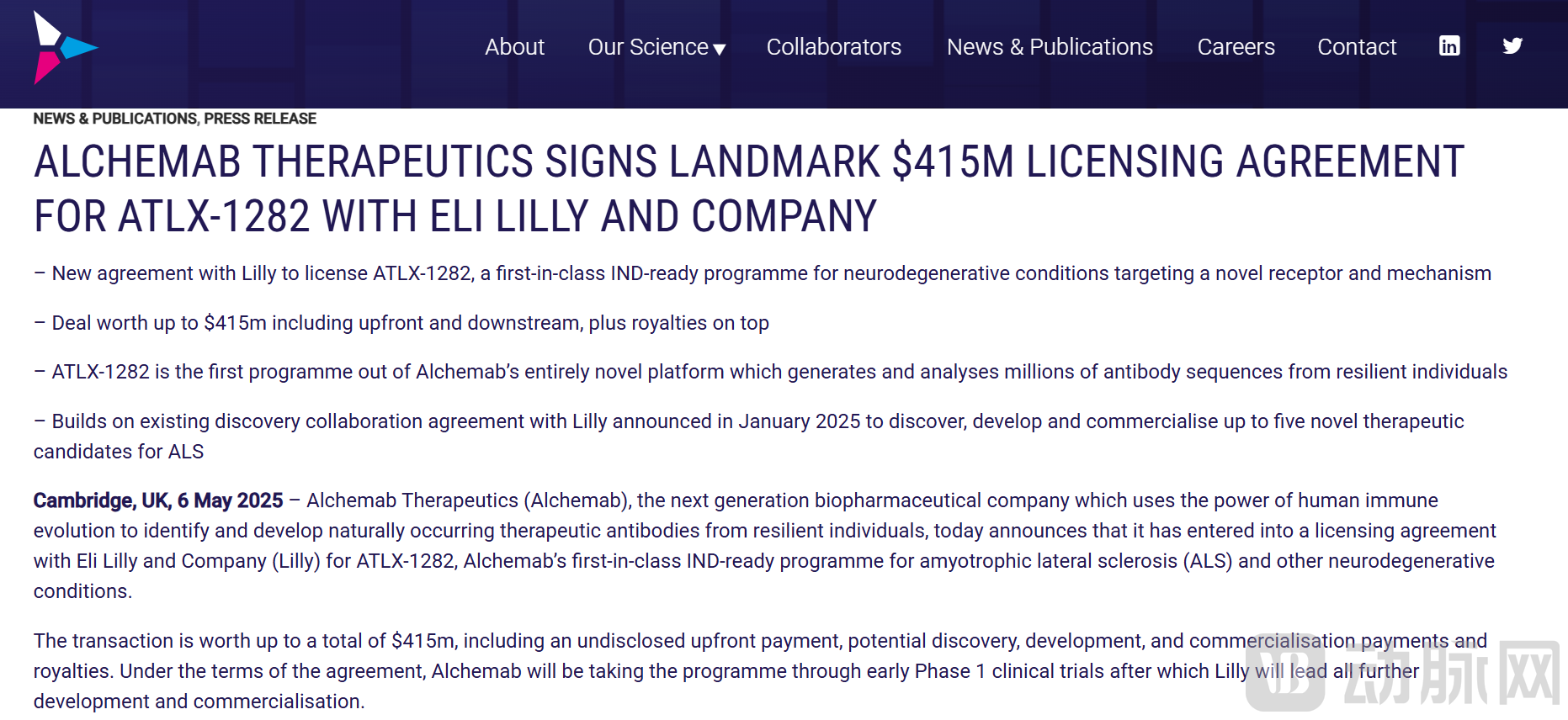
On May 6 local time, Alchemab Therapeutics announced that it had reached a licensing agreement with Eli Lilly for ATLX-1282, an antibody targeting UNC5C. ATLX-1282 is Alchemab's innovative candidate drug for Amyotrophic Lateral Sclerosis (ALS, commonly known as "Lou Gehrig's disease") and other neurodegenerative diseases (CNS).
The total value of the transaction is up to $415 million (approximately RMB 2.997 billion), including an undisclosed upfront payment, potential discovery, development and commercialization payments, as well as royalties. According to the terms of the agreement, Alchemab will lead the project through early Phase I clinical trials, after which Eli Lilly will take over leadership for further development and commercialization.
Source: Alchemab Therapeutics Ltd official website
The deal began in early this year. In January 2025, Eli Lilly and Company partnered with Alchemab Therapeutics to leverage the latter’s unique antibody discovery platform for the joint discovery and development of up to five antibodies aimed at treating Amyotrophic Lateral Sclerosis (ALS). Under the agreement, Alchemab will receive an undisclosed upfront payment and is eligible for discovery, development, and commercialization milestone payments, as well as royalties. The ATLX-1282 antibody project from this transaction originated from this collaboration.
Alchemab's unique platform utilizes machine learning and artificial intelligence to analyze the complexity of human immune responses. Based on over 6,000 carefully selected and highly curated patient samples from neurodegenerative diseases, immunology, oncology, and healthy aging, it identifies antibodies with unique relevance to resilience against diseases that currently have no treatment.
Alchemab Therapeutics Combines Lab-Based Protein Science and Biology with Machine Learning, Human Samples, and Proprietary Data Analysis, Leveraging NVIDIA’s Supercomputer in Cambridge to Sequence and Analyze Millions of Antibody Sequences to Uncover Novel Targets and Antibodies with Unique Mechanisms of Action.
Through its research, Alchemab Therapeutics discovered an antibody in patients with frontotemporal dementia (FTD) mutations. By sequencing this antibody and identifying its target, Alchemab subsequently demonstrated its significance in neuroprotection and various neurodegenerative diseases, including ALS and FTD.
As the first project developed on Alchemab's unique platform, which leverages machine learning and artificial intelligence technologies, ATLX-1282 is an investigational antibody targeting the UNC5C protein. The UNC5C protein is associated with various neurodegenerative diseases, and ATLX-1282 has the potential to become a first-in-class drug. Currently, ATLX-1282 is in the IND-ready stage. Moving forward, Alchemab will be responsible for advancing the early Phase I clinical trials of ATLX-1282, after which Eli Lilly will lead further development and commercialization of the program.
This is Eli Lilly's second formal collaboration in the ALS field within less than a year.
The first collaboration was in June 2024, when QurAlis entered into an exclusive licensing agreement with Eli Lilly and Company. QurAlis will receive a $45 million upfront payment, additional equity investment, and is eligible for up to $577 million in milestone payments and royalty sharing. Eli Lilly and Company will obtain global rights to develop and commercialize the QRL-204 program. QRL-204 is a potential antisense oligonucleotide (ASO) therapy designed to restore UNC13A function in amyotrophic lateral sclerosis (ALS), frontotemporal dementia (FTD), and other neurodegenerative diseases.
Not only ALS, but Eli Lilly is also frequently deploying across the entire CNS field:
In March 2024, Eli Lilly participated in the seed financing round of TRIMTECH Therapeutics, a rising company in protein degradation. TRIMTECH Therapeutics focuses on developing innovative therapies for CNS and inflammatory diseases by targeting the disruption of pathogenic protein aggregation.
In April 2025, Eli Lilly and Company reached a collaboration with Sangamo. Eli Lilly obtained the exclusive rights to use Sangamo's STAC-BBB targeting neurogenic adenopathy-related capsids on an initial disease target, with the option to add up to four additional neurological disease targets under the agreement. If Eli Lilly decides to apply Sangamo’s technology across all five targets, Sangamo could receive up to $1.4 billion in additional milestone payments, as well as future tiered royalties.
The reason why Eli Lilly frequently invests in the CNS field is easy to understand.
First, the CNS market has enormous potential. According to WHO predictions, within 20 years, CNS diseases will become the second leading cause of death. In China, one-sixth of the population suffers from neurological-related disorders. The aging population further drives the continuous rise in neurodegenerative diseases. However, current treatments for CNS conditions such as schizophrenia, addiction, depression, and AD (Alzheimer's disease) are less than 50% effective, indicating a significant unmet clinical need and promising market prospects. According to statistics from Frost & Sullivan, the global CNS drug market size was $124.5 billion in 2019 and is projected to reach $172.1 billion by 2034. In 2019, China’s CNS drug market size was $29.6 billion and is expected to grow to $57.1 billion by 2034.
Secondly, Eli Lilly has sufficient successful experience in the CNS field. Eli Lilly has launched the well-known antidepressant Prozac and the star Alzheimer's drug Donanemab. According to Evaluate Pharma's prediction, the peak annual sales of Donanemab could reach 10 billion US dollars. In addition, Eli Lilly also has a new Alzheimer's drug in development called Remternetug. Early clinical trials have shown that Remternetug can effectively clear β-amyloid plaques with an effect comparable to Donanemab. Currently, Remternetug is undergoing global multi-center Phase III pivotal clinical trials and is expected to be approved for marketing as early as 2027–2028.
Moreover, the success of tirzepatide has also given Eli Lilly the confidence to "buy, buy, buy." Not only in the field of neuroscience, but based on its strong financial foundation, Eli Lilly has also made comprehensive arrangements in the fields of cardiometabolic diseases, oncology, and immunology. We look forward to Eli Lilly successfully launching its CNS drugs under research, accelerating the arrival of the explosive growth of CNS industrialization, and bringing more accessible therapies to patients.
Reference: "Eli Lilly Strikes Again! Targeting the Next 'Secret Growth Point'"