Home Novartis Advances Novel SHOC2–RAS(Q61*) Interaction Inhibitor for NRAS-Mutant Cancers

Novartis Advances Novel SHOC2–RAS(Q61*) Interaction Inhibitor for NRAS-Mutant Cancers

May 09, 2025 06:14 CST Updated 06:14
Novartis

Drug Development and Manufacturing

Image

Early R&D Talking

Focus

RAS Mutation

Image
Image
Image
Image
Image

DOI: 10.1038/s41586-025-08931-1

Image

Talk Confidently, Apply Knowledge Practically


Activating mutations in the RAS gene family (including HRAS, NRAS, and KRAS) represent the most common oncogenic drivers in human cancers. For a long time, they have been considered the quintessential "undruggable" protein targets, until the breakthrough with KRAS G12C, leading to the approval of two small-molecule inhibitors. In recent years, research progress has been continuous, not only for KRAS G12C but also for several drugs targeting KRAS G12D that have entered clinical trials, and drugs targeting KRAS G12V are also expected to enter clinical studies soon.

However, selectivelyTargeting NRAS (Q61*) Mutant(* represents any sequence) of clinical drugs are still scarce. This series of mutants isThe Second Most Common Oncogenic Driver in Melanoma

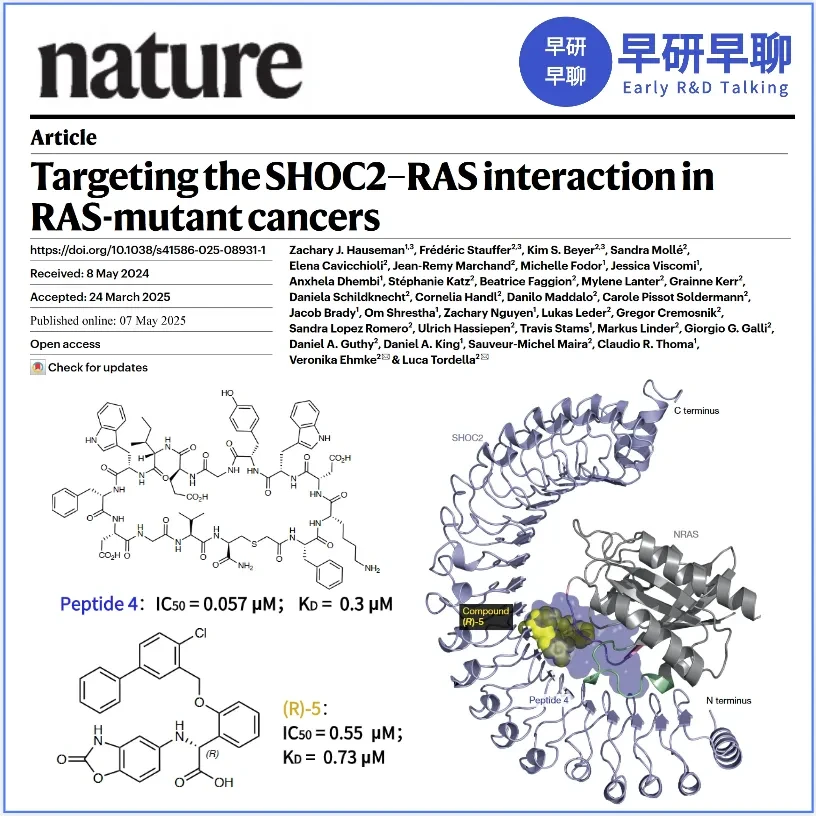
Yesterday (May 7),Novartis Biomedical Research CenterInNature An article was published, introducing an SHOC2-MRAS-PP1C complex model, in which SHOC2 becomes a dependency factor for RAS (Q61*) tumors in a nucleotide state-dependent and isoform-independent manner.

The study discovered and confirmed that the oncogenic NRAS(Q61R) directly interacts with SHOC2; throughHigh-Throughput Screening in Vitro, small molecules that bind to SHOC2 and disrupt PPI were discovered;Optimization of Gene StructureObtained tool molecules with cellular activity, which showed an inhibitory effect on MAPK signaling and proliferation in cancer models.

This study provides a proof of concept and foundation for the development of new therapies targeting the core of the RAS signaling pathway.

Original text open source, click "Read Original Text" at the end to access the original publication.

Image
Image

01

RAS Mutations and SHOC2 Biological Function

Image


The typical RAS protein family consists of HRAS, NRAS, and KRAS, whose activity is regulated by binding to GDP or GTP, corresponding to structural changes in the switch regions, leading to inactive and active states, respectively.
 1.1   The Role of RAS Mutations in Cancer
In the GTP-bound active state, RAS proteins interact with effector proteins (most importantly, the RAF protein family), leading to the activation of the downstream MAPK signaling pathway.
Mutations in RAS proteins occur most frequently at positions 12, 13, and 61, and haveIsomer Bias, andTissue BiasThe model.
For example, in KRAS protein mutants, the G12 site mutation is the most common (accounting for over 80%); however, in NRAS protein mutants, the Q61 mutation is the most common activating event (accounting for over 60%); moreover, in NRAS-mutated melanoma, the Q61 mutant accounts for the vast majority, exceeding 85%.
NRAS mutations represent the second largest subtype in melanoma, following BRAF mutations (accounting for 20%-30% of all cases). However, there are currently no targeted therapies approved for this patient population, which meansThere are currently a large number of unmet medical needs.
All RAS oncogenic mutations promote the transition of RAS activity states toward higher morbidity by disrupting GTP hydrolysis, but the extent of the transition varies depending on the specific mutation.
In addition, existing KRAS G12C/D inhibitors have limited efficacy against NRAS Q61*, and new treatment strategies are urgently needed.
The challenges of directly targeting RAS mutants are well-known, and as an alternative option, perhapsCan be treated by targeting specific RAS mutant addictions or co-factors of dependency.

 1.2   Biological Functions of SHOC2
SHOC2 It is a leucine-rich repeat (LRR) adaptor protein and part of the SHOC2-MRAS-PP1C (SMP) holophosphatase complex.
This complex enables the dephosphorylation of RAF at the S259 site, a key event that allows RAS-GTP to transmit signals through the RAF protein.
Therefore, SHOC2 has a causal relationship with common pathological processes mediated by RAS-MAPK, such as cancer and RAS syndrome.
The structural characteristics of the SMP complex suggest its potential as a novel therapeutic target for related diseases.. In RAS-mutant cancers, SHOC2 may act through alternative ...MRASDirect binding with RAS.

 1.3   Main Research Methods
In this study, the researchers adopted a variety of research methods.
(1) Gene Editing and Cell Model Construction: Multiple Ba/F3 cell models carrying different RAS mutations (including G12C, G12D, Q61R) were constructed using CRISPR-Cas9 technology, along with cell lines stably expressing SHOC2 or NRAS-targeting shRNA.
(2) Gene Dependency Screening: Through genome-scale sgRNA library screening, used to identify genetic dependency genes associated with RAS mutations.
(3) Protein Interaction Analysis: Biophysical methods such as surface plasmon resonance (SPR) and ultracentrifugation were used.Complex structure of cofactor proteins interacting with RAS studied through techniques such as sedimentation velocity analysis and X-ray crystallography.
(4) High-throughput Screening and Small Molecule Optimization: Discover compounds that regulate PPI and optimize to obtain tool molecules with cellular activity.
(5) Cell and Animal Experiments: Evaluate the impact of target knockout or inhibition on cell proliferation and the MAPK signaling pathway across multiple cell lines, and validate the in vivo antitumor activity of the target ligand using animal models.

02

Key Findings

Image


Through the above research methods, researchers first identified the RAS mutation-dependent factor SHOC2; then, through PPI analysis and structural resolution, they determined the interaction mechanism between SHOC2 and RAS(Q61*); subsequently, via high-throughput screening, they developed SHOC2 inhibitors and tested their regulation of PPI and related biological effects.
 2.1   SHOC2 is a dependency factor for RAS(Q61*) mutation
Researchers first studied the three most common RAS hotspot mutations G12C, G12D, Q61R associated withGenetic Dependence, as well as genetic dependencies associated with specific KRAS and NRAS isoforms. As shown in Figure a, IL3-deficient Ba/F3 cell lines were used to model RTK/RAS/MAPK oncogenic addiction in the absence of other confounding background mutations.
Image
After treatment with KRAS G12C or KRAS G12D selective inhibitors, mutant and isoform-selective growth dependencies were confirmed, as shown in Figure b below.
Image
Subsequently, the researchers usedWhole Genome Chronic Virus sgRNA LibraryTo detect the growth dependency of gene sets such as RAS, as shown in the figure below.
Image
As shown in the figure below, each screening consistently retrieves a small subset of Hits. Pan-lethal genes and tumor suppressor genes scored as growth inhibitors or growth enhancers, respectively, across all five cell models.
Image
A small number of Hits are associated with different G12 mutations or RAS subtypes, as shown in the figure below.
Image
From the principal component analysis (PCA), a major component is independent of the subtype and is driven by mutations Q61R or G12C/D, as shown in the figure below.
Image
Notably, the selective Hits for G12C/D includeIGF1R, PTPN11, SHC1, and SOS1, which encode proteins involved in promoting the RAS-GTP state, as shown in the figure below.
Image
Image
As shown in Figure h, using existing drugs targeting SHP2, SOS1, and IGFR, it was verified that cell lines expressing NRAS/KRAS (G12C/D) exhibit higher overall sensitivity to upstream pathway inhibition through these nodes compared to models expressing NRAS/KRAS (Q61R).
Image
This indicates a deeper inhibition of the MAPK signaling, as shown in the figure below.
Image
It should be noted that, from the data in figures d-f above, in the model expressing NRAS/KRAS (Q61R) (the subscript in figure f is incorrect),The most important Hits are screened out by SHOC2.
SHOC2 is a component of the SMP holophosphatase complex and a positive regulator of the RAS-MAPK pathway. Currently, there are no selective drugs targeting SHOC2 reported.
Therefore, the researchers adopted sgRNA-mediated SHOC2 knockout and found that it resulted in a more profound lethality in NRAS/KRAS (Q61) mutants compared to NRAS/KRAS (G12) mutant Ba/F3 cell lines, as shown in the figure below.
Image
In another KRAS Q61H Ba/F3 system, representing the most common oncogenic mutation at KRAS codon 61, exhibited the same level as the Q61R mutation system.Dependence on SHOC2
This suggests that these findings are mutation-specific and independent of the isoform. Given the significant challenges in targeting RAS Q61* mutants, the researchers focused their attention on SHOC2.
As shown in figures a and b, researchers analyzed DepMap data and found that SHOC2 exhibits specific genetic dependency in RAS Q61* mutant cancers, such as melanoma.
Image
In all NRAS Q61* mutants (excluding BRAF V600E), the SHOC2 knockdown model of melanoma suppressed cell proliferation in the colony formation assay, as shown in the figure below.
Image
At the same time, it also led to the restriction of the MAPK pathway. This was reflected by the decrease in pERK and pMEK levels, as shown in Figure d below. Additionally, it reduced the mRNA expression of DUSP5, SPRY4, and EGR1, as shown in Figure e below.
Image
Next, the researchers conducted in vivo efficacy studies using different tumor models and foundInduced reduction in SHOC2 expression significantly impairs tumor growth, as shown in the figure below.
Image
Transcriptomic analysis of tumors through efficacy studies shows a strong correlation and comparable degree of gene expression regulation between the dissociation constants (KD) of SHOC2 and NRAS, particularly in RAS/MAPK regulatory genes.
Image
Image
Gene enrichment analysis identified biological processes related to RAS/MAPK signaling or reflecting cell cycle or cell death regulation, as shown in the figure below.
Image
Overall, the genetic co-dependency and target validation datasets suggest that,SHOC2 is crucial for RAS Q61 signaling and presents potential therapeutic opportunities in this field.

 2.2   Mechanism of Interaction between SHOC2 and RAS(Q61*)
Previous studies have shown that RAS mutants can replace non-essential components for cancer cell survival. MRASIntegrated into the SMP complex. However, the function of such interactions remains unclear.
Therefore, the researchers'The aim is to investigate the relationship between two protein interactions by identifying drugs that interfere with PPI.
First, we investigated whether SHOC2 and mutant RAS could form a stable binary interaction in vitro, despite the known high cooperativity of ternary SMP assembly.
As shown in the figure below, the study found that when wild-type NRAS and KRAS are loaded with GDP, these proteins cannot form larger complexes with SHOC2; however, when the Q61R mutants of both subtypes are loaded with GTP, species with high sedimentation coefficients are generated, consistent with the binary SHOC2-RAS complex being accompanied by the depletion of two monomers.
This indicates that the binding of PPI is nucleotide-dependent.
Image
Binary interactions between SHOC2 and NRAS Q61R and KRAS Q61R were confirmed by SPR orthologous method, with KD values of 11 μM and 12 μM, respectively.
X-ray co-crystallography shows that NRAS Q61R binds to the LRR domain of SHOC2 through the Switch I/II regions, forming a stable binary complex, as shown in the figure below.
Image
A careful analysis reveals several hydrogen bonds originating from SWI or SWII, which are activated due to the increased proximity of SWII and part of SWI to SHOC2, as shown in the figure below.
Image
Based on the above findings, it can be inferred that:Identification of chemical substances that bind to the RAS interaction domain of SHOC2 should have the potential to disrupt the SHOC2-RAS interaction, thereby preventing the formation of the holophosphatase complex.
In summary: Multiple pieces of evidence indicate that,There is a stable binary interaction between SHOC2 and oncogenic NRAS Q61R, and this interaction depends on the mutation as well as the nucleotide state. Therefore, targeting this interface will interfere with SHOC2-RAS function.

 2.3   Development of SHOC2 Inhibitors
Ligand-based evaluation shows that the surface of SHOC2 is mostly flat, with the RAS PPI site on its concave side being the only hydrophobic patch region, as shown in the figure below.
Image
This hydrophobic patch area has a limited buried surface, several charged residues, and flexible side chains.
Researchers used in vitro high-throughput screening to screen approximately 320,000 small molecules from Novartis' inventory through TR-FRET competition assays targeting SHOC2 and GTP-loaded NRAS Q61R.
Initially, a total of 3,353 primary hits were obtained (hit rate 1.05%, competition effect cut-off at 25%), of which 881 could be passed through.Half maximal inhibitory concentration (IC50) Dose-Response CurveConfirm, IC50Value ranges from 0.2 μM to 100 μM.
Further evaluation of direct binding with SHOC2 through SPR confirmed thatCompound 1(A mixture of diastereomers at the carboxylic acid site) is a competitive binder for NRAS Q61R and targets SHOC2.Single-digit μM affinity, as shown in the table below.
Image
Separation of diastereomeric mixtures to obtain a singleIsomers 2, 3, among whichIsomer 2The affinity has been further improved,Isomer 3Even worse.
In addition, the researchers conducted an unbiased screening of macrocyclic peptides to gain a more detailed understanding of the ligandable pockets on SHOC2, and discovered and confirmedCyclic Peptide 4, SHOC2 binders with sub-μM affinity, and effectively interfere with the SHOC2-NRAS Q61R interaction.
As discovered through X-ray crystallography, and consistent with ligand-based analysis, cyclic peptide 4 occupies the sole putative ligand cavity found on SHOC2, as shown in the figure below.
Image
For small-molecule ligands, further SAR optimization led to the deconstruction of the biaryl moiety while retaining the carboxylic acid portion, resulting in enhanced affinity enantiomers (S)-5 and (R)-5. Additionally, the crystal structure of the small-molecule binding was obtained, as shown in the figure above (the yellow part represents...Compound R-5)。
It can be seen from the crystal structure that the ligand pockets of small molecules and cyclic peptides overlap.
The carboxyl moiety of compound (R)-5 interacts with R223 and Q269, while the benzooxazol-2(3H)-one moiety is fully constrained on the protein surface, forming several hydrogen bonds, as shown in Figure b below.
Image
In view of(R)- 5The chemical instability and the linker having room for further optimization, researchers further optimized to obtain improved affinityCompound 6, as shown in Figure c above.
Moreover, through the SHOC2 G290A mutantCompound 6No response, confirm the binding specificity and selectivity, as shown in the figure below.
Image

 2.4   Biological Effect Validation
In cell model tests,Compound 6Inhibition of NRAS Q61* melanoma cells' MAPK signaling (pERK/pMEK downregulation), but ineffective for BRAF V600E mutations, as shown in figures e and f below.
Image
As shown in the 3D proliferation assay, compound 6 significantly inhibits the spheroid growth of RAS Q61* melanoma cells, as illustrated in Figure h above.
Transcriptome analysis showed that SHOC2 inhibition led to the downregulation of RAS/MPAK pathway genes, as shown in the figure below, Figure i above.

03

Summary and Outlook

Image


This study reveals the potential of SHOC2 as a new therapeutic target for RAS Q61* cancers through multidisciplinary collaboration in genetics, structural biology, and medicinal chemistry.
In addition, this study has developed the first small-molecule inhibitor with cell activity.Provides proof of concept and foundation for the development of new therapies targeting the core of the RAS signaling pathway, and offers a new treatment direction for NRAS-mutant melanoma.


Previous Related Review


Latest Summary of KRAS Clinical Drugs

2025-05-05

Image

JMC: Small molecule macrocyclization, capable of modulating RAS-OFF, RAS-ON selective affinity

2025-04-02

Image

JMC: A Novel Inhibitor Targeting Copper Metabolism in KRAS-Mutant Cancer Cells, Synergizing with COX2 Inhibitors for Combination Therapy to Tackle the "Achilles' Heel" of Pancreatic Cancer Treatment

2025-03-28

Image

Roche's New Patent: Novel Tricyclic KRAS Inhibitor

2025-01-11

Image

10 Years of RAS Inhibitor Development —— Experience and Lessons

2024-07-29

Image

Patent Breakthrough: Who Will Be the Game-Changer? Is There Still a Chance for Those Yet to Enter the KRAS(G12D) Arena?

2024-07-13

Image

Cancer Cell | Progress in HRS-4642, the First China-produced KRAS-G12D-Targeted Non-Covalent Inhibitor from Hengrui

2024-07-01

Image

Structure-Based Design, Macrocyclic Peptidomimetics in Action, Cancer's Nemesis — "Molecular Glue"-Like Inhibitors Promote Ternary Complex Formation, Inhibiting Activated KRAS Mutants

2024-04-25

Image

JMC Express || Targeting KRAS Diversity —— G12X and Other Covalent Modulations in Cancer Therapy

2024-04-19

Image

Revolution Medicines Latest Revelation: Three-Body Solution, Structural Analysis of Molecular Glue

2025-03-02

Image
Image

Instructions: This official account aims to study and share the latest scientific research achievements. The content includes reading literature, news, etc., and is based on personal understanding, translation, and interpretation for reference only. Due to limited knowledge, there may be omissions and errors, and constructive criticism is sincerely welcomed. Content marked as [Original] refers to original compilation and translation for ease of dissemination, with copyright belonging to the publisher and author. For detailed and comprehensive information on the literature, please refer to the original text. For cooperation, communication, reprinting, and BD inquiries, please contact us via private message in the backend. Reasonable reprints are welcome, please indicate the source as [Early Research, Early Discussion].