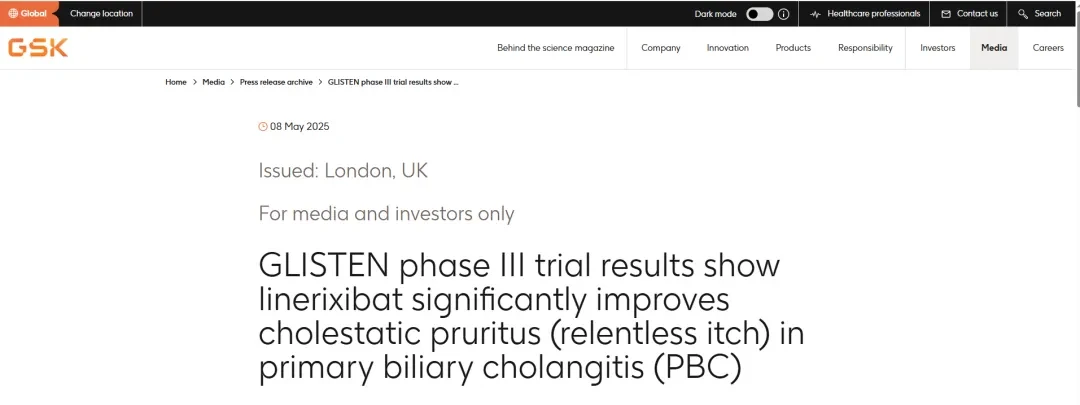
Local time on May 8, GSK announcedIts Phase III clinical trial, GLISTEN, has achieved positive results.Linerixibat canSignificant ImprovementPrimary Biliary Cholangitis (PBC) in ChinaCholestatic Pruritus(Persistent Itching)。Screenshot source: Corporate official websiteGLISTEN isA Double-Blind, Randomized, Placebo-Controlled Phase III Clinical Trial(NCT04950127), aimed to evaluate the ileal bile acid transporter(IBAT)Targeted Inhibitor LinerixibatEfficacy and Safety of Treating Cholestatic Pruritus in PBC Patients. The primary endpoint is assessed using a Numerical Rating Scale. (NRS) CalculationChange in monthly pruritus score from baseline over 24 weeks。The full data has been presented at the 2025 Annual Meeting of the European Association for the Study of the Liver (EASL).(EASL)Publicly announced in China. The trial met its primary endpoint, with patients receiving Linerixibat during the 24-week treatment period.(n=119)Compared with the placebo group(n=119)Significant improvement in itching symptoms. The least squares mean difference between the two groups was -0.72, as measured by the worst itching severity assessed on a 0-10 numerical rating scale, indicating that LinerixibatHas the potential to treat persistent pruritus in PBC patients。The trial also met multiple key secondary endpoints, including improvement in itch score at Week 2 and improvement in itch-related sleep interference score over 24 weeks, with results showing:
Rapid onset of itch relief, significantly improved compared to the placebo group at Week 2 and continued to improve throughout the trial period.
Over the 24-week treatment period, compared with placebo, LinerixibatSignificantly improved sleep disturbances caused by itching.
At Week 24, in the Linerixibat group,56% of patients showed clinically significant improvement in pruritus scores.(WI-NRS reduction ≥3 points), while the placebo group was 43%.
In terms of safety,The safety profile of Linerixibat is consistent with previous studies and the mechanism of IBAT inhibition, but gastrointestinal side effects were more common in the active treatment group. The most frequent adverse event was diarrhea, mostly mild in severity.The proportion of patients discontinuing Linerixibat due to diarrhea was 4%, compared to less than 1% in the placebo group.PBC is a cholestatic liver disease in which the flow of bile from the liver is impaired. The resulting excess of bile acids in circulation is considered to be the cause of cholestatic pruritus, an internal itch that cannot be relieved by scratching. Cholestatic pruritus is a serious condition that can debilitate patients, leading to sleep disturbances, fatigue, reduced quality of life, and sometimes even the need for liver transplantation despite the absence of liver failure. First-line treatment for PBC can control the disease in approximately 70% of patients but does not alleviate the severity or impact of the pruritus.Linerixibat is an oral IBAT inhibitor that reduces various pruritic mediators in the bloodstream by inhibiting bile acid reuptake. The FDA and EMA have granted this drugOrphan Drug Designation, used to treat cholestatic pruritus in PBC patients.Cover Source:Company LogoDisclaimer:This article is for information sharing only,不代表 Insight 立场和观点, and does not recommend or introduce any treatment options. If you have any needs, please consult and contact正规医疗机构.PR Article Coordination: WeChat insightxbSubmissionWeChat: insightxb; Email: insight@dxy.cn



'%20fill='%23FFFFFF'%3E%3Crect%20x='249'%20y='126'%20width='1'%20height='1'%3E%3C/rect%3E%3C/g%3E%3C/g%3E%3C/svg%3E)