


Johnson & Johnson
Healthcare Product Manufacturers, Health Service Providers
Eli Lilly
Global Pharmaceutical R&D and Production Company

As the financial reports for the first quarter of 2025 are gradually released, the performance of the world's top 10 multinational pharmaceutical companies has once again become the focus of the industry.

Revenue ranking is an important indicator to measure the strength of pharmaceutical companies. The list for the first quarter of 2025 was highly competitive, with some subtle changes in the landscape. The top 10 global pharmaceutical companies are Johnson & Johnson, Roche, Merck, Pfizer, AstraZeneca, AbbVie, Novartis, Eli Lilly and Company, Bristol-Myers Squibb, and Novo Nordisk.
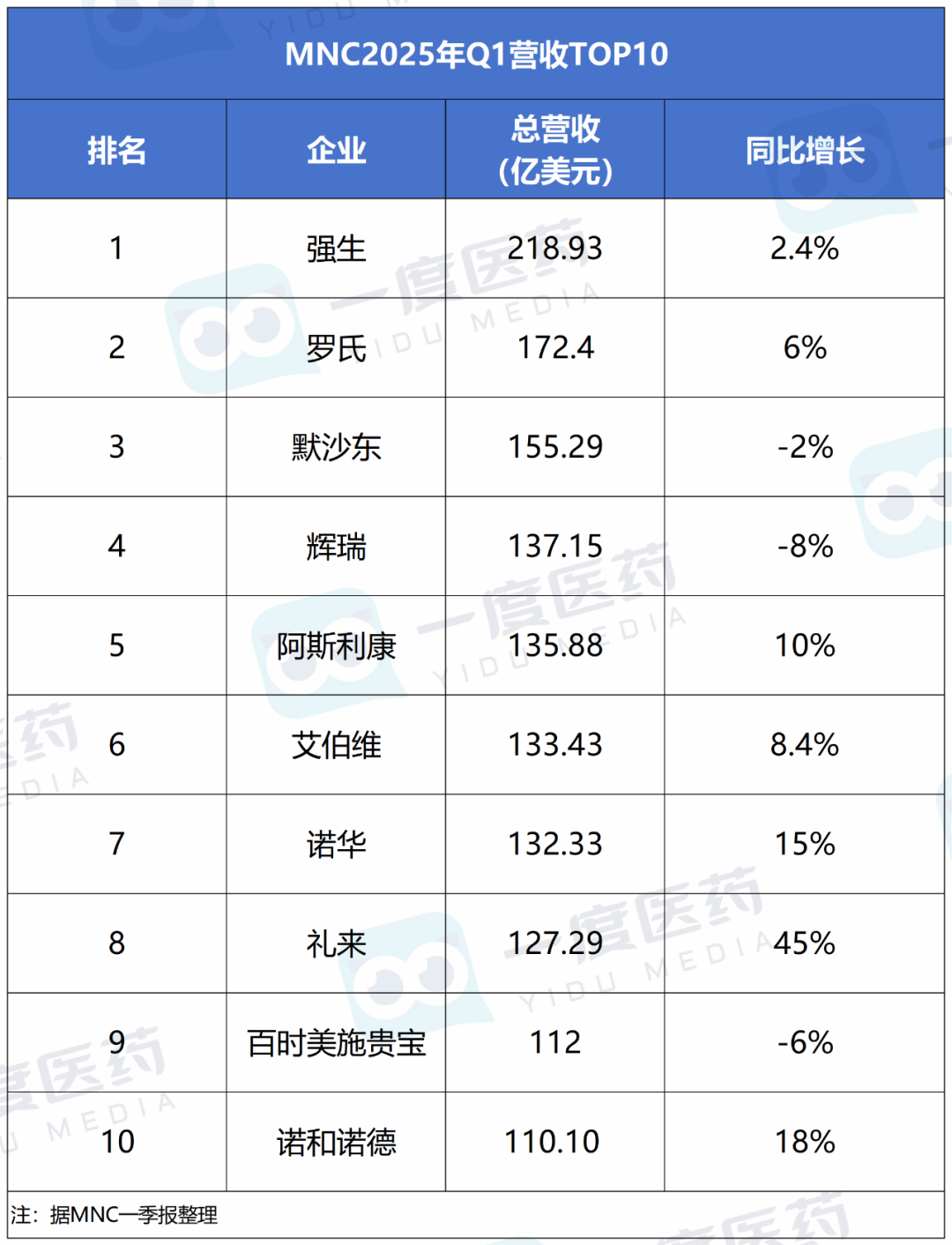
In terms of year-on-year growth rate, compared with the same period last year, Merck, Pfizer, and Bristol-Myers Squibb showed negative growth; Eli Lilly had the fastest growth rate, reaching 45%; in addition, AstraZeneca, Novartis, and Novo Nordisk had growth rates above 10%.
Johnson & Johnson topped the list again with a total revenue of $21.893 billion, representing a year-on-year increase of 2.4%. Its diversified business layout, covering multiple fields such as pharmaceuticals and medical devices, has become a solid backing for its steady growth. The sales of its innovative drug segment reached $13.9 billion, marking a year-on-year increase of 4.2%.
Roche's total revenue was 15.44 billion Swiss francs (approximately 17.24 billion US dollars, based on the average exchange rate for 2025, 1 Swiss franc = 1.1166 US dollars), representing a year-on-year increase of 6% (at constant exchange rates). Excluding COVID-19 related products, sales growth reached 7%. Pharmaceutical business revenue amounted to 11.949 billion Swiss francs, demonstrating strong growth resilience.
In the first quarter, Merck's total revenue reached $15.529 billion, a year-on-year increase of 9%, and its net profit was $4.762 billion, a significant year-on-year increase of 69%. The super blockbuster drug Keytruda continued to gain momentum.
Pfizer's Q1 total revenue was $13.715 billion, an 8% decrease year-over-year; product revenue reached $11.294 billion, a 9% decline year-over-year (from $12.411 billion in the same period last year). However, excluding the sales of COVID-19 products, the company achieved 11% growth in the most recent quarter, demonstrating strong resilience in its non-COVID-19 business.
AstraZeneca's Q1 revenue reached $13.588 billion, increasing by 10% year-on-year, driven by double-digit growth in oncology and biopharmaceuticals.
Additionally, AbbVie's revenue surged from $12.31 billion last year to $13.343 billion, surpassing analysts' expectations and ranking sixth on the list, driven primarily by the robust market performance of its immunotherapy drugs.
Novartis' global net sales reached $13.233 billion, representing a 15% year-over-year increase. Robust growth was achieved across core therapeutic areas including cardiovascular-renal-metabolic, immunology, neuroscience, and oncology.
Eli Lilly's First Quarter Revenue Reached $12.729 Billion, a Year-on-Year Increase of 45%, with Outstanding Performance. Net Profit was $2.759 Billion, a Year-on-Year Increase of 23%. The Rapid Growth in Performance Was Mainly Driven by Tirzepatide, a Once-Weekly GLP-1/GIP Dual Agonist.
In Q1 2025, Bristol-Myers Squibb achieved total revenue of $11.2 billion, a year-over-year decrease of 6% (a decline of 4% at constant exchange rates). Despite certain challenges, the growth product portfolio continued to provide strong support for the company’s performance.
Novo Nordisk's total revenue in the first quarter was 78.087 billion Danish kroner, approximately $11.01 billion (calculated at the average exchange rate of 1 Danish krone = 0.141 USD in Q1 this year), a year-on-year increase of 19%, or 18% at constant exchange rates. Semaglutide remains the key driver of its performance growth.
Notably, Sanofi's total revenue in Q1 2025 reached €9.895 billion, approximately $10.457 billion, representing a 9.7% increase year-over-year (at constant exchange rates). This performance, however, did not secure the company a spot among the top ten global pharmaceutical enterprises by total revenue.
'%20fill='%23FFFFFF'%3E%3Crect%20x='249'%20y='126'%20width='1'%20height='1'%3E%3C/rect%3E%3C/g%3E%3C/g%3E%3C/svg%3E)
In the fierce competition of the global pharmaceutical market, the title of "King of Drugs" is not only a symbol of a drug's remarkable efficacy and market influence but also a key battleground for the strength contest among major multinational corporations (MNCs). In recent years, the race for the "King of Drugs" has become increasingly intense, with several blockbuster drugs closely competing in sales figures. This reflects the competition among pharmaceutical companies in areas such as research and development and market strategy.
Novo Nordisk's Semaglutide Series (Ozempic, Wegovy, Rybelsus) Q1 Revenue78.64Billion USD (+31%),Accounting for more than 70% of its total revenue during the same period.Surpassing Merck's Keytruda (USD 7.205 billion) for the first time, it has become the world's top-selling单品. However, due to competition from U.S. generic drugs, Novo Nordisk has lowered its full-year sales growth forecast to 13%-21%.
Eli Lilly's tirzepatide (for both blood sugar reduction and weight loss) generated $6.15 billion in revenue in Q1 (accounting for 48% of total revenue), with the U.S. market contributing $2.66 billion (+75%). After receiving approval in the Chinese market in 2024, it is expected to become a new growth engine with formal commercialization beginning in 2025.
K Drug Growth Slows, Merck Accelerates ADC Strategy. Merck's blockbuster drug Keytruda saw a 4% increase in sales this quarter, reaching $7.205 billion, accounting for approximately 46% of its Q1 total revenue; HPV vaccine Gardasil also grew by 14%, with sales reaching $2.2 billion. These two products remain the core drivers of Merck’s performance growth. The company is expediting the development of ADC drug Trastuzumab Deruxtecan ($1.086 billion) and subcutaneous formulations to address the upcoming Keytruda patent expiration in 2028.
Performance of other MNC core products is as follows——
Johnson & Johnson's Darzalex revenue reached $3.24 billion in the oncology field, increasing by 22.5% year-over-year, with its market share expanding to 65% of the global CD38 monoclonal antibody market; Carvykti revenue was $369 million, growing by 135% year-over-year. In the autoimmune field, Tremfya revenue amounted to $956 million, increasing by 20.1% year-over-year.
Roche's multiple key products achieved remarkable results. The sales of Phesgo (subcutaneous injection of pertuzumab and trastuzumab) for breast cancer treatment reached 593 million Swiss francs, soaring 52% year-on-year, driven by strong demand in China and the United States. The ophthalmology bispecific antibody drug Vabysmo (faricimab) generated sales of 1.018 billion Swiss francs, increasing by 18%, with rising demand across all regions. Xolair (omalizumab) for allergy treatment earned 645 million Swiss francs, growing by 26%. Hemlibra (emicizumab), the bispecific antibody for hemophilia, achieved sales of 1.165 billion Swiss francs, up 11% year-on-year.
In the oncology sector, Pfizer's Padcev (enfortumab vedotin) performed remarkably, with sales reaching $426 million, a 25% year-over-year increase, driven by its expanded market share in first-line metastatic urothelial cancer. Sales of Lorbrena (lorlatinib) also grew by 39% year-over-year, bolstered by market share gains in the U.S., China, and other regions. However, Adcetris (brentuximab vedotin) sales amounted to $218 million, reflecting a 15% decline, potentially due to intensified competition in the ADC drug market.
AZ's star drug Tagrisso (Osimertinib) achieved single-quarter sales of $1.679 billion, an 8% year-on-year increase, continuing to lead the market. Enhertu (Trastuzumab Deruxtecan) showed strong growth momentum with global sales reaching $1.086 billion. It has been approved for multiple indications in areas such as breast cancer and gastric cancer, continuously expanding its market. Truqap (Capivasertib), the world’s first AKT inhibitor launched in the past two years, generated sales of $132 million, showing promising growth. In the CVRM sector, Farxiga (Dapagliflozin) achieved revenue of $2.058 billion, a 16% year-on-year increase, making it one of the key contributors to AZ’s earnings. In the respiratory and immunology field, the asthma drug Tezspire (Tezepelumab) reported revenue of $217 million, marking a significant year-on-year increase of 85%, with its market potential steadily being realized.
In Q1 2025, AbbVie's immunology segment remained the revenue pillar, with an income of $6.264 billion, reflecting a high growth rate of 16.6%. Among its products, Skyrizi (risankizumab) saw its sales soar to $3.425 billion, marking a robust year-on-year increase of 70.5%, demonstrating outstanding performance in areas such as Crohn's disease and psoriasis; Rinvoq (upadacitinib) achieved a revenue of $1.718 billion, growing by 57.2% year-on-year, covering nine major indications, and also gaining approval for the EU indication of giant cell arteritis. However, the former star product Humira (adalimumab), impacted by biosimilars, generated only $1.121 billion in sales, representing a year-on-year decline of 50.6%.
In core therapeutic areas such as cardio-renal-metabolism, immunology, neuroscience, and oncology, Novartis has achieved steady growth. For instance, Entresto (sacubitril/valsartan) generated $2.261 billion in revenue in Q1 2025, representing a 22% year-over-year increase. It has shown significant efficacy in heart failure treatment and made a substantial contribution to the growth of the pharmaceutical business.
In the First Quarter of 2025, Bristol-Myers Squibb's Product Performance Shows Polarization. The revenue from the growth product portfolio reached $5.6 billion, increasing by 16% year-over-year. Among them, the sales of the cancer immunotherapy Opdivo were $2.265 billion, growing by 9%, with a stable market share; the revenue from the CAR-T cell therapy Breyanzi was $263 million, surging by 146% year-over-year, gaining stronger influence in the field of hematological tumor treatment; the sales of Reblozyl for anemia treatment were $478 million, increasing by 35%, driven significantly by clinical demand. Meanwhile, the revenue from the mature product portfolio decreased by 20% year-over-year.
According to the disclosed financial report data, among the top ten global multinational pharmaceutical companies in terms of Q1 revenue, the performance in the China region showed significant differentiation.
Among them, AstraZeneca's revenue in China reached $18.05 billion (+5%), accounting for 13% of AstraZeneca's global market share. Osimertinib (EGFR inhibitor) and ADC drug Trastuzumab Deruxtecan showed strong growth in China.
Roche's pharmaceutical business in China grew by 14%, but its diagnostics business declined by 23% due to the impact of volume-based procurement. Strong demand for key products Xofluza (influenza drug) and Phesgo (subcutaneous formulation for breast cancer). In the first quarter of 2025, BMS's revenue in China decreased by 10% year-on-year, mainly due to the decline in revenue from the mature product portfolio. Despite the overall revenue decline, the growth product portfolio performed strongly in China, especially innovative drugs such as Opdivo (nivolumab) and Camzyos (mavacamten).
Novartis International: Regional Sales Increase by 18%, with China as a Core Market. siRNA Lipid-Lowering Drug Leqvio (+72%) and Radiopharmaceutical Pluvicto (+21%) Show Outstanding Performance; China Radiopharmaceutical Production Base to Begin Operations in 2026. Novo Nordisk’s China Region Revenue Reaches $807 Million (+22%), with the Three Versions of Semaglutide Contributing a Combined $318 Million; Wegovy (Weight Loss Version) Sales Surge 83% Year-on-Year.
Eli Lilly's revenue in China reached $451 million (+20%). Tirzepatide is expected to be approved for weight loss and diabetes indications in 2024, with official commercialization starting in 2025, anticipated to become a new growth engine. AbbVie's revenue exceeded analysts' expectations. In the Chinese market, its next-generation immunology drugs, Skyrizi (risankizumab) and Rinvoq (upadacitinib), also performed exceptionally well.
However, there were also declines in revenue. For example, Merck's revenue in China fell 62% year-over-year to $6.68 billion, accounting for 4.9% of Merck's global pharmaceutical business. Keytruda (K药) remained the main revenue driver, generating $7.205 billion, a 4% increase. With its broad range of indications and strong efficacy, it maintained a high market share in China’s oncology treatment market. However, sales of the HPV vaccine Gardasil/Gardasil 9 amounted to $1.327 billion, a 40% decrease, primarily due to reduced demand in China and persistently high inventory levels, significantly negatively impacting performance in the China region.
GLP-1 drugs, innovative oncology therapies, and advancements in autoimmune targets have become the core growth drivers for MNCs in China. However, policy pressures, local competition, and the patent cliff are pushing companies to accelerate strategic adjustments. In the future, those who can more flexibly balance innovation investment, localization strategies, and cost control will gain an edge in this critical battleground of China.
Source: MNC Financial Reports