

Dr. Guo Zhentao’s Team Achieves a Nephrology Breakthrough: High-Pressure Scoring Balloon Successfully Addresses AVF Stenosis in Hemodialysis Patients

DK Medtech
Vascular Interventional Balloon Product Developer

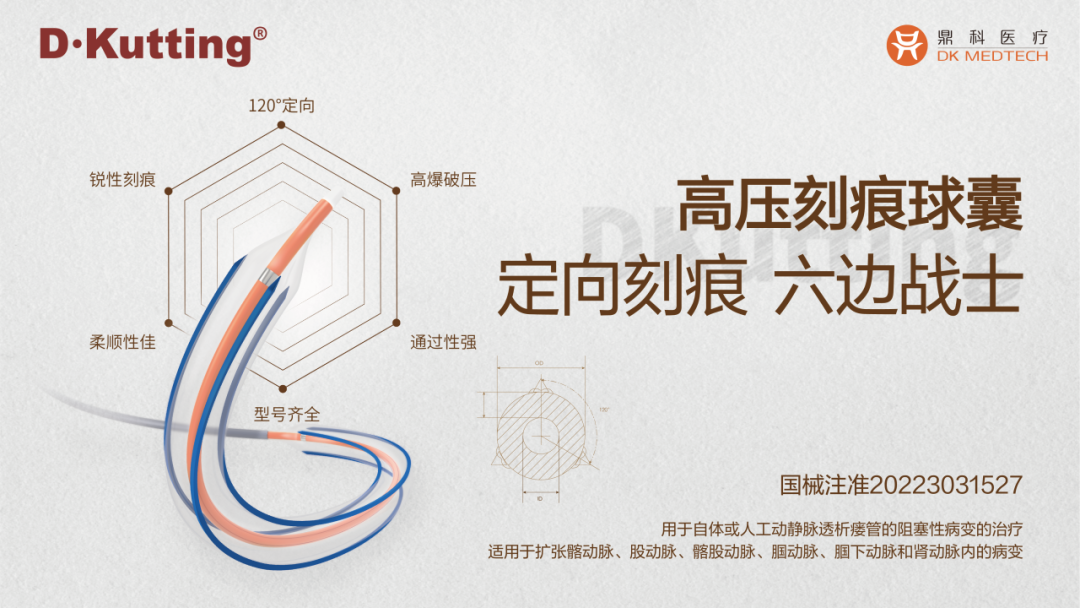
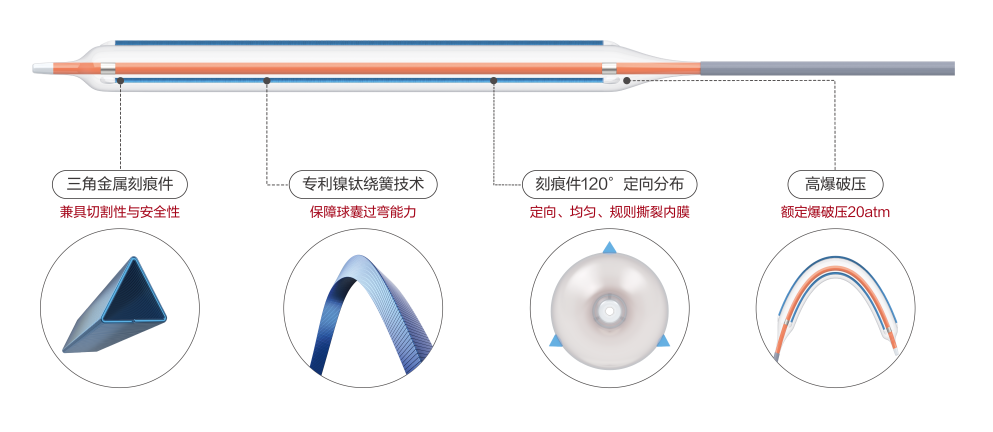
With the vigorous development of China's peripheral vascular intervention market, common balloons tend to cause complications such as excessive vascular injury, flow-limiting dissections, and hematomas when addressing the increasing number of highly resistant stenotic lesions. In contrast, pressure-focusing balloons utilize cutting/notching elements positioned between the inner wall of the blood vessel and the outer diameter of the balloon during expansion. These elements enhance localized pressure for efficient directional dilation, thereby reducing vascular elastic recoil and representing a new direction in the evolution of vascular intervention balloons.
DK Medtech's Self-Developed DKutting®The high-pressure scoring balloon, featuring an exclusive patented design (CN201810478242.X), boasts numerous advantages such as excellent deliverability, uniform expansion, and high burst pressure. In terms of overall product performance, it can be regarded as a "hexagonal warrior," marking a significant breakthrough in local innovation surpassing top-tier imported products.
DK Medtech Special Release[Professor Guo Zhentao's Team: New Breakthrough in Nephrology — High-Pressure Scoring Balloon Enhances AVF Patency, Successfully Resolves Stenosis in Arteriovenous Fistulas for Uremic Dialysis Patients] Case Presentation, demonstrating the meticulous operation of each case and the clinical application of advanced equipment and instruments. From the formulation of treatment strategies for different cases, standardized procedures during surgery, technical applications, complication prevention, to perioperative management, etc., the aim is to promote the standardization of diagnosis and treatment for vascular stenosis and occlusive diseases, strengthen technical exchanges and experience sharing among doctors, with the hope of providing new ideas and methods for future diagnosis and treatment, benefiting more clinical patients.
New Breakthrough in Nephrology — High-Pressure Scoring Balloon Helps AVF Stay More Open
Successfully Solve the Problem of Arteriovenous Fistula Stenosis in Uremic Dialysis Patients
Shandong Second Medical University Affiliated Hospital
Guo Zhentao, Chen Xuexun, Zhu Zihao
Patient Information
Basic Information:Male, 44 years old, on hemodialysis for over a year, with an arteriovenous fistula established 3 months ago.
Chief Complaint:Left forearm AVF established for 3 months, with poor fistula function.
History of Present Illness:The patient underwent left forearm AVF at our hospital on December 16, 2024. Due to insufficient fistula flow within three months post-operation, the fistula could not be activated and the patient has been using a right internal jugular long-term central venous catheter for regular dialysis.
Past Medical History:"A 10-year history of hypertension and renal hypertension, diagnosed with chronic renal failure (uremic stage) one year ago, followed by the placement of a long-term right internal jugular vein catheter for dialysis."
Physical Examination:There is a surgical scar about 5cm long near the wrist on the left forearm, with weak thrill of the internal fistula upon palpation.MiscellaneousThe sound is relatively weak.
Admission Diagnosis:Left forearm AVF stenosis.
Previous interventional treatment
Time | Main Treatment Process |
2024.5.21 | Due to the need for hemodialysis, a semi-permanent catheter was inserted into the right internal jugular vein. |
2024.12.16 | Left Upper Limb Autologous Arteriovenous Fistula Surgery, Procedure Successful, Thrill Present,MiscellaneousSoundable |
2025.3.12 | Angio-venous Fistula Balloon Dilation |
Preoperative Analysis
Preoperative Analysis:Ultrasound showed long segment occlusion of the proximal radial artery in the patient, with distal fistula blood supply unable to achieve the required blood flow for hemodialysis. A scoring balloon was used to open the arterial occlusive lesion.
Surgical Goal:
Main Objectives:Dilate the radial artery inflow tract, restore normal fistula vessel flow, and meet the requirements for dialysis;
Secondary Objectives:Prolong the service life of AVF, reduce complications, and minimize the number of interventions.
Surgical Strategy/Plan:Balloon dilation under ultrasound guidance.
Surgical Procedure
Equipment Preparation:
6F puncture sheath *1 set
Super-slip guidewire *1 set
Pressure Pump *1 Set
DKutting®High-pressure scoring balloon 4*40mm*1
Re-evaluate the fistula and radial artery condition preoperatively, and confirm the radial artery.FarThe puncture point was set at the end, with brachial plexus anesthesia administered. After routine disinfection, the sheath was guided under ultrasound and smoothly passed through the narrow section. A 4*40mm scoring balloon dilation catheter was introduced, starting from the initial segment of the radial artery, gradually dilating at low pressure until reaching the anastomosis. High-pressure dilation was then performed again from the initial segment of the radial artery. The waistline was observed to open, and the radial artery showed significant imaging with an internal diameter reaching 3.0mm without obvious bleeding or hematoma. The guidewire was then introduced into the outflow tract of the arteriovenous fistula, dilating the drift segment. The waistline opened without obvious bleeding, and the thrill of the arteriovenous fistula significantly increased. The procedure was completed.
'%20fill='%23FFFFFF'%3E%3Crect%20x='249'%20y='126'%20width='1'%20height='1'%3E%3C/rect%3E%3C/g%3E%3C/g%3E%3C/svg%3E)
Preoperative Marking of Stenotic Segment and Access Route of the Fistula
Long-segment occlusion of the proximal radial artery (luminal diameter only 1.06mm)
After successful puncture, the sheath is placed and the guidewire is introduced.
Insertion of 4mm Notched Balloon Over Guidewire
Starting from the initial segment of the radial artery, progressively perform low-pressure pre-dilation until reaching the anastomosis. Again, starting from the initial segment of the radial artery, perform high-pressure dilation of the proximal occlusive lesion and the stenotic vessel of the outflow tract drift segment of the arteriovenous fistula. Fully expand the vessel (maintain for half a minute).
Follow-up
Discharge Status:After balloon dilation, the thrill of the AVF significantly increased; the next day, the AVF was used for dialysis treatment with normal blood flow and venous pressure.
Postoperative review showed good patency of the entire radial artery and the drift segment of the outflow tract of the arteriovenous fistula, no retraction, and adequate blood flow.
Case Summary
Case Characteristics:
The artery is thin and the blood supply is insufficient during the establishment of autologous arteriovenous fistula.MiscellaneousSound and tremor are relatively weak;
After the establishment of AVF, it was found that the internal fistula had poor maturation after a 3-month maturation period, and ultrasound revealed that the internal fistula was in the radial artery.FarThe blood supply is compromised, with near-total occlusion at the proximal segment. The arteriovenous fistula has insufficient flow, and there is intimal hyperplasia of the proximal radial artery, leading to stenosis.
Preoperative Assessment Key Points:
Approach Selection:
Outflow Vein Approach:The guidewire was difficult to pass through the anastomosis into the proximal radial artery, and although it might be assisted by a catheter, due to significant hyperplasia and near occlusion, the auxiliary catheter and balloon were challenging to advance through the stenotic and occluded radial artery due to insufficient support.
Distal Radial Artery Approach:Relatively easy to pass through the narrow and occluded radial artery, as the sheath provides sufficient support to smoothly pass through the stenotic area, and the catheter can also easily pass through. However, there may be postoperative radial artery issues.FarThe risk of thrombosis and occlusion at the end, with partial loss of the radial artery in the fistulaFarBlood supply. In summary, the radial artery first...FarTransradial approach, higher surgical success rate.
Surgical Strategy/Technical Key Points:
For the first PTA of the internal fistula vessel, in case of arterial occlusion, a smaller balloon should be selected to treat the vascular lesion segment while taking care to avoid vascular rupture;
The use of high-pressure scoring balloons is beneficial for handling difficult cases and reducing complications.。
Device Features / Usage Tips:
Balloon Selection:
Diameter Selection:If the diameter is too large, it may cause complications such as vascular rupture and hematoma; if too small, significant intimal hyperplasia and retraction can lead to unsatisfactory surgical outcomes.
Balloon Type Selection:After ordinary high-pressure balloon dilation, due to severe intimal hyperplasia and significant vascular recoil, the surgical outcome was unsatisfactory. The scored balloon has a directional scoring effect with minimal elastic recoil. Therefore, a 4.0mm*40mm scored balloon was chosen.
Expert Introduction
Professor Guo Zhentao
The Surgeon of This Case
Member of the Party Committee and Vice President of the Affiliated Hospital of Shandong Second Medical University, Director of the Nephrology Department, concurrently serving as the Director of the Hemodialysis Center, Director of the Clinical Medicine Introduction Teaching and Research Office of Shandong Second Medical University, Third-Level Professor, and Doctoral Supervisor. Skilled in nephrology diagnostic and therapeutic techniques such as deep venous catheterization, arteriovenous fistula surgery, PTA surgery, autologous and artificial blood vessel implantation, etc., and has accumulated rich clinical experience in the treatment of common, frequently occurring, acute, and critical illnesses in nephrology. In 2020, honored as "Weifang City Outstanding Middle-Aged and Young Expert," presided over and completed 3 provincial-level projects and 3 department-level projects; participated in 2 National Natural Science Foundation projects, 2 provincial-level projects, and 5 department-level projects. First place winner for two second prizes of Weifang City Science and Technology Progress Award; published over 30 papers as first or corresponding author, including 11 SCI-indexed papers and more than 10 Chinese core journal articles; edited 2 nephrology monographs, chief editor of the "14th Five-Year Plan" undergraduate textbook "Introduction to General Practice"; obtained 1 national invention patent. Main academic positions include: Vice President of Shandong Health Human Resources Association, Vice Chairman of the Nephrology Branch of Shandong Medical Association, Vice Chairman of the Blood Purification Branch of Shandong Medical Association, Vice Chairman of the Kidney Rehabilitation Branch of Shandong Rehabilitation Medical Association, Vice Chairman of the Nephrology Branch of Shandong Research-Oriented Hospital Association, Chairman of the Multi-Disciplinary Joint Committee of Translational Medicine of Weifang Medical Association, etc.
Professor Chen Xuexun
Surgeon of This Case
Department of Nephrology, Affiliated Hospital of Shandong Second Medical University, Associate Chief Physician, Master's Graduate Supervisor. Mainly engaged in clinical practice, teaching, and research work related to kidney diseases and blood purification technology. Leader of the Vascular Access Group for Hemodialysis, skilled in establishing and maintaining various types of vascular access for hemodialysis. Accumulated extensive clinical experience in treating acute and chronic kidney diseases, secondary kidney diseases, and blood purification, especially in managing critical and severe cases. Research areas: Basic and clinical research on uremic peripheral neuropathy, basic and clinical research on vascular calcification in chronic kidney disease. Published over 40 papers as the first author, corresponding author, or co-author in domestic and international journals, including more than 10 papers in Peking University Core Journals and 8 SCI-indexed papers (5 as the first or corresponding author). Participated in editing one textbook planned for "the 14th Five-Year Plan" of general higher medical education. Led and participated in completing 12 department-level projects (5 as the principal investigator) and participated in one Shandong Provincial Natural Science Foundation project (3rd position). Awarded the Third Prize of Shandong Traditional Chinese Medicine Science and Technology Award (1st position), two Third Prizes of Qilu Nursing Science and Technology Award (1st position for one, 2nd position for one), and one Third Prize of Shandong Association of Integrated Traditional Chinese and Western Medicine Science and Technology Award (3rd position). As the second main researcher, received one Second Prize of Weifang City Natural Science Award and four Second and Third Prizes of Weifang City Science and Technology Progress Awards. Major academic positions include Vice Chairman of the Kidney Disease Prevention and Control Professional Committee of Weifang Preventive Medicine Association; Standing Committee Member of the Vascular Access Professional Committee of Shandong Association of Integrated Traditional Chinese and Western Medicine; Member of the Nephrology Professional Committee of Shandong Association of Integrated Traditional Chinese and Western Medicine; Member of the Kidney Rehabilitation Branch of Shandong Rehabilitation Medical Association; Member of the Blood Purification Vascular Access Physician Branch of Shandong Physician Association; Deputy Secretary General and Standing Committee Member of the Young Physicians Branch of Weifang Physician Association; Standing Committee Member of the Nephrology Physician Branch of Weifang Physician Association, etc.
Professor Zihuao Zhu
Surgeon of This Case
Department of Nephrology, Affiliated Hospital of Shandong Second Medical University, Attending Physician, Member of the Communist Party of China, Master's degree in Nephrology, Member of the Youth Group of the Blood Purification Branch of Shandong Medical Association, Secretary of the First Multidisciplinary Joint Committee of Translational Medicine of Weifang Medical Association. Mainly engaged in clinical medical treatment, teaching, and scientific research work related to kidney diseases and vascular access.
Department Introduction
The Department of Nephrology at the Affiliated Hospital of Shandong Second Medical University is one of the earliest established kidney specialty departments in Shandong Province, offering a comprehensive range of kidney diagnosis and treatment projects and technologies. It is an advantageous and distinctive discipline that integrates medical treatment, teaching, and research, a master's degree cultivation site, a national clinical drug and device experimental base, a key discipline construction unit of Shandong Provincial Medical and Health System, a cultivation project unit for key clinical specialties in Weifang City, a key clinical specialty of traditional Chinese medicine in Weifang City, a key laboratory for integrated traditional Chinese and Western medicine prevention and treatment of chronic renal failure in Weifang City, a vice-chairman unit of the Shandong Medical Association's Nephrology Professional Committee and Blood Purification Committee, a vice-president unit of the Shandong Health Human Resources Management Association Professional Committee, a chairman unit of the Nephrology Physicians Branch of the Weifang Medical Association, a chairman unit of the Multidisciplinary Joint Committee of Translational Medicine of the Weifang Medical Association, and the leading unit of the Shandong Second Medical University Affiliated Hospital Nephrology Specialty Alliance. This specialty has a 50-bed nephrology ward, a blood purification center, a peritoneal dialysis center, and a key laboratory for integrated traditional Chinese and Western medicine prevention and treatment of chronic renal failure.
The department boasts strong technical strength, with 5 chief physicians, 4 deputy chief physicians, 1 doctoral supervisor, 6 master's supervisors, 2 renowned doctors from Weifang, 3 doctors with a Ph.D., and 11 with a master’s degree. Currently, the department covers several sub-specialties including integrated management of chronic kidney disease (CKD), hemodialysis, peritoneal dialysis, vascular access, CRRT for critically ill patients, and CKD-MBD. In recent years, multiple advanced clinical diagnosis and treatment programs have been implemented, such as an integrated diagnostic, therapeutic, and follow-up system for CKD with precision medicine, including low or no hormone therapy for nephropathy patients, multi-target immunosuppressant biologics therapy, ultrasound-guided renal biopsy puncture technology, cyst puncture sclerotherapy, and CT-guided renal cyst puncture sclerotherapy. The blood purification and vascular access services form a unified, coordinated, and efficient diagnosis and treatment system, including specialized expertise in establishing and repairing vascular access. Traditional surgeries offered include arteriovenous fistula formation, complex arteriovenous fistula formation, angioplasty, arteriovenous fistula transposition, autologous vessel transplantation, and artificial vessel implantation. The department also focuses on visualized clinical procedures and precision medicine, especially ultrasound-guided percutaneous transluminal angioplasty (PTA) for arteriovenous fistulas, stent placement, DSA-guided PTA for arteriovenous fistulas, central vein stenosis dilation and angioplasty, stent placement, long-term catheter insertion, peritoneal dialysis catheterization, renal cyst puncture sclerotherapy, and laparoscopic-assisted peritoneal dialysis catheter fixation. These advanced technologies are leading within the province, providing patients with safe and effective diagnostic and therapeutic options.
Copyright Statement: This platform aims to help medical and health professionals better understand the latest developments in related disease areas. The information content published on this platform does not imply agreement with its descriptions or viewpoints, but is only for providing more information. If there are any copyright issues, we kindly request the rights holders to contact us, and we will handle it as soon as possible. This information is solely for medical and health professionals to learn about updates, and such information cannot replace professional medical guidance in any way, nor should it be regarded as diagnostic or treatment advice. If such information is used for purposes other than understanding updates, this platform and the author shall not bear any related responsibility.Contact email for cooperation:vascular@edoctor.work。