

StairMed Completes China's First Prospective Clinical Trial of Invasive Brain-Computer Interface, Enabling Quadriplegic Patient to Play Mario Kart via Thought Control

StairMed
Developer of Implantable Brain-Computer Interface Technology
· This is the first prospective clinical trial of an invasive brain-computer interface in China before registration, making the company the second in the world, after Musk's Neuralink, to enter the clinical stage for invasive brain-computer interfaces. Unlike clinical research aimed at feasibility and scientific exploration, the purpose of a prospective clinical trial is to bring the product truly into clinical application.
On May 8, 2025, scientists from Shanghai StairMed Technology Co., Ltd. (hereinafter referred to as "StairMed") showcased a video at a media briefing, in which a subject was playing the "Mario Kart" game using a brain-computer interface device. Keeping his eyes fixed on the screen, he skillfully maneuvered the racing car and sped along just by thought.
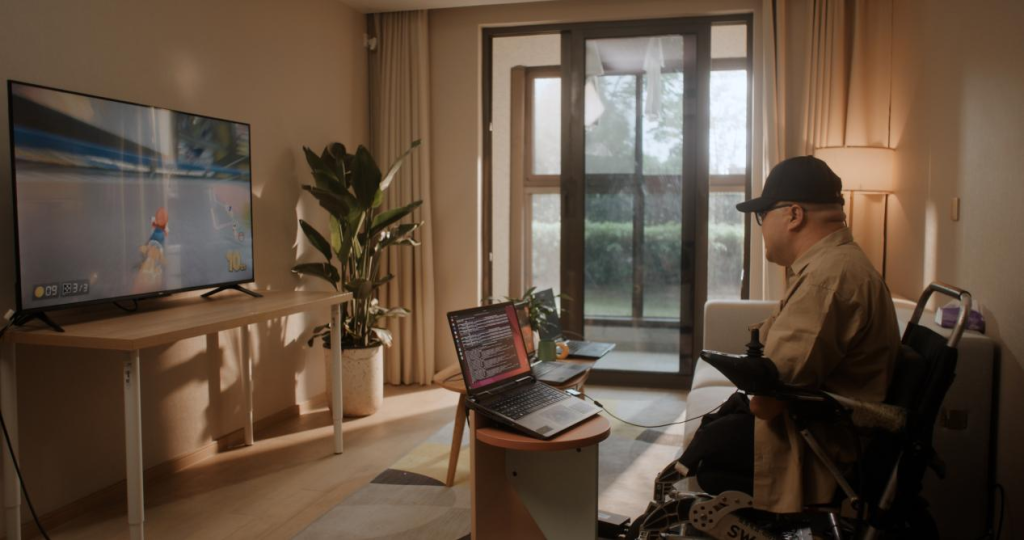
One month after the surgery, the participant played a racing game using brain control. (Photo provided by StairMed)
The subject lost all four limbs in a high-voltage electric shock accident. On March 25 this year, he underwent surgery at Huashan Hospital, affiliated with Fudan University, to implant this brain-computer interface product developed by StairMed. Two flexible electrodes, each only one-hundredth the thickness of a hair, were inserted into his brain through minimally invasive surgery and connected to a coin-sized implant embedded in the skull.
Through this implant, the collected brain signals can be wirelessly transmitted to an external device and converted into operational intentions that a computer can understand. After more than a month of training, the subject has been able to operate a computer through thought, playing racing and chess games.
StairMed's staff told reporters that this is the first prospective clinical trial of an invasive brain-computer interface in China before registration. The company has also become the second invasive brain-computer interface company to enter the clinical stage globally, following Musk's Neuralink.
The subject showed no adverse reactions, and the implanted electrode was stable.
Brain-computer interfaces hold the potential to enable paralyzed subjects to control computers, robotic arms, electric wheelchairs, and other devices. However, achieving more precise control requires the acquisition of a greater amount of more accurate EEG signals. The product in this clinical trial adopts the most beneficial invasive technical approach, which involves directly implanting neural electrodes into the brain.
Zhao Zhengtuo, founder of StairMed and researcher at the Center for Excellence in Brain Science and Intelligence Technology of the Chinese Academy of Sciences, told reporters that compared with Neuralink, which also adopts an invasive approach, StairMed's implant is about half as thin. Therefore, it does not need to penetrate the skull; it only requires a 5-millimeter groove to be "thinned out" on the skull above the brain's motor cortex to embed the device. A small hole is then drilled in the groove to insert the electrode tip into the brain tissue, with a depth of approximately 5-8 millimeters.
To reduce damage to brain tissue, these electrodes need to be made extremely tiny and flexible. Li Xue, founder of StairMed and researcher at the Center for Excellence in Brain Science and Intelligence Technology of the Chinese Academy of Sciences, introduced that the electrodes they use are currently the smallest neural electrodes in the world, with a cross-sectional area only 1/5 to 1/7 of those used by Neuralink.
"These electrodes are extremely thin and can float in the air. The force they generate when bent is similar to the forces between cells, making the brain cells almost 'unaware' of the presence of a foreign object," she said.
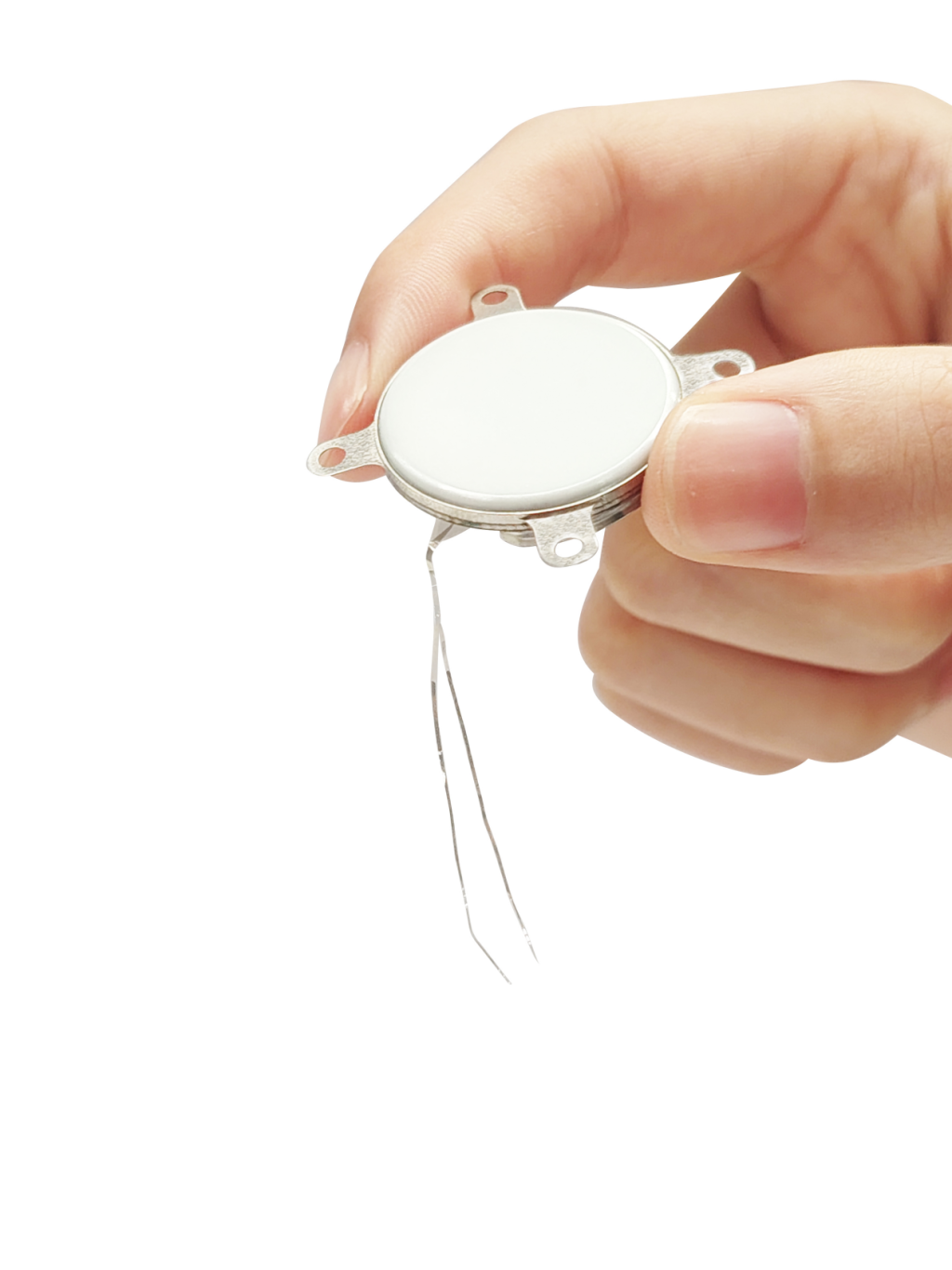
The implant has a diameter of 26mm and a thickness of less than 6mm, making it the smallest brain-control implant in the world, about the size of a coin. The part embedded in the brain is located at the tip of the electrode, which is barely visible to the naked eye. (Photo provided by StairMed.)
The entire surgery lasted about an hour. The subject waited in the hospital for wound recovery and underwent simple training, returning home a week later. Zhao Zhengtuo told The Paper that, so far, the subject has not experienced any adverse reactions after the surgery. "The subject told me that he can't feel the presence of the brain-computer interface after the surgery. However, since the surgical incision on the lower side is connected to the masseter muscle, there was a slight tingling sensation around the scalp wound before full recovery."
The device embedded in the skull is flush with the skull, and after the scalp is sutured, no protrusion can be felt by hand. The device is charged and transmits data wirelessly, eliminating the need for an open wound on the scalp. When in use, simply wear a hat equipped with a receiver.
Unlike devices such as pacemakers that take effect once implanted, as an active control system, brain-computer interfaces require subjects to learn how to control the device with their thoughts, a process similar to imagining moving and performing actions with their limbs. Compared to Neuralink's first-generation product, which has 64 electrodes and 1,024 channels, the system used in this trial, although equipped with only 2 electrodes and 64 channels, collects sufficient signals for effective device control.
"We let the subjects imagine that they have a virtual arm moving left and right, corresponding to the movement of the ball on the computer, establishing a connection in this way. As they continued, they eventually felt as if they forgot about their virtual arm—just by looking at the target position, the ball would move there," said Zhao Zhengtuo.
He stated that in this trial, the subjects will first train to control electronic devices, achieving cursor control on mobile phones, tablets, and computers. The next step is to attempt controlling intelligent devices such as robotic arms and wheelchairs, assisting the subjects in performing operations like grasping in real-life scenarios. The entire training period will last 3 to 6 months.
Slight movement of brain tissue within the skull may cause the electrodes of brain-computer interfaces to dislodge from the brain. According to relevant reports, the first clinical trial participant of Neuralink experienced large-scale electrode displacement and dislodgement after about a month of training and using the brain-computer interface, with a proportion as high as 85%, significantly reducing the acquired signals.
Li Xue said that after the implantation of the brain-computer interface this time, they observed the electrode position for a long time and found no displacement, with stable signal quality. This is because, in their solution, the electrodes are ultra-flexible. Apart from the tip entering the brain tissue, there is a lot of redundant part forming a bend between the skull and brain tissue, which can resist displacement. In addition, since the surgery is minimally invasive, not much air will enter the brain, reducing the airbag effect that causes brain tissue movement.
The product is expected to be launched in 2028.
Unlike clinical research aimed at feasibility and scientific exploration, the purpose of this prospective clinical trial is to truly bring the product to clinical use. Zhao Zhengtuo introduced that the trial was carried out under the guidance of the pharmaceutical supervision system in accordance with the same regulatory requirements as the medical device registration clinical trial, and its results can accelerate the progress of subsequent formal registration.
He indicated that there will be approximately 3 to 4 such prospective clinical trials in total, with an overall follow-up period of around one year to preliminarily verify the product's safety and efficacy. Early next year, StairMed will initiate large-scale, multi-center registration clinical trials, expecting to recruit 30 to 40 subjects. Including the time for recruitment, follow-up, data collection, and registration review, the product is expected to enter the market around 2028.
Since 2004, more than 70 subjects worldwide have undergone invasive brain-computer interface implant surgeries in investigator-initiated clinical studies. From the initial hard electrodes resembling steel needles to today's ultra-flexible electrodes that are barely visible to the naked eye, and from large "plug-like" devices on the skull to coin-sized wireless transmission implants, brain-computer interfaces are gradually becoming a reality.
China’s brain-computer interface research and industry have been accumulating strength for rapid development in recent years. Multiple enterprises and research institutions are actively conducting clinical trials and scientific research. The number of brain-computer interface trials, technical patents, and research achievements in China has risen to the forefront globally. In addition, the formulation of relevant policies and standards is continuously progressing. In March this year, the National Healthcare Security Administration introduced new pricing projects related to brain-computer interfaces, indicating that China’s brain-computer interface technology may enter clinical applications in the near future, truly benefiting subjects with restricted mobility, such as those with high-level paralysis or amputations.
Zhao Zhengtuo said that the brain-computer interface industry is still in its infancy, with broad room for development. In addition to clinical validation, StairMed has also done a lot of work in establishing testing standards, methods, and equipment development. "We hope that through our own exploration, we can set a benchmark for the industry's development and work together with peers at home and abroad to promote the advancement of brain-computer interface technology," he said.
Zhao Zhentuo mentioned that StairMed has achieved independent research, design, production, and testing in all aspects from the front-end electrodes to the back-end systems. "We hope to establish the first MEMS (Micro-Electro-Mechanical Systems) medical device-level production line in China, transforming the front-end electrodes of brain-computer interfaces from a laboratory concept into a mature, reliable, and quantifiably producible product."
It is reported that StairMed is expected to launch its next-generation product in early next year. The product’s throughput will increase fourfold, meeting the control demands of more complex physical terminal devices, while also developing language decoding capabilities.