Janssen's Autoimmune Blockbuster Guselkumab Approved in China for Ulcerative Colitis

Johnson & Johnson
Healthcare Product Manufacturers, Health Service Providers
On May 9, Johnson & Johnson announced that its key drug Guselkumab had been approved by the National Medical Products Administration for the treatment of adult patients with moderately to severely active ulcerative colitis who have had an inadequate response to, lost response to, or were intolerant to conventional therapy or biologics.
This event marks the official entry of China's ulcerative colitis treatment into the interleukin-23 (IL-23) targeted era.
1. The First in China
As the world's first approved fully humanized IL-23 inhibitor, Guselkumab (brand name: TREMFYA®) precisely modulates immune responses through a unique dual mechanism of action: it not only directly binds to the IL-23 cytokine but also targets CD64+ inflammatory cells enriched with IL-23, blocking this core pathogenic factor driving immune-mediated diseases such as ulcerative colitis (UC) at its source.
Today, Guselkumab has been officially approved by the China National Medical Products Administration for the treatment of adult patients with moderately to severely active ulcerative colitis, becoming the first interleukin-23 inhibitor in China for the treatment of ulcerative colitis. In February this year, Guselkumab was approved in China for the indication of Crohn's disease. So far, the drug's approved indications in China now cover psoriasis, Crohn's disease, and ulcerative colitis, forming a broad coverage of IL-23 pathway-related immune diseases.
This approval is based on the pivotal Phase 2b/3 QUASAR study, where Guselimumab demonstrated therapeutic advantages in UC patients with inadequate responses to conventional treatments, other biologics, or JAK inhibitors:
Significant relief of symptoms such as diarrhea and bloody stools was observed in patients during the first week of treatment, with efficacy continuously improving over the 12-week induction period.
In the 44th week of the maintenance treatment phase, 50% of patients in the group receiving 200mg of Guselkumab every 4 weeks reached the primary endpoint of clinical remission at week 44, while 45% of patients in the group receiving 100mg every 8 weeks achieved the same clinical remission, both significantly higher than the 19% in the placebo group (<0.001).
Endoscopic evaluation showed that 34% and 35% of patients in the 200mg and 100mg groups, respectively, achieved complete mucosal healing (MES=0), compared to only 15% in the placebo group reaching endoscopic remission (P<0.001).
Prominent Safety Advantages: The most common adverse reactions (>2%) are respiratory infections, and the incidence of this adverse reaction is higher in the placebo group. In the maintenance study, the most common adverse reactions (>3%) are injection site reactions, arthralgia, and upper respiratory tract infections.
2. Pattern Reconstruction
Ulcerative colitis (UC) is a type of inflammatory bowel disease (IBD) that causes chronic inflammation in the intestines and damages the colonic mucosa. Currently, there is no cure for ulcerative colitis.
Traditional treatments for ulcerative colitis (UC) and Crohn's disease (CD) rely on anti-inflammatory drugs, glucocorticoids, and immunosuppressants, but all have significant limitations. Aminosalicylates (such as 5-ASA) can alleviate mild inflammation but are ineffective at inducing remission in active CD or preventing relapse in inactive CD; glucocorticoids show high short-term efficacy but some patients develop dependency or experience recurrence within a year; immunosuppressants, due to their non-specific mechanisms of action, cause short-term toxicity and long-term health risks, limiting their clinical application.
The advent of biotargeted drugs has ushered in the era of precision treatment. Currently, UC/CD biologics approved in China are divided into three categories:
TNF-α Inhibitors: Inhibit inflammation by blocking TNF receptor binding, but some patients develop resistance after use, requiring frequent changes in treatment plans;
Integrin α4β7 Inhibitors: Bind to the surface of leukocytes, preventing them from passing through tissue layers and exacerbating inflammation, but carry a potential risk of inducing progressive multifocal leukoencephalopathy, with significant safety concerns;
IL-12/IL-23 Inhibitors (e.g., Ustekinumab): Specifically target the Th1/Th17 immune pathways, demonstrating high clinical remission rates while maintaining strong safety profiles, offering the dual advantages of "high efficacy + low safety risk."
The total number of UC and CD patients in China increased from 490,000 in 2018 to 670,000 in 2022, and is expected to reach 1,154,000 by 2030. In recent years, the UC/CD drug market in China has grown rapidly, increasing from US$594 million in 2018 to US$1.051 billion in 2022, and is projected to reach US$5.49 billion by 2030. In 2022, biologics accounted for 13.7% of the UC/CD drug market in China, and this share is estimated to grow to 55.9% by 2030.
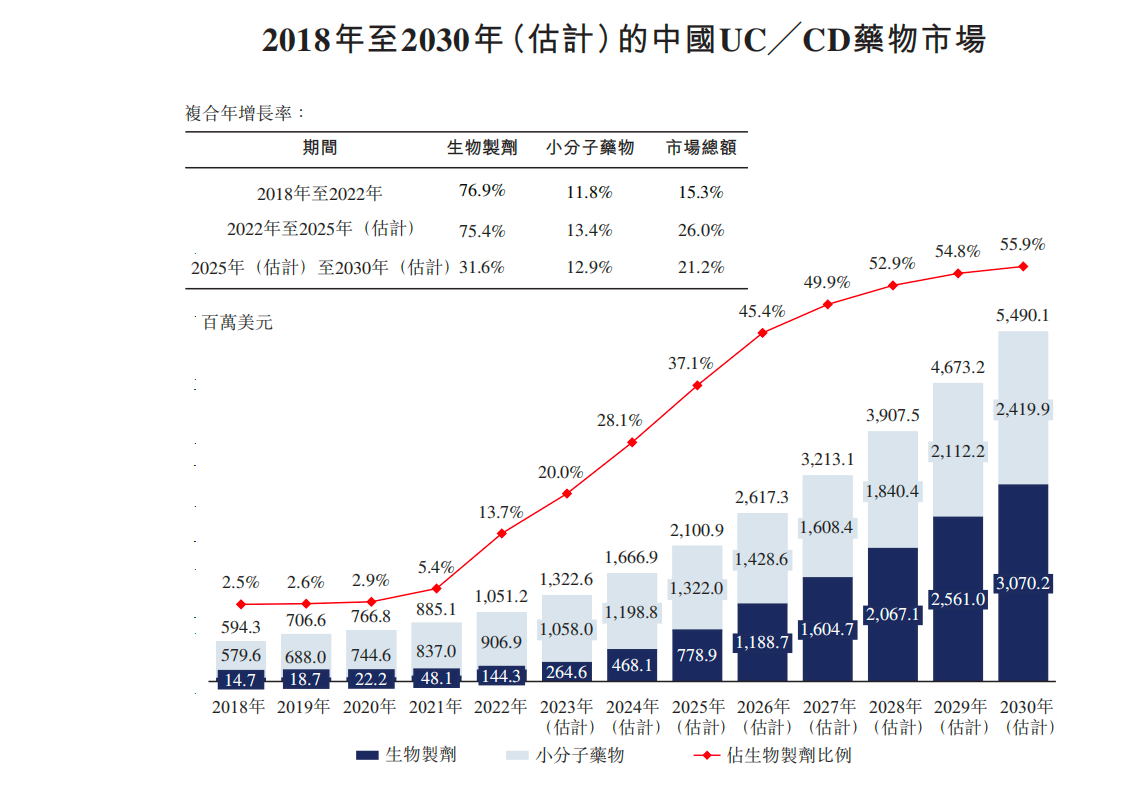
Source of the image: Frost & Sullivan Report
3. Johnson & Johnson's Autoimmune Layout
Autoimmunity business is the core pillar of Johnson & Johnson's pharmaceutical sector, generating $17.828 billion in revenue in 2024, accounting for 31.3% of the pharmaceutical business. Despite a 4.6% decline in sales of its key product Stelara (ustekinumab) to $10.361 billion due to biosimilar competition, the company continues to solidify its industry leadership through a strategy of "product pipeline transition + acquisition of cutting-edge targets."
Johnson & Johnson has built a product portfolio covering multiple indications such as psoriasis, Crohn's disease (CD), and ulcerative colitis (UC), centered around the IL-23/IL-12 pathway.
The flagship product Stelara (Ustekinumab), as the world's first IL-12/IL-23 dual-target inhibitor, has achieved cumulative sales of over 100 billion US dollars since its launch in 2009. In 2023, its sales exceeded 10 billion US dollars for the first time (10.858 billion US dollars). However, due to patent expiration and the impact of biosimilars, sales in 2024 declined by 4.6% year-on-year to 10.361 billion US dollars. Nevertheless, Johnson & Johnson extended its lifecycle by introducing a subcutaneous injection formulation and expanding pediatric indications.
To address the patent cliff, Johnson & Johnson launched Tremfya (Guselkumab), a second-generation IL-23 inhibitor. With its dual mechanism of action (blocking IL-23 and modulating immune cell activity), it achieved differentiation. In 2024, Tremfya was successively approved for Crohn's disease and ulcerative colitis indications, becoming the world’s first drug to head-to-head defeat Ustekinumab in the CD indication. In 2024, Tremfya's sales increased by 16.6% year-over-year to $3.67 billion, and in Q1 2025, it achieved sales of $956 million, showing a significant year-over-year growth of 18.2%. If it maintains a compound annual growth rate of 15%-20%, Tremfya is expected to surpass $6 billion by 2026, becoming the core growth driver of Johnson & Johnson's autoimmune segment.
To address the fierce competition in mature fields such as IL-23 and JAK, Johnson & Johnson has adopted strategies like mergers and acquisitions and in-licensing to deploy differentiated targets. It is expanding into new targets such as TSLP, FcRn, and STAT6, covering a broader range of indications including atopic dermatitis and myasthenia gravis. Meanwhile, it leverages technological innovations such as bispecific antibodies and oral peptides for its strategic layout.
Targeting the compliance pain points of biologics, Johnson & Johnson is accelerating the development of Icotrokinra (JNJ-2113), the world’s first oral IL-23R antagonist. In Phase 3 trials for psoriasis, Icotrokinra achieved a 49.6% PASI 90 response rate at 16 weeks, significantly outperforming BMS's TYK2 inhibitor Sotyktu (36.8%). Its marketing application for psoriasis is expected to be submitted in 2025, with peak sales projected to exceed $5 billion.
Johnson & Johnson's FcRn monoclonal antibody Nipocalimab was launched in the United States in April 2025 for the treatment of myasthenia gravis. The drug met the primary endpoint in the Phase 2 DAHLIAS trial for Sjögren's syndrome. Its peak sales are expected to exceed $5 billion, positioning it as a potential blockbuster product and the next-generation FcRn inhibitor following Efgartigimod.
In the field of bispecific antibodies, in 2024, Johnson & Johnson acquired Proteologix for $850 million, obtaining PX128 (targeting atopic dermatitis and asthma), an IL-13/TSLP bispecific antibody, and PX130 (targeting atopic dermatitis), an IL-13/IL-22 bispecific antibody. PX128 demonstrated the potential to reduce dosing frequency in Phase 1 clinical trials by simultaneously inhibiting the IL-13 and TSLP pathways, which could address the issue of poor compliance associated with traditional monoclonal antibodies. In the same year, Johnson & Johnson spent $1.25 billion to acquire Yellow Jersey, gaining access to NM26, a bispecific antibody targeting atopic dermatitis.
Johnson & Johnson has also introduced KP-723 from Japan's Kaken to layout STAT6 inhibitors, focusing on Th2-mediated inflammatory diseases. It is racing against companies like Sanofi and Kymera in the development of the next generation of oral targeted therapies, further enhancing its coverage in this disease area.
From injectable formulations to oral peptides, from single-target to bispecific antibody platforms, Johnson & Johnson's autoimmune layout represents not only an iteration of its product pipeline but also the integration of technological innovation and clinical needs, redefining the treatment paradigm for autoimmune diseases.
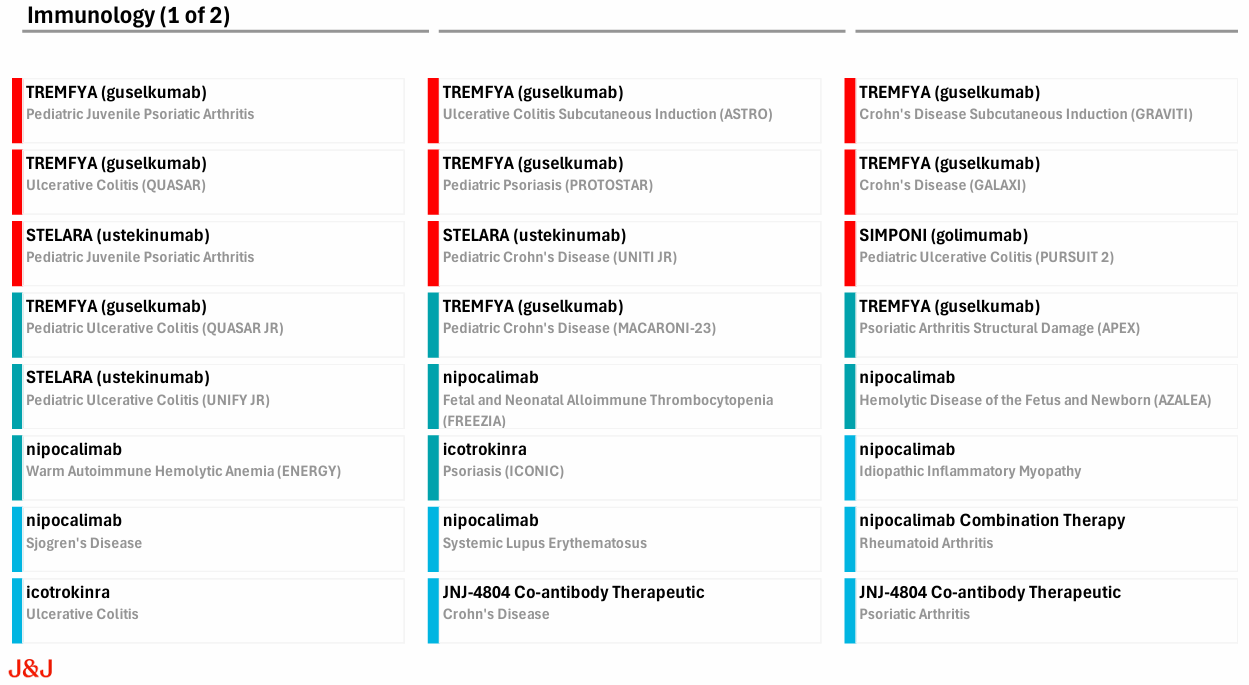
Johnson & Johnson's Partial Autoimmune Pipeline
Source of the image: Johnson & Johnson 2024 Earnings Report
4. Conclusion
Guselkumab Approved for Ulcerative Colitis, Becoming China's First Interleukin-23 Inhibitor for UC Treatment: A Significant Milestone in China’s UC Treatment History
References:
1. Johnson & Johnson Innovative Pharmaceutical Management
2. Quanxin Biotech Prospectus


Editor: Liuli
Disclaimer: The views expressed in this article are solely those of the author and do not represent the position of PharmNet. We welcome exchanges and additional input in the comment section; for reprints, please be sure to credit the author and source. If there are any issues regarding the content, copyright, or other aspects of the work, please leave a message on this platform, and we will address it promptly.