

BeOne
Developer of Molecular Targeted and Immune Anti-Tumor Drugs

AstraZeneca
Biopharmaceutical Manufacturer

Eli Lilly
Global Pharmaceutical R&D and Production Company

On May 16, 2025, it was reported that the UK-based pharmaceutical consulting firm IDEA Pharma released the 2025 Pharmaceutical Innovation Index and Pharmaceutical Invention Index rankings, with Eli Lilly and AstraZeneca topping the two lists respectively.
In the 2025 Pharmaceutical Innovation Index, the TOP10 pharmaceutical companies are Eli Lilly, Merck, AstraZeneca, Roche, Pfizer, Regeneron, UCB, Johnson & Johnson, Novo Nordisk, Novartis, and Vertex Pharmaceuticals; in the Invention Index, the TOP10 pharmaceutical companies are AstraZeneca, Johnson & Johnson, Moderna, Roche, Regeneron, Eli Lilly, Merck, GlaxoSmithKline, Pfizer, BeOne Medicines, and Boehringer Ingelheim. Among them, BeOne Medicines entered the top ten, advancing three places from the previous year; Roche and GlaxoSmithKline advanced 13 and 8 places respectively in the Invention Index ranking.
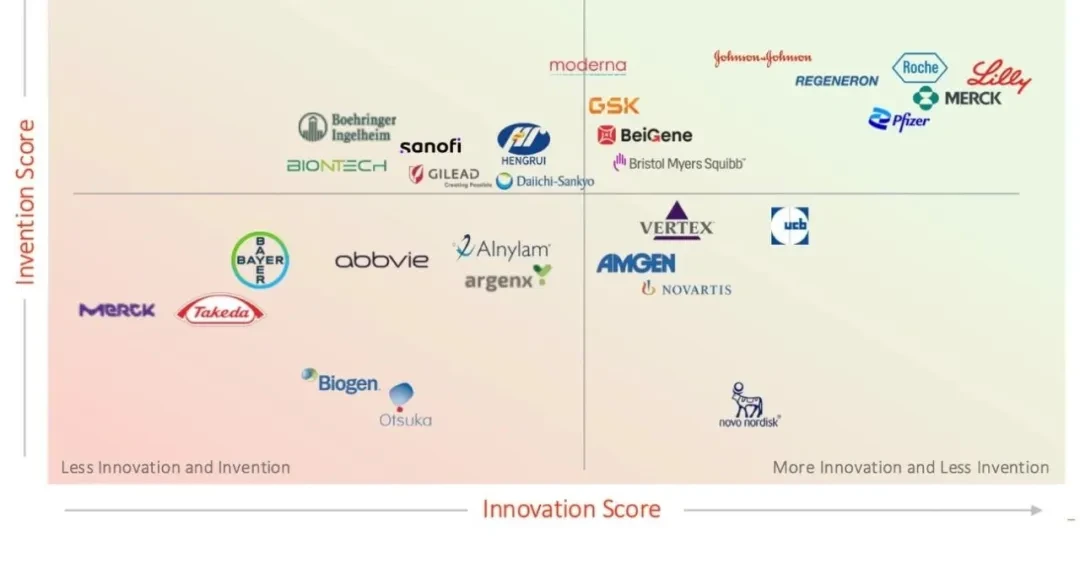
Note: This chart is based on the ranking and scoring of the top 30 companies globally by market value as of January 1, 2025, using these two dimensions.
In the pharmaceutical industry, IDEA Pharma's "Pharmaceutical Innovation and Invention Index" list is known as the "Oscar". It not only measures the innovation capabilities of pharmaceutical companies but also guides the development direction of the industry.
'%20fill='%23FFFFFF'%3E%3Crect%20x='249'%20y='126'%20width='1'%20height='1'%3E%3C/rect%3E%3C/g%3E%3C/g%3E%3C/svg%3E)
Eli Lilly Regains Top Spot in 2025 Pharmaceutical Innovation Index, Last Held in 2021.In 2024, Eli Lilly's total annual revenue reached $45.043 billion, increasing by 32% year-over-year; net profit was $10.59 billion, surging by 106% year-over-year.
Eli Lilly's Return to the Top Influenced by Multiple Key Factors: Zepbound (tirzepatide) Approved as the First Prescription Drug for Treating Moderate to Severe Obstructive Sleep Apnea (OSA) in Adults with Obesity. OSA is a common condition that can lead to various complications, and the approval of Zepbound provides a new treatment option in this field.
Kisunla (donanemab) Approved for the Treatment of Alzheimer's Disease. Alzheimer's disease remains a medical challenge, and Kisunla brings new hope to patients. Its approval represents a significant advancement for Eli Lilly in the development of treatments for neurodegenerative diseases.
In addition, Eli Lilly expanded its immunology portfolio by approving Ebglyss (lebrikizumab) for the treatment of moderate to severe atopic dermatitis and acquiring Morphic Therapeutic. This acquisition strengthens Eli Lilly's pipeline in inflammatory bowel disease by adding oral integrin therapies such as MORF-057, aligning with the company’s broader strategy to address unmet needs in autoimmune diseases.
MSD's innovation index jumped to second place, a significant rise from its tenth position in 2024.At the heart of this success is Keytruda (pembrolizumab), which has achieved breakthroughs across multiple fields. Keytruda leads in clinical data for lung cancer, melanoma, and triple-negative breast cancer, with 10-year survival data for advanced melanoma solidifying its position as the leading PD-1 inhibitor. Keytruda accounts for nearly 50% of Merck's 2024 revenue (over $23 billion), with a research and development investment rate of approximately 20%.
Other pipeline highlights include ADC drugs: zilovertamab vedotin (100% complete response rate in DLBCL), ifinatamab deruxtecan (effective in SCLC); infectious diseases: clesrovimab (over 90% efficacy in RSV prevention, planned FDA approval in July 2025), 21-valent pneumonia vaccine V116; rare diseases: Winrevair approved for pulmonary arterial hypertension. In addition, Keytruda's new adjuvant indication for lung cancer in China has been implemented, EyeBio acquired to expand ophthalmology, and LM-299 introduced to strengthen the oncology pipeline.
In the fierce competition of the 2025 Medicine Innovation Index, AstraZeneca and Roche stood out, tying for third place, while AZ made a strong return to the top spot in the Invention Index.A core driver behind AZ's success is its oncology portfolio, particularly the performance of Imfinzi (durvalumab) across multiple cancers. There’s also Tagrisso (osimertinib), which reduces the risk of death or progression by 84% in stage 3 EGFR-mutant NSCLC following chemoradiotherapy (CRT). Additionally, Enhertu (trastuzumab deruxtecan), an antibody-drug conjugate co-developed and commercialized with Daiichi Sankyo, has shown significant improvement in PFS for HER2-low metastatic breast cancer.
AstraZeneca's success extends to rare diseases, with Fasenra (benralizumab) approved for the treatment of Eosinophilic Granulomatosis with Polyangiitis (EGPA) and Voydeya (danicopan) for the treatment of Paroxysmal Nocturnal Hemoglobinuria (PNH) in the United States and the European Union.
In immuno-oncology, Calquence (acalabrutinib) demonstrated higher PFS in chronic lymphocytic leukemia, while Truqap (capivasertib) showed significant improvement in PTEN-deficient prostate cancer.
Despite setbacks in the TROPION-Breast01 and TROPION-Lung01 Phase 3 trials of Datroway (datopotamab deruxtecan), which failed to meet the overall survival endpoint, AstraZeneca's pipeline remains robust.
In addition, Johnson & Johnson ranked eighth in the 2025 Innovation Index, second in the Invention Index, and made significant progress in oncology, immunology, cardiology, and rare diseases.
Besides, in the fierce competition of the 2025 Medicine Innovation Index,UCB优时比Like a dark horse, it has broken into the top ten for the first time, and its outstanding performance has attracted much attention. This is a concentrated manifestation of its innovative achievements in multiple fields such as inflammation, neuroscience, and rare diseases.
However, some pharmaceutical companies ranked lower in terms of innovation in this list. For exampleBayer, Takeda, Merck。For these pharmaceutical companies, the depth and breadth of their R&D pipelines are crucial. They need to continuously invest in the development of new drugs to maintain their leading position in the fiercely competitive market. Meanwhile, the innovation and market competitiveness of their main products also significantly impact the revenue performance of these pharmaceutical enterprises.
Among them, Bayer's performance in recent years has drawn significant attention from the industry. Bayer’s R&D pipeline mainly focuses on oncology, cardiovascular and renal diseases, neurology and rare diseases, and immunology. In terms of its main products, Bayer holds a certain market share across multiple therapeutic areas. Products in the agricultural sector provide the company with stable revenue; in the pharmaceuticals sector, diabetes drugs like Glucobay once occupied a significant market position but are now facing challenges due to intensifying competition. Some of its cardiovascular drugs are also under competitive pressure from similar products.
In terms of revenue in 2024, although Bayer has a certain scale, its growth is facing challenges. While the prescription drug division continues to invest in R&D, new products have not yet fully translated into significant revenue growth. Sales of some traditional products have declined due to factors such as patent expiration and market competition. For example, some original drugs have seen their market share diluted under the impact of generic drugs, affecting overall revenue performance.
However, with the launch of a series of new products in 2025, such as the approval of darolutamide for new indications, Beyfortus, finerenone, elinzanetant, and other products entering the market, these are expected to inject new momentum into revenue growth. Nevertheless, they will still face the test of fierce market competition.
Some of Takeda's key products, such as Enbrel and Velcade, contribute the majority of the company’s revenue. If these products face market challenges, such as patent expiration, increased competition, or safety issues, the company's performance will be significantly impacted. Therefore, continuous innovation is necessary to reduce reliance on a small number of products.
Moreover, Takeda has also cut multiple projects, including the hot R&D pipeline acquired from Maverick Therapeutics for $525 million. This indicates that Takeda needs to undergo strategic transformation and optimize resource allocation in response to challenges such as market competition and patent expirations. However, this adjustment also means that some of the company’s earlier R&D investments may not yield expected returns. Additionally, focusing on the most promising projects post-adjustment and achieving efficient innovation is a significant pressure for Takeda.
Merck KGaA Faces Challenges from Uneven Business Segment Growth
At the same time, organic sales in the life sciences segment, including scientific and laboratory solutions as well as life sciences services, declined due to uncertainties in research funding and early-stage biotechnology projects, reflecting the indirect impact of the macroeconomic environment on its innovation-driven businesses.
IDEA Pharma's list is divided into the "Pharmaceutical Innovation Index" and the "Pharmaceutical Invention Index." The former focuses on pharmaceutical companies' ability to transform early-stage projects into market-successful new drugs, while the latter emphasizes the quantity and scale of a company’s R&D. For pharmaceutical enterprises, whether at the front end or back end of innovation and invention, continuous investment in innovation and strategic adjustments are key to maintaining competitiveness and market position.