

23andMe
Genomic Sequencing Service Provider
Regeneron
Biopharmaceutical Manufacturer

On May 19, 2025, Regeneron announced plans to acquire 23andMe, the pioneer in genetic testing, for $2.56 billion.. The announcement stated that the company has been designated as the winning bidder for the bankruptcy auction.
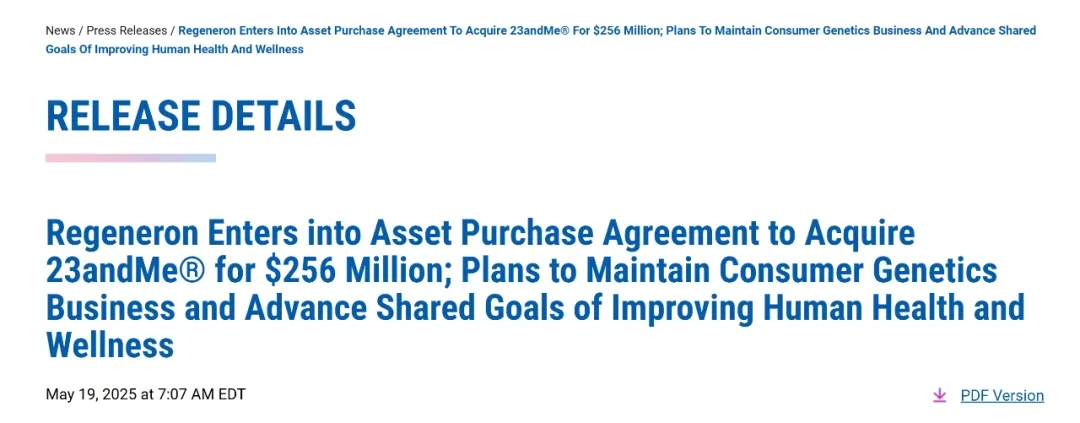
This timeThe acquisition includes 23andMe's Personal Genome Service (PGS), comprehensive health and research service business lines, as well as its biobank and related assets, while 23andMe continues to provide all consumer genomic services.Subject to the approval of the bankruptcy court and regulatory authorities, as well as other customary closing conditions, the transaction is expected to be completed in the third quarter of 2025.
After the acquisition news broke, 23andMe's stock price soared over 100% in pre-market trading. Its long-term downturn may be resolved due to Regeneron's involvement, raising market expectations as financial difficulties are expected to ease. Regeneron's stock price remained relatively stable initially, as while its acquisition strategy was acknowledged, integration risks still linger.
'%20fill='%23FFFFFF'%3E%3Crect%20x='249'%20y='126'%20width='1'%20height='1'%3E%3C/rect%3E%3C/g%3E%3C/g%3E%3C/svg%3E)
23andMe was founded by Anne Wojcicki in 2006. The name comes from the 23 pairs of human chromosomes. It pioneered the field of consumer genetic testing. Users only need to provide a saliva sample to receive a comprehensive DNA report, including ancestry tracing, health risk assessments, and more—such as the likelihood of developing Alzheimer's disease or certain cancers.
In its early entrepreneurial stage, 23andMe quickly gained prominence with its innovative business model. In 2007, the company successfully secured Series A funding with participation from well-known institutions such as Google, New Enterprise Associates (NEA), and Genentech. Since then, its financing journey has been smooth, raising $27.8 million in Series B funding and $31 million in Series C funding, with investors including Johnson & Johnson, MPM Capital, Google, and New Enterprise Associates (NEA).
In 2012, with the completion of a $57.9 million Series D financing round, 23andMe significantly reduced the price of its DNA testing from the initial $999 to $99. This move brought genetic testing services quickly into the public eye, attracting a large number of users.
In 2015, the company completed a $115 million Series E financing round, officially entering the unicorn ranks. In 2017, well-known institutions such as Altimeter Capital, Wallenberg Foundation, and Casdin Capital joined in, completing a $250 million Series F financing round. In 2018, it received a $300 million strategic investment from pharmaceutical giant GlaxoSmithKline. In 2021, 23andMe successfully went public through a merger with a special purpose acquisition company (SPAC), with its market value soaring to $6 billion at one point and its stock price peaking at $300. At its peak, the company had nearly 15 million users, demonstrating extraordinary influence.
However, behind the prosperity lies a crisis. From the financial data, in the fiscal years 2022 to 2024, 23andMe's total revenue was $272 million, $299 million, and $220 million respectively, but the net losses reached $254 million, $314 million, and $667 million respectively, accumulating losses of over $2 billion. In the first three quarters of the fiscal year 2024, the accumulated net loss was $458 million, an increase of 85% year-on-year.
Even raising the service price to $119 in 2024 failed to reverse the losses. To make matters worse, in 2023, a cyberattack led to the leak of genetic data from nearly 7 million users. This incident was like a bombshell, plunging 23andMe into a deep trust crisis. A massive loss of users followed, severely damaging the company’s reputation, and it faced multiple class-action lawsuits, ultimately resulting in a $30 million settlement. Under these compounded blows, in 2024, the company laid off 40% of its workforce and shut down its drug research and development division. The once-mighty gene testing giant has edged closer and closer to bankruptcy. (Related report: "Gene Testing Giant 23andMe Goes Bankrupt, Data Security of 15 Million Customers' Genetic Information in Jeopardy》)
Regeneron's announcement shows that 23andMe will operate as its wholly-owned direct or indirect subsidiary and continue to provide personal genomics services. Regeneron’s acquisition does not include 23andMe’s Lemonaid Health business. Additional details regarding the company’s operational plans will be shared upon completion of the transaction.
23andMe’s 15-million-user genetic database is its most core asset. Regeneron has accelerated its layout in gene therapy in recent years. Its VelociSuite platform relies on precise gene target discovery, and massive consumer-level data can expedite the drug development pipeline. For instance, Regeneron's CRISPR therapy collaboration with Mammoth Biosciences requires broader support from genetically diverse data.
Notably, Regeneron has acquired several companies specializing in gene delivery technologies (such as Oxular's ophthalmic therapies and Decibel's hearing loss treatments) but lacks a direct consumer-facing entry point. 23andMe's consumer genetic testing network can provide an entry point for patient recruitment, disease screening, and personalized medicine, forming a closed-loop of "data-driven R&D - precision treatment - market promotion."
Acquiring a company once valued at $6 billion for $256 million, the cost is only 4% of its peak value. Regeneron has the option to retain core assets (such as databases, patents) and divest loss-making businesses (such as the telemedicine platform Lemonaid). Additionally, the bankruptcy process can help Regeneron avoid potential debt disputes.
However, the shadow of 23andMe's data breach has not dissipated, and Regeneron needs to rebuild user trust. The California Attorney General has urged users to delete their data, and future data usage may face stricter regulations. Additionally, there are significant differences between the business models of consumer genetic testing and pharmaceutical research and development. Regeneron must convert 23andMe's ancestry analysis technology into medical-grade data and ensure it meets clinical trial standards.
From the industry's overall perspective, companies like Ancestry and Color Health are still competing for the consumer genetic market, while pharmaceutical giants such as Novartis and Roche are building their own genetic databases. Regeneron needs to quickly demonstrate the synergies of this deal.
It can be seen that Regeneron's acquisition marks a shift in the pharmaceuticals industry from "drug development" to "data ecosystem" competition. 23andMe's database could become the cornerstone of the next generation of gene therapies — for example, designing drugs targeting rare disease mutation sites or predicting disease risks through population data analysis. However, the success of this high-stakes bet depends on whether Regeneron can transform data into real clinical breakthroughs.