

AlphaFold3: A Diffusion-Based Breakthrough for Predicting Biomolecular Complex Structures

DeepMind
Artificial Intelligence Enterprises

Isomorphic Labs
AI Drug Developer
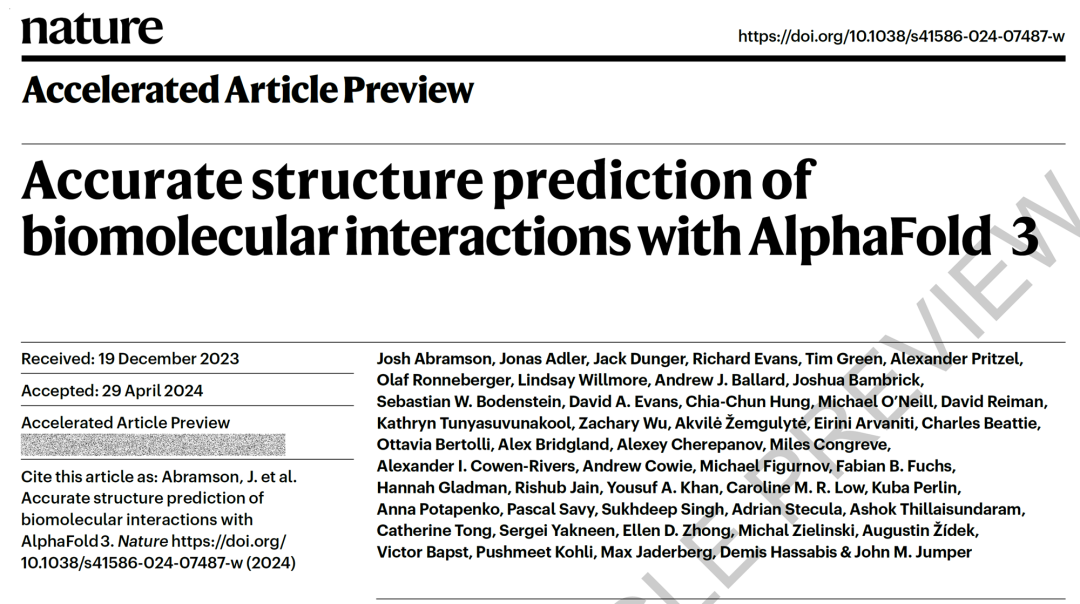
The structural prediction/parsing of complexes can help people understand cellular mechanisms and aid in the development of manipulation and disease treatment strategies [1].
Recently, Nature reported AlphaFold3, developed by researchers John Jumper and Demis Hassabis from DeepMind, as well as Max Jaderberg from Isomorphic Labs. Compared to AlphaFold2, AlphaFold3 has been upgraded to a diffusion model.(diffusion model)The new architecture(Mainly to enhance the flexibility of structural prediction and improve the versatility of this tool), as well as the lateral composite interaction interface(interface)The training has achieved: surpassing existing standard tools(AutoDock Vina, etc.)Better prediction of protein-small molecule binding(docking)、Better prediction of protein-nucleic acid binding structures than professional tools、Significantly improved protein interactions compared to AlphaFold-Multimer2.3(Especially antigen-antibody binding)The ability to predict structures, as well as structural predictions of protein glycosylation modifications [1]–[3].
'%20fill='%23FFFFFF'%3E%3Crect%20x='249'%20y='126'%20width='1'%20height='1'%3E%3C/rect%3E%3C/g%3E%3C/g%3E%3C/svg%3E) AlphaFold3 Upgrades to New Architecture Based on Diffusion Model [1], [2].
AlphaFold3 Upgrades to New Architecture Based on Diffusion Model [1], [2].
AlphaFold3 can universally and more accurately predict protein-small molecule docking, protein glycosylation modifications, protein-nucleic acid interactions, and protein-protein interactions compared to other tools [1].
This work was published in Nature on May 8, 2024 [1].
Comment(s):
AlphaFold3's structural prediction of complexes is still in a very preliminary stage, especially the accuracy of predicting interfaces for protein-protein and protein-nucleic acid interactions still needs further improvement.
Moreover, given that AlphaFold3's structural prediction capability rapidly saturates with training and performs poorly in predicting dynamic structures of complexes, improving its protein interaction structural prediction to a practical level may not be a problem that can be solved simply by increasing the amount of training data from static complex experimental structures. After all, protein interactions are not solely determined by potential interaction interfaces but are also influenced by the structural states prior to binding [4]. The future might require furtherCombining cryo-electron microscopy, molecular dynamics simulations, and further new technologies to analyze the dynamic processes of protein binding/interaction, and using these dynamic process movies to train protein complex structure prediction models, thereby achieving better prediction performance.。
AlphaFold3's ability to predict the interface structure of complexes rapidly saturates with training; and it performs poorly in predicting the dynamic structures of complexes [1].
https://scholar.google.com/citations?user=a5goOh8AAAAJhttps://scholar.google.com/citations?user=dYpPMQEAAAAJhttps://scholar.google.com/citations?user=JeZoMicAAAAJ