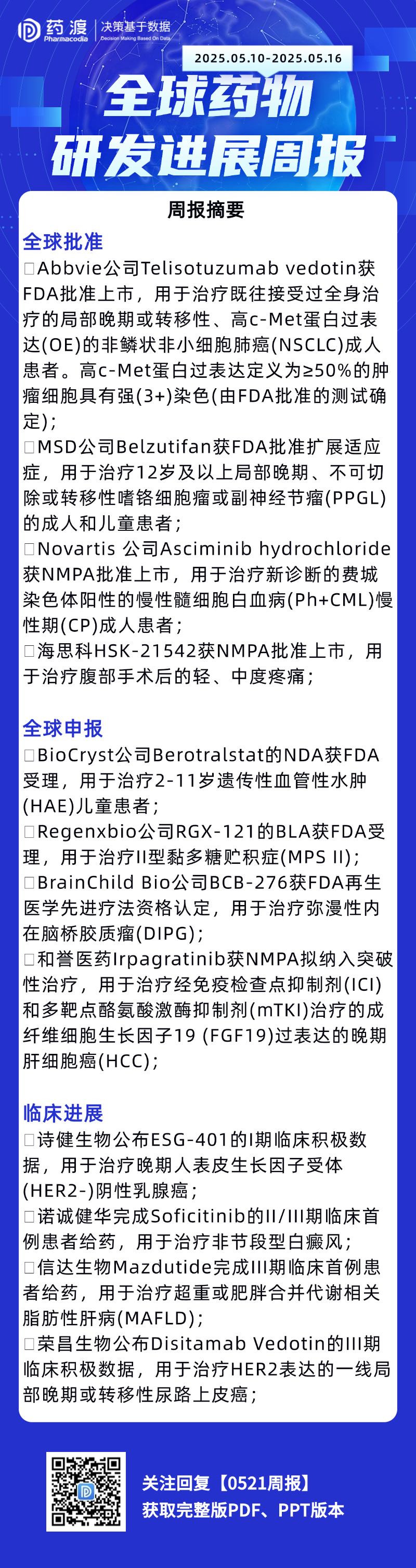
Global Drug Approvals/R&D UpdatesGlobal New Drug ApprovalsAccording to the PharmaBlock data statistics analysis, during this statistical period (May 10, 2025 - May 16, 2025), a total of 4 new drugs were approved for marketing globally (excluding China). Among them, there was 1 BLA approval and 3 new indication approvals. Compared with the previous statistical period, this cycle saw an increase of 1 newly approved drug.'%20fill='%23FFFFFF'%3E%3Crect%20x='249'%20y='126'%20width='1'%20height='1'%3E%3C/rect%3E%3C/g%3E%3C/g%3E%3C/svg%3E) On May 15, AbbVie announced that the FDA had granted accelerated approval for Emrelis (Telisotuzumab Vedotin, Teliso-V) to treat adult patients with locally advanced or metastatic non-squamous non-small cell lung cancer (NSCLC) characterized by high c-Met protein overexpression (OE), who have previously received systemic therapy. High c-Met protein overexpression is defined as ≥50% of tumor cells showing strong positive (3+) staining, as determined by an FDA-approved test. Analysis showed that the overall response rates for patients with high and moderate c-Met expression were 35% and 23%, respectively. The mDoR for high and moderate c-Met expression patients was 9 months and 7.2 months, respectively, while the mOS was 14.6 months and 14.2 months, respectively. The safety profile was consistent with previous results and demonstrated good tolerability.On May 16, MSD announced that the FDA had approved its oral hypoxia-inducible factor-2α (HIF-2α) inhibitor Welireg (Belzutifan) for the treatment of adult and pediatric patients aged 12 years and older with locally advanced, unresectable, or metastatic pheochromocytoma or paraganglioma (PPGL). This approval was primarily based on data from the single-arm LITESPARK-015 clinical trial. The primary efficacy endpoint for treating advanced PPGL was the Objective Response Rate (ORR) assessed by Blinded Independent Central Review (BICR) according to RECIST v1.1. Other efficacy endpoints included duration of response and time to response.
On May 15, AbbVie announced that the FDA had granted accelerated approval for Emrelis (Telisotuzumab Vedotin, Teliso-V) to treat adult patients with locally advanced or metastatic non-squamous non-small cell lung cancer (NSCLC) characterized by high c-Met protein overexpression (OE), who have previously received systemic therapy. High c-Met protein overexpression is defined as ≥50% of tumor cells showing strong positive (3+) staining, as determined by an FDA-approved test. Analysis showed that the overall response rates for patients with high and moderate c-Met expression were 35% and 23%, respectively. The mDoR for high and moderate c-Met expression patients was 9 months and 7.2 months, respectively, while the mOS was 14.6 months and 14.2 months, respectively. The safety profile was consistent with previous results and demonstrated good tolerability.On May 16, MSD announced that the FDA had approved its oral hypoxia-inducible factor-2α (HIF-2α) inhibitor Welireg (Belzutifan) for the treatment of adult and pediatric patients aged 12 years and older with locally advanced, unresectable, or metastatic pheochromocytoma or paraganglioma (PPGL). This approval was primarily based on data from the single-arm LITESPARK-015 clinical trial. The primary efficacy endpoint for treating advanced PPGL was the Objective Response Rate (ORR) assessed by Blinded Independent Central Review (BICR) according to RECIST v1.1. Other efficacy endpoints included duration of response and time to response.New Drug Approvals Worldwide (Excluding China)
Global New Drug Submission ProgressAccording to the PharmaBlock data analysis, during this statistical period (May 10, 2025 - May 16, 2025), there were a total of 4 new drug applications for marketing approval globally (excluding China). Among them, 3 were NDA submissions and 1 was a BLA submission. Compared with the previous statistical period, there were 2 additional NDA/BLA submissions in this period.。On May 14, REGENXBIO announced that the FDA had accepted its BLA for Clemidsogene Lanparvovec (RGX-121) for the treatment of Mucopolysaccharidosis Type II (MPS II). Trial results showed that cerebrospinal fluid D2S6 levels in patients treated with RGX-121 decreased by an average of 86%. Among patients receiving the recommended dose during the pivotal trial phase, 80% did not require standard intravenous enzyme replacement therapy at their latest follow-up.According to the PharmaDJ data analysis, during this statistical period (May 10, 2025 - May 16, 2025), there was one drug granted special regulatory designation globally (excluding China). Among them, there was one biologic drug. Compared with the previous statistical period, the number of drugs granted special regulatory designations decreased by four in this period.On May 15, BrainChild Bio announced that its autologous CAR-T cell therapy targeting B7-H3 has been granted Regenerative Medicine Advanced Therapy (RMAT) designation by the FDA for the treatment of Diffuse Intrinsic Pontine Glioma (DIPG). The use of regenerative medicine, particularly Chimeric Antigen Receptor T-cell (CAR-T) therapy, holds the potential to overcome obstacles faced by other drug therapies in treating Diffuse Intrinsic Pontine Glioma (DIPG). The approach of B7-H3 CAR-T cell therapy has been successfully implemented, with promising overall survival benefits observed in brain tumor patients during the BrainChild-03 Phase I trial conducted at the Seattle Children's Research Institute.Globally Recognized Drugs with Special Regulatory Designations
Global New Drug Development ProgressAccording to the PharmaDJ data statistics analysis, during this statistical period (May 10, 2025 - May 16, 2025), there were a total of 45 updates on the global (excluding China) new drug clinical R&D status, involving oncology, neurological disorders, infections, andA total of 13 fields, including digestive system diseases.Among them, the clinical progress updates in the field of oncology ranked first among all fields, with a total of 12 updates, including 3 for chemical drugs, 8 for biologics, and 1 for vaccines.On May 14, Pasithea Therapeutics announced the initiation of an open-label Phase I/Ib study to evaluate the safety, tolerability, pharmacokinetics (PK), and pharmacodynamics (PD) of PAS-004 in symptomatic, surgically ineligible adult patients with Type 1 Neurofibromatosis (NF1). The study will also assess preliminary anti-tumor activity and help determine the recommended dose for subsequent Phase II trials.On May 15, Cytokinetics announced positive topline results from the Phase III MAPLE-HCM clinical trial. Analysis showed that its investigational small molecule inhibitor Aficamten monotherapy demonstrated superior efficacy compared to existing standard treatments in symptomatic patients with obstructive hypertrophic cardiomyopathy (HCM). The analysis indicated that MAPLE-HCM met its primary endpoint, with Aficamten showing a statistically significant advantage over the active comparator in improving peak oxygen uptake from baseline to week 24. In the MAPLE-HCM trial, Aficamten also exhibited a better safety and tolerability profile compared to the control group.Global New Drug Development Progress Details (Partial)
Global Pharmaceutical Transaction EventsThis statistical cycle(2025.05.10-05.16)There were a total of 28 pharmaceutical transaction events globally (including China), involving drug rights transfers, company acquisitions, and other transaction events.
Summary Table of Global Pharmaceutical Transaction Times (Partial)
Drug Approval/Development Updates in ChinaNew Drug Approvals in ChinaAccording to the statistical analysis by PharmaDJ, the current statistical period (2025.05.10-05.16)In China, a total of 5 new drugs were approved for marketing by the NMPA, among which 3 were approved via NDA, 1 via BLA, and 1 for a new indication. Compared with the previous statistical cycle, the number of newly approved drugs decreased by 8 in this cycle.
On May 14, Novartis' innovative drug Scemblix® (asciminib hydrochloride tablets) was approved by the NMPA for the treatment of newly diagnosed Philadelphia chromosome-positive chronic myeloid leukemia (Ph+CML) in the chronic phase (CP) in adult patients. Trial results showed that, in newly diagnosed patients, compared with first- or second-generation TKI treatment regimens, the proportion of patients receiving asciminib who achieved MMR at week 96 significantly increased compared to the control group (74.1% vs 52.0%). In terms of the rate of response, the median time to achieve MMR for patients treated with asciminib was only 24 weeks, which was 12-24 weeks shorter than the control group. The DMR achievement rate was twice that of the control group, fully demonstrating the superior efficacy of asciminib in achieving faster and deeper remission.On May 16,北海康成 (Canbridge Pharma) announced that the injection of velaglucerase beta (Gornine) was approved for marketing by the NMPA. Gornine is the first domestically developed enzyme replacement therapy in China for the long-term treatment of Type I and Type III Gaucher disease in patients aged 12 years and older, classified as a Class 1 innovative drug. It can fully replace similar imported products and will significantly improve the availability of medication for patients in China. Data from pivotal clinical trials showed that both the 60U/kg dose group and the lower 30U/kg dose group successfully achieved their primary efficacy endpoint, which is the mean percentage reduction in spleen volume from baseline after 9 months of treatment.New Drug Approvals in China (Partial)Progress of Clinical Tacit Consent for New Drugs in ChinaAccording to the PharmaBlock data statistics analysis, the statistical period for this report is from May 10, 2025, to May 16, 2025.) A total of 22 new drugs received clinical tacit approval in China, involving 26 application numbers.Among them, there are 7 chemical drugs, 12 therapeutic biological products, and 3 preventive biological products.Compared with the last statistical period, this time there was a reduction of 16 clinical tacit approval acceptance numbers.
This Week's Progress on Clinical Trial Approvals for New Drugs in China (Partial)
Progress of New Drug Applications in ChinaAccording to the PharmaBlock data analysis, during this statistical period (May 10-16, 2025), there were 8 new drug applications for marketing in China, involving 17 acceptance numbers. Among them, 4 were chemical drugs and 4 were therapeutic biological products. Compared with the previous statistical period, this period saw an increase of 13 acceptance numbers for new drug applications for marketing.。
New Drug Clinical Launch Status in ChinaAccording to the data analysis by PharmaDJ, during this statistical period (May 10-16, 2025), a total of 40 new drug clinical trial applications were filed in China, involving 56 application numbers. Among them, there were 21 chemical drugs, 18 therapeutic biologics, and 1 preventive biologic. Compared with the previous statistical period, this period saw an increase of 16 clinical trial application numbers.
Clinical Trial Applications for New Drugs in China (Partial)According to the PharmaBlock data statistics analysis, the statistical cycle for this period (2025.05.10-05.16)There are a total of 5 in ChinaDrug ApprovalNMPASpecial Qualification Recognition. Among them, Chemical Drug 3Two biologics. The number of drugs granted special status by the NMPA in this statistical cycle remained the same as the previous one.
On May 16, the latest announcement on the CDE official website indicated that the injection of Lukansatuzumab submitted by Kelun-Biotech is proposed to be included in the priority review. It is intended for adult patients with unresectable locally advanced or metastatic hormone receptor-positive (HR+) and human epidermal growth factor receptor 2-negative (HER2-) breast cancer who have previously received endocrine therapy and other systemic treatments at the advanced or metastatic stage. Among the 38 evaluable patients treated with SKB264 at a dose of 5mg/kg Q2W, the ORR was 36.8%, the DCR was 89.5%, the median DOR was 7.4 months, the 6-month DoR rate was 80%, the median PFS was 11.1 months, and the 6-month PFS rate was 61.2%. The drug demonstrated controllable safety and promising anti-tumor activity in the trial.On May 16, the CDE website showed that ABSK-011 capsule (Ipagotinib) from Shanghai Hebao BioPharmaceuticals was proposed to be included in the breakthrough therapy category. The indication is: advanced hepatocellular carcinoma (HCC) with fibroblast growth factor 19 (FGF19) overexpression treated with immune checkpoint inhibitors (ICI) and multi-target tyrosine kinase inhibitors (mTKI). The latest clinical trial data results of Ipagotinib combined with Atezolizumab for treating advanced hepatocellular carcinoma patients, which are about to be announced, demonstrate that this combination therapy has good safety and significant anti-tumor activity. The significant progression-free survival benefit further highlights the development potential of FGFR4 inhibitor-based combination therapies in both ICI-treated and untreated patients.NMPAProgress on Special Drug Designation
Progress in New Drug Development in ChinaAccording to the data analysis by PharmaDJ, during this statistical period (May 10-16, 2025), there were a total of 13 updates on the clinical R&D status of new drugs in China, covering seven fields including oncology, nutritional and metabolic diseases, hematological and lymphatic system diseases, and respiratory diseases. Among these updates, five were for chemical drugs, six for biologics, and two for cell therapies. Compared with the previous statistical period, there were seven additional updates on the clinical R&D status of new drugs in China.
On May 12, CARsgen Therapeutics announced preliminary clinical data for CT0596 in the treatment of relapsed/refractory multiple myeloma (R/R MM) or relapsed/refractory plasma cell leukemia (R/R PCL): five patients have completed the first efficacy evaluation at week four, with three showing an overall response reaching stringent complete response/complete response (sCR/CR), and four achieving bone marrow minimal residual disease (MRD) negativity; two patients obtained early efficacy observation data on day 14, with measurable lesion reductions of over 92% and 65%, respectively. Patients demonstrated good overall tolerance, and all sCR/CR patients are in continued remission.On May 13, Zhengda Tianqing announced in the oncology journal under The Lancet the key Phase III clinical trial results of Anlotinib Hydrochloride Capsules (Fukexi®) combined with Penpulimab Injection (Anliko®) as first-line treatment for advanced hepatocellular carcinoma (HCC). The study showed that this treatment regimen reduced the risk of disease progression by 48% and the risk of death by 31% compared to the control group. Both primary endpoints, PFS and OS, achieved positive results, with a median PFS of 6.9 months and a median OS of 16.5 months. Subgroup analysis indicated that the combination of Anlotinib and Penpulimab demonstrated more significant benefits in populations with major vascular invasion and baseline AFP ≥400 ng/mL.Progress in New Drug Development in China (Partial)
Policy and Regulatory Updates in China's New Drug Development FieldNotice on Publicly Soliciting Opinions for the "Technical Guiding Principles for Writing Risk Management Plans During the Development of Innovative Drugs (Draft for Comments)"To guide applicants in standardizing the writing of risk management plans during the development of innovative drugs, the Drug Evaluation Center has organized the drafting of the "Technical Guidance Principles for Writing Risk Management Plans During the Development of Innovative Drugs." After internal discussions within the center, a draft for public comment has been formed.We sincerely welcome valuable opinions and suggestions from all sectors of society on the draft for comments, and please provide timely feedback to us for subsequent improvements. The comment solicitation period is 1 month from the date of publication.Hot News in China's New Drug Development FieldAstraZeneca's Open StrategyAstraZeneca has turned around.Recently, AstraZeneca announced that it will officially exit the neuroscience research and development field, prioritizing core therapeutic areas such as weight loss and immunology.The shift in focus not only means AstraZeneca is concentrating resources on high-potential fields and rebuilding its growth engine, but also reconstructing its core competitiveness.More information, read the original text
FcRn Target Forms a Triumvirate, Johnson & Johnson's $6.5 Billion Acquisition to ReinvigorateRecently, Johnson & Johnson announced that its FcRn monoclonal antibody Nipocalimab (brand name: Imaavy) has been approved by the FDA for marketing. It is used to treat generalized myasthenia gravis (gMG) in patients aged 12 years and older who are autoantibody-positive (positive for anti-acetylcholine receptor [AChR], anti-muscle-specific tyrosine kinase [MuSK], or anti-low-density lipoprotein receptor-related protein 4 [LRP4]).Nicalimab is a high-affinity, fully human, glycosylated, effector-null, pH-insensitive IgG1 monoclonal antibody that selectively blocks the neonatal Fc receptor (FcRn) to reduce the levels of circulating immunoglobulin G (IgG) antibodies, including pathogenic autoantibodies and alloantibodies.More information, read the original textLittle D Has Something to Say
For the convenience of readers to read and save, we have organized the original weekly report into a PDF version. If you need to obtain the full text, you can click on the blue words at the top.PharmSnap DailReply "0521 Weekly Report" in the official account backstage to download.