

Field Medical, Founded by 'Father of PFA' Steven Mickelsen, Files IPO Prospectus Following $40M Series A Round

Field Medical
Developer of Pulsed Electric Field Catheter Ablation Technology
In today's rapidly advancing medical technology landscape, Pulsed Field Ablation (PFA) is gradually becoming a focal point in the field of arrhythmia treatment. Recently, Field Medical announced the completion of a $40 million Series A financing round (approximately RMB 280 million). This round of funding, composed of new capital and seed-round debt conversion, will be used to advance research and commercialization of the PFA system for treating VT (ventricular tachycardia) and AFib (atrial fibrillation).
Field Medical was founded in 2022 by Steven Mickelsen, who is known as the "Father of PFA." As a leader in introducing pulsed field ablation (PFA) technology for patient treatment, he previously established FARAPULSE and successfully launched the first-generation PFA technology, which was acquired by Boston Scientific for over $460 million. After successfully advancing the development of the first-generation PFA technology, Steven Mickelsen embarked on a new journey by founding Field Medical, focusing on the development of improved PFA technology.
1Rapid and precise ablation, PFA technology widely used in clinical applications for atrial fibrillation and tumors
PFA Technology, or Pulsed Field Ablation Technology, is a non-thermal ablation technology based on the principle of irreversible electroporation (IRE). Its working principle involves applying high-voltage pulsed electric fields to cell membranes, causing irreversible electroporation in the cell membrane and thereby achieving tissue ablation. The emergence of this technology stems from the need to optimize traditional arrhythmia treatment methods.
Traditional treatments for arrhythmia mainly include radiofrequency ablation and cryoablation. Although these technologies are widely used in clinical practice, they have certain limitations. In contrast, PFA technology shows significant advantages due to its unique mechanism of action.
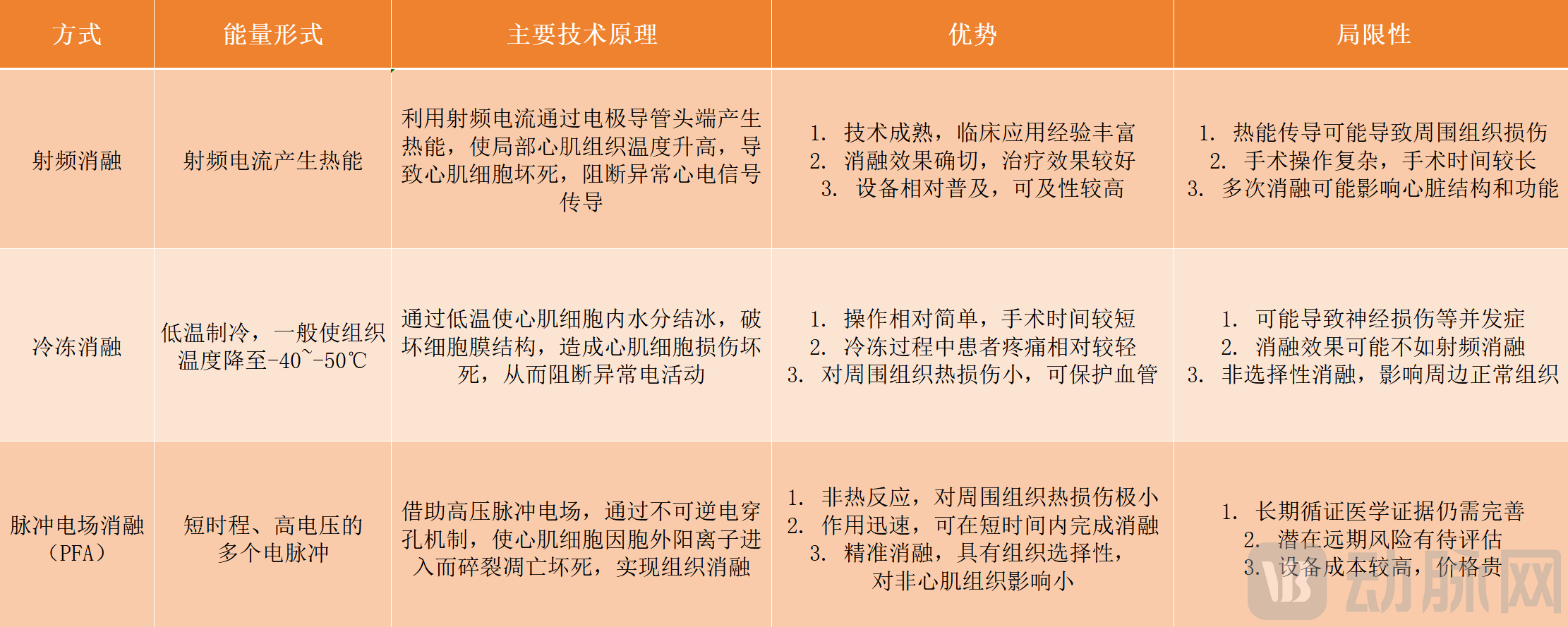
Comparison of Main Ablation Techniques
Compared with traditional technologies, PFA demonstrates significant tissue selectivity, precisely targeting myocardial cells while minimizing damage to surrounding non-target tissues. Additionally, PFA offers higher procedural efficiency, significantly reduces operation time, and involves relatively simple manipulation with a lower learning curve for operators, thereby decreasing procedural complexity and risk.
Currently, PFA technology has been widely used in the treatment of arrhythmias such as atrial fibrillation. In December 2023, Medtronic's PFA product was the first to receive FDA approval, followed by Boston Scientific's PFA product gaining approval in January of the following year. With leading companies' products being approved one after another, 2024 has become the first year of commercialization for PFA in the United States, with international giants accelerating their market layout. PFA products from Boston Scientific, Medtronic, Johnson & Johnson, and other companies are rapidly being launched in global markets. Boston Scientific’s Q3 2024 data shows that its PFA product, the Farapulse system, has driven growth in electrophysiology business procedures, with sales increasing by 177% year-over-year.
In addition, PFA technology is also applied in the treatment of solid tumors such as liver cancer, lung cancer, pancreatic cancer, and prostate cancer. This article will not delve into further interpretation.
2The only contact force PFA catheter optimized for ventricles
Among the many companies developing PFA technology, Field Medical's FieldForce system is the world's first pulsed field ablation system specifically designed for the treatment of persistent monomorphic scar-related ventricular tachycardia (VT). Its core components include a catheter and an energy generator. The system offers a new option for the treatment of complex ventricular arrhythmias with its innovative FieldBending patented technology and optimized contact force technology.
FieldBending Technology Ultra-Targeted Energy Focusing.The catheter tip of the FieldForce system adopts proprietary FieldBending technology, which features an ultra-targeted energy focusing mechanism. Traditional technologies in the past often suffered from energy diffusion during treatment, affecting surrounding healthy tissues, whereas this technology effectively avoids that issue. When the catheter comes into contact with cardiac tissue, FieldBending technology predictably delivers power precisely to the tissue surrounding the catheter, significantly reducing unwanted far-field effects and thereby improving efficiency. In clinical practice, this feature not only enhances the accuracy of treatments but also allows energy to penetrate deeper into tissues, achieving a broader ablation range.
Dual Mechanism Optimizes Contact Force.During the treatment process, the contact force between the catheter and tissue directly affects the efficacy of PFA. Optimizing the contact force can increase lesion depth and is a key factor in ensuring effective contact between the electrode and tissue. The FieldForce catheter stands out in contact force optimization. Its design fully considers the matching mechanism with the energy generator, laying a solid foundation for excellent contact force performance from the starting point of energy transmission. Additionally, the innovative FieldBending technology plays a significant role. By precisely controlling the electric field distribution, the catheter can automatically adjust the contact force based on specific tissue conditions when in contact with the tissue, achieving precise effects. Through these optimization measures, the FieldForce catheter has, to a certain extent, enhanced the contact force effect, significantly improving the stability and safety of the treatment.
Bipolar Pulse Electrode Enhances Treatment Tolerance.The catheter's fluid lumen is equipped with a unique electrode, and its distal end features a non-conductive tip design. Paired with an external electrode, it forms a bipolar circuit. During operation, voltage is transmitted through the internal and external electrodes, generating a specific electric field. The direction of the electric field assists in stabilizing the catheter’s contact with the tissue. Through in-depth optimization of electrode configuration, the FieldForce system significantly enhances current concentration and targeting, enabling more efficient utilization of the electric field. Additionally, this design effectively suppresses patient discomfort or muscle twitching caused by far-field stimulation, improving treatment tolerance and providing patients with a better therapeutic experience.
The energy generator matches precisely with the catheter.The system catheter adopts a pulsed wave design, capable of penetrating the endocardium to reach the epicardium, achieving transmural full-layer focal pulsed field ablation. The energy generator and catheter are highly compatible in design, providing stable and efficient energy output to ensure precise targeting of the electric field on the target tissue, enhancing the treatment capability for complex ventricular arrhythmias. When treating patients with ventricular arrhythmias caused by special lesions, the stable and precise energy output enables more effective ablation therapy targeting the lesion, improving treatment outcomes and meeting unmet needs in the current arrhythmia treatment field.
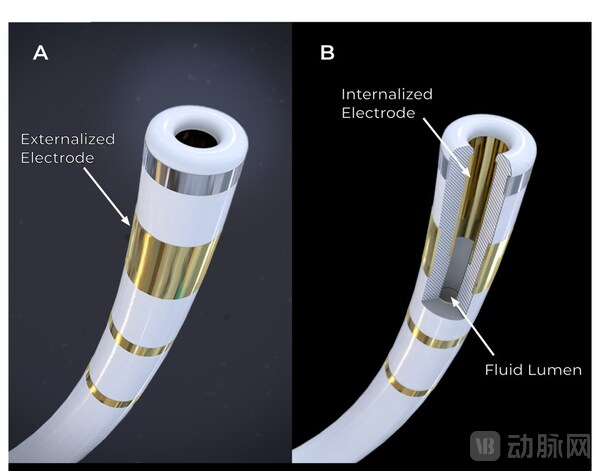
FieldForce™ Catheter Tip (A); FieldBending™ Technology in Cross-Section (B) Source: Field Medical Official Website
Currently, the FieldForce catheter is the first and only contact-force PFA catheter optimized for ventricular use, with the first-in-human study having been initiated in May 2024. Regarding the preliminary trial data, Professor Vivek Reddy, the principal investigator from the Icahn School of Medicine at Mount Sinai in New York, stated that although the current findings are preliminary, the system shows significant potential to revolutionize the field of catheter ablation for complex ventricular arrhythmias and may surpass the current standard of care. The scientific community anticipates gaining further insights from the complete results of this study.
This technology has also gained recognition from authoritative institutions. The FDA granted breakthrough designation to the FieldForce system for treating persistent monomorphic scar-related ventricular tachycardia and included it in the TAP pilot program, marking significant progress toward regulatory approval. This Series A financing will also help Field Medical accelerate clinical research, PFA system development, and operational expansion, advancing the commercialization of cardiac ablation technology.
3Global Competition in the PFA Market
From the perspective of the catheter ablation market, the global catheter ablation market size is expected to reach USD 14 billion by 2033, with a compound annual growth rate (CAGR) of 13%. Currently, over 70% of catheter ablation procedures use single-point deflectable radiofrequency (RF) catheters, but this scenario is rapidly changing with the development of PFA technology.
In the field of atrial fibrillation treatment, the advantages of PFA technology are more significant. Industry and Wall Street predict that by 2028, the global market size for atrial fibrillation ablation will double to 11 billion yuan. In this process, the market share of PFA will increase significantly, from the current less than 5% to over 60%, becoming the mainstream treatment method.
The Chinese market also has enormous potential. Frost & Sullivan predicts that the size of China's PFA market will reach 1.3 billion yuan by 2025, exceed 16.3 billion yuan by 2032, with an annual compound growth rate of 43.73%. Its share of the overall electrophysiology device market is also expected to continuously increase, rising from 8.18% to 38.87%.
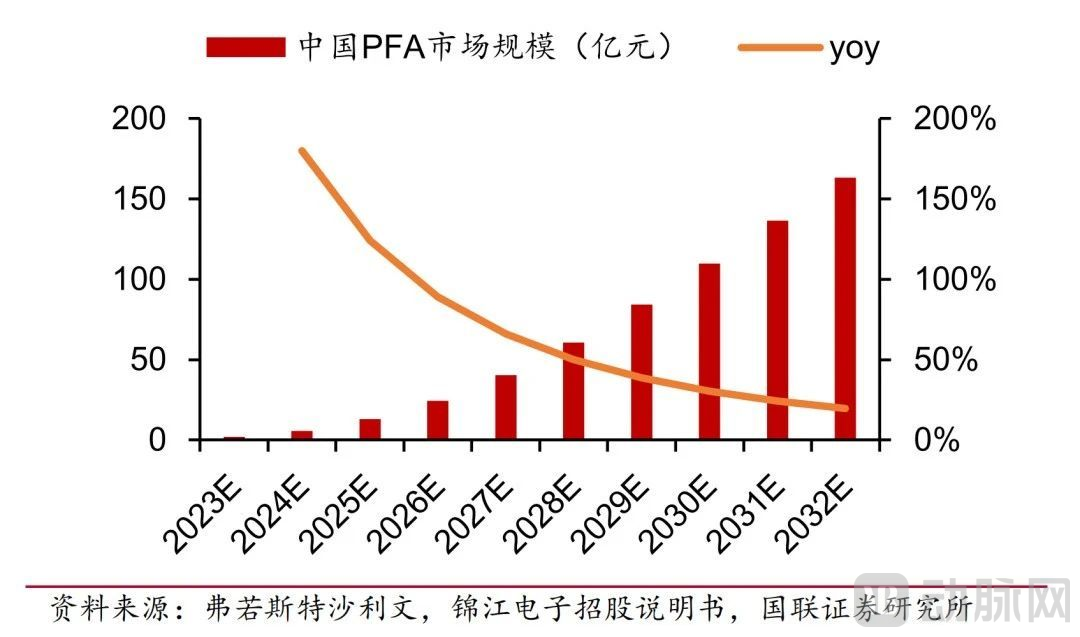
The huge market cake has attracted domestic and foreign enterprises to accelerate their layout. Internationally, the FDA has approved five PFA products from three companies: Boston Scientific, Medtronic, and Johnson & Johnson. Boston Scientific owns two products, FARAPULSE and FARAWAVE NAV; Medtronic's Pulseselect and Sphere-9&Affera; and Johnson & Johnson's VARIPULSE.
In China, the NMPA has approved the registration applications for innovative pulsed field ablation products from multiple companies including Jinjiang Electronics, Denovo Electrophysiology, HT Medical, XuanYu Medical, Aikangmai Medical, Yuanshan Medical, and MicroPort Electrophysiology. Additionally, an increasing number of domestic companies are actively positioning themselves in the PFA sector. Companies such as Xinlvtong, Beixi Medical, Hanyu Medical, Maiwei Medical, Zhoulín Medical, Jianhu Medical, and Xinhanglu Medicine are intensifying their R&D investments, conducting clinical trials, and exploring PFA technologies and products suitable for Chinese patients.
Relying on the vast patient base of cancer and atrial fibrillation, China's catheter ablation market has broad development potential. PFA, as a new generation of ablation technology, holds immense commercialization prospects. With the enhancement of technological innovation capabilities by domestically produced enterprises, and by offering products that better meet local needs along with comprehensive technical systems, the future will not only see significant standing in the domestic market but also reshape the global electrophysiology market landscape alongside international giants. The development prospects of China’s PFA market are promising.
Note: The data on the catheter ablation market comes from Steven Mickelsen's presentation to participants at the LSI Europe conference when introducing the progress of Field Medical.