

Dunbo Medical's Transcatheter Leadless Pacemaker Enters NMPA Innovative Device Review Pathway

MicroPace
Developer of Cardiovascular Nerve Stimulators

SiYu Annual Event Review:The First Global Ophthalmology Conference | The First Global Orthopedics Conference | The First Global Cardiovascular Conference
Coming Soon:
June 12, 2025, The First Global Medical Aesthetics Technology Conference
July 17, 2025, The 2nd Global Medical Technology Conference
September 4-5, 2025, The 3rd Global Surgical Robotics Conference
Heart Future
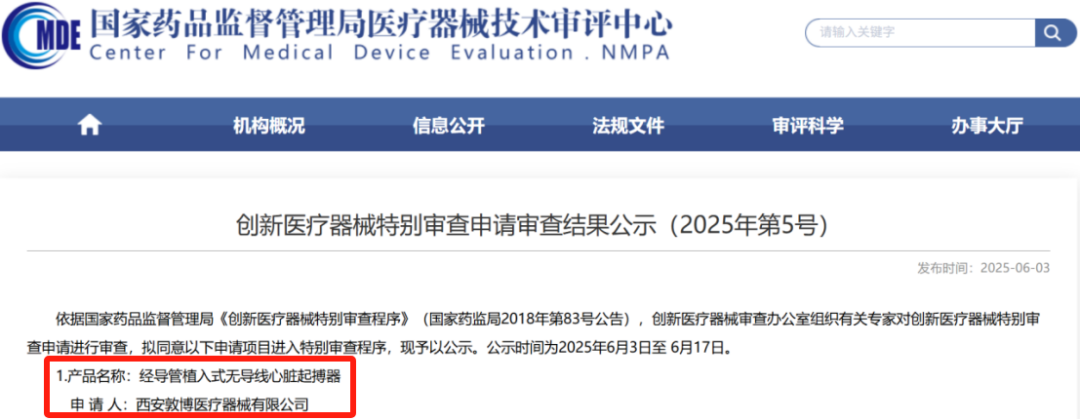
On June 3, 2025, the NMPA announced the public notification of the review results for the special review application of innovative medical devices (No. 5 of 2025).6 ProductsEnter the innovation channel.
Including,Xi’an MicroPace Medical Device Co., Ltd.(Abbreviation: "MicroPace") ApplicationTranscatheter Implantable Leadless Cardiac Pacemaker。
Founder of MicroPaceHe YupingOnce stated:"Leadless pacemakers, as the latest generation of pacemaker technology, haveSmaller Size, More Convenient, SaferThe advantages are promising in the treatment of heart disease. MicroPace appliesSelf-developed chip, achieving a breakthrough in the key technology of leadless cardiac pacemakers, not only catching up with the world's highest level but also taking a small step further. On the technical level, the volume of the pacemaker has been further reduced, the static power consumption has been significantly decreased, and the service life of the pacemaker has been extended, making the application of leadless cardiac pacemakers in clinical practice more convenient and safer."
# About Cardiac Resynchronization Therapy (CRT)
Heart FailureIs a global health issue affecting tens of millions of people.It is due toVarious heart diseases lead to a condition where the heart's pumping ability decreases and cannot meet the body's demands. Medication can help slow the progression of heart failure, but some patients with severe heart failure experience unsynchronized contractions of the left and right ventricles, limiting the effectiveness of drug treatment.
Cardiac Resynchronization Therapy (CRT)Through implantationCardiac Resynchronization Therapy Pacemaker (CRT-P) orCardiac Resynchronization Therapy Defibrillator (CRT-D)ComeSynchronize the Contraction of the Left and Right Ventricles, Improve cardiac function。
'%20fill='%23FFFFFF'%3E%3Crect%20x='249'%20y='126'%20width='1'%20height='1'%3E%3C/rect%3E%3C/g%3E%3C/g%3E%3C/svg%3E)
Working Principle
Precise Positioning:Doctors will use examinations such as echocardiography and electrocardiogram to accurately locate the site of abnormal electrical conduction in the heart.
Implantable Electrodes:InXUnder line guidance, the electrode lead is implanted into specific parts of the heart through a vein, typically including the right atrium, right ventricle, and left ventricle.
Synchronous Pacing:CRTThe pacemaker emits electrical impulses that stimulate the synchronized contraction of the left and right ventricles, improving the heart's pumping function.
Indications
Left Ventricular Ejection Fraction (LVEF)≤35%
Left Bundle Branch Block
QRSWave Duration≥130ms
NewAbout the Heart Association (NYHA) Cardiac Function ClassificationII-IVLevel
Expected ventricular pacing ratio >40%
Symptoms persist after optimized drug therapy
CRTAdvantages
Improve Cardiac Function:CRTCan significantly improve the cardiac function of patients and enhance their quality of life.
Reduce Hospitalization Rate:CRTCan reduce the number of hospitalizations for heart failure patients and lower medical costs.
Prolong Survival Period:Research shows,CRTCan extend the survival period of heart failure patients.
However, the traditionalCRT devices rely on leads to transmit pacing signals, which not only limits the choice of pacing locations but also may cause complications such as infection and lead displacement. According to statistics,Approximately 30% of patients do not respond to conventional CRT therapy due to lead-related issues.
Traditional Pacemaker ImplantationThe pacemaker and electrode leads are implanted after surgical anesthesia. The electrode leads are guided through the veins to the heart and connected to the myocardium, while the other end is placed in a pocket under the skin on the chest. After surgery, patients should keep the wound clean and dry in daily life to prevent complications such as lead damage and pocket infection.
Leadless PacemakerWith the advantages of smaller size, more convenience, and higher safety, it integrates the pulse generator with the pacing electrode into one.“Microcapsule" in the form of directly implanting the pacemaker into the patient's heart chamber.No need for transvenous endocardial leads, nor subcutaneous incisions and pockets.The advantage lies in the absence of complications such as lead damage and pacemaker pocket infection, and it does not affect the patient's bilateral upper limb movement after the operation.
▲ NoneLead HeartDirty PacingDevice
MicroPace's core product, the leadless pacemaker, combines the pacing lead and pulse generator into one unit. It is extremely small in size and can be directly implanted into the heart. As a result, there is no skin bulge or scarring at the implant site on the body surface as seen with traditional pacemakers. It also avoids complications such as rupture and infection of the pacemaker pocket, wear and fracture of pacing leads, while offering a long service life and compatibility with magnetic resonance imaging (MRI).
Product Features
Small size, light weight:MicroPace's Leadless Cardiac PacemakerVolume only0.8cc,Compared with Medtronic's Micra pacemakerSmaller, with a weight equivalent to Micra and a diameter6mm, Length 25mm。
Integrated Design:Integrate the pulse generator with the pacing electrode into one unit, in order to“Microcapsule"that can be directly implanted inside the patient's heart chamber, without requiring transvenous endocardial leads, subcutaneous incisions, or a pocket."
High Technical Integration:The product technology involves highly integrated multi-disciplinary fields, including high-precision chip design, high-reliability software and hardware design, and advanced mechanical design and processing.
# Overview of China's Heart Failure Market
With the aggravation of China's population aging and the increase of people's life pressure, the prevalence of heart failure in China not only rises year by year, but also presents a trend of..."The Trend of Becoming Younger"
Gao Runlin, an academician of the Chinese Academy of Medical Sciences Fuwai Hospital, and Professor Wang Zengwu et al. in "Eur J Heart Fail》published a latest survey result showing that, in China≥35 years oldIn the adult population, the weighted prevalence of heart failure is1.3%, that is, approximately13.7 MillionHeart failure patients, and every year there will be3 MillionNew heart failure patients on both sides.
According to the "2025-2030 China Pacemaker Industry Research and Market Investment Decision Report" released by CRI China, the scale of China's pacemaker market reached6.8 billion yuan, but the market share of imported products is still as high as89%, the process of domestic substitution urgently needs breakthrough.
Such a huge market potential, like a powerful magnet, attracts many companies in the cardiovascular field who dare to strive and are brave enough to innovate.
Although there is currently no production in ChinaCRT products have successfully emerged, but in other innovative device fields for heart failure treatment, such asLeft Ventricular Assist Device、Atrial Shunt DeviceInAndHeartContractility ModulatorIn these aspects, domestic enterprises have made remarkable breakthrough progress.
Left Ventricular Assist Device (LVAD): Entering the Critical Moment of Approval Surge
It is reported that the left ventricular assist device is currently the most maturely developed field in heart failure treatment devices, and currently there are4Chinese-made implantable left ventricular assist systemApproved for marketing, respectively fromChongqing Yongrenxin, Suzhou Tongxin, Aerospace Tainxin, Shenzhen Core, each of which has unique market advantages.
Eternal Heart'sEVAHEARTIt is currently the only artificial heart product approved by the China Food and Drug Administration for long-term use in bridging or destination therapy in China.
▲Zuo WeiEVAHEART,Right: EVA-Pulsar
Suzhou TongxinCH-VADYesChina’s first domestically produced implantable left ventricular assist system with fully independent intellectual property rights, which uses full magnetic levitation blood pump technology, has completely broken Abbott's monopoly in this field.
▲CH-VAD
Aerospace Taixin's"Rocket Heart" HeartConIt is the first implantable left ventricular assist system in China to adopt magnetic-liquid suspension technology, and it also significantly reduces the cost of the product, promoting the accessibility of LVADs in China.
▲HeartCon
Shenzhen Core MedicalCorheart® 6It is currently the smallest and lightest implantable left ventricular assist device in the world, with a blood pump diameter of only 34 millimeters, thickness of 26 millimeters, and weight of approximately 90 grams. Compared to similar products on the market, the diameter is reduced by 40% and the weight is reduced by 50%. It can be used for pediatric artificial heart implants, filling the gap in pediatric artificial heart implants in China.
▲Corheart® 6
Atrial Shunt Device: Standing on the Same Starting Line as the Giants
Currently, atrial shunt devices are still only in the clinical research stage globally, and in ChinaWeicoD-shant Atrial ShuntIt has been approved to enter the "National Innovative Medical Device" green channel and successfully completed the enrollment for multi-center large clinical trials, standing on the same starting line with international giants.
The person in charge of Weike Medical once said that the company is continuing to assist.D-shant's participating centers have completed the follow-up work for enrolled patients. It is expected that all follow-up will be completed by early 2024, after which the product will be submitted for market approval, with the hope of obtaining the "first certification" for an atrial shunt device.
Cardiac Contractility Modulator (CCM): The charge horn for domestically produced breakthrough has been blown in China.
Currently, byMicroPort Scientific's pioneering Cardiac Contractility Modulation (CCM)It has officially passed the special review application for innovative medical devices by the National Medical Products Administration and completed the first clinical trial enrollment, with the hope of being approved this year.
# Company Introduction
MicroPaceFounded in2018Year, headquartered in the Civil Aerospace Industry Base of Xi'an City, Shaanxi Province, ChinaIt is a high-tech company that researches and produces implantable Class III active medical devices.。
Currently, the products under development include:Single-chamber Leadless Pacemaker, Dual-chamber Leadless Pacemaker, Vagus Nerve Stimulator for Heart Failure TreatmentAnd other products.
The company masters key medical and semiconductor core technologies, and owns independently developed dedicated mixed-signal chips, hardware circuits, software application systems, and structural materials.
According to Tianyancha data, as of now,MicroPaceTotal Completion4 Rounds of Financing:
Welcome companies to actively participate in the conference organized by Siyu ↓
June 12, 2025, The First Global Medical Aesthetics Technology Conference
July 17, 2025, The 2nd Global Medical Technology Conference
September 4-5, 2025, The 3rd Global Surgical Robotics Conference