

Roche Announces Positive Phase III IMforte Trial Results for Tecentriq Plus Lurbinectedin in Extensive-Stage Small Cell Lung Cancer

Roche
Oncology Drug Research, Development, and Manufacturing

On June 3, Roche announced positive results from its IMforte Phase III clinical study, confirming the efficacy of Tecentriq® (atezolizumab) in combination with lurbinectedin (Lurbinectedin) in combination as a first-line maintenance treatment for extensive-stage small cell lung cancer. This study demonstratesCompared with maintenance therapy using Tecentriq alone, this combination therapy reduced the risk of disease progression or death by 46% and the risk of death by 27%.These data were presented as an oral report at the 2025 American Society of Clinical Oncology (ASCO) Annual Meeting and simultaneously published in the authoritative medical journal, The Lancet.
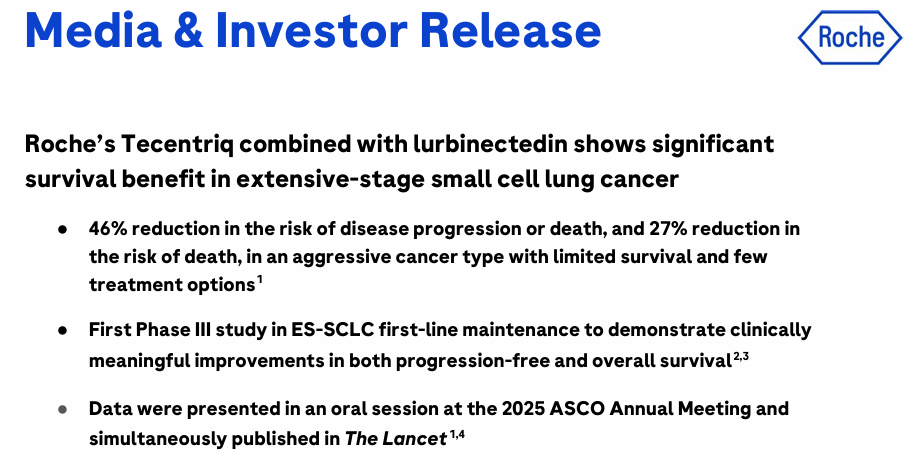
IMforte Study is the first Phase III study to demonstrate clinically meaningful improvements in both progression-free survival (PFS) and overall survival (OS) in the first-line maintenance treatment of ES-SCLC. Specific data show that, starting from the randomization into the maintenance treatment phase,The median overall survival for the Tecentriq plus lurbinectedin combination was 13.2 months, compared to 10.6 months for Tecentriq alone.Moreover, through independent assessment,The median progression-free survival was 5.4 months for the combination regimen and 2.1 months for Tecentriq alone.The safety profile of this combination therapy is consistent with the known safety profiles of Tecentriq and lurbinectedin, with no new safety signals observed.
Levi Garraway, MD, PhD, Chief Medical Officer and Head of Global Product Development at Roche, also emphasized that this study further reinforces the favorable safety and efficacy profile of Tecentriq as the first immunotherapy for this type of cancer, and may offer doctors and patients another way to manage this aggressive disease.
Tecentriq (Atezolizumab) is a monoclonal antibody that works by binding to the PD-L1 protein. By binding to PD-L1 expressed on tumor cells and tumor-infiltrating immune cells, Tecentriq can block its interaction with PD-1 and B7.1 receptors, potentially reactivating the anti-tumor activity of T cells. As an important cancer immunotherapy, Tecentriq has been approved for treating various aggressive and hard-to-treat cancers, including specific types of early non-small cell lung cancer (NSCLC), small cell lung cancer (SCLC), and hepatocellular carcinoma (HCC). The IMforte trial is sponsored by Roche and co-funded by Jazz Pharmaceuticals.
This new breakthrough undoubtedly brings significant hope to patients with extensive-stage small cell lung cancer. The combination therapy of Tecentriq and lurbinectedin significantly extends patient survival while maintaining good safety, marking an important advancement in treatment strategies for this field and offering a potential new lifeline for patients in urgent need of more effective treatment options.
'%20fill='%23FFFFFF'%3E%3Crect%20x='249'%20y='126'%20width='1'%20height='1'%3E%3C/rect%3E%3C/g%3E%3C/g%3E%3C/svg%3E)