

AstraZeneca Launches Three Phase III Trials Simultaneously for Oral Small-Molecule PCSK9 Inhibitor AZD0780

AstraZeneca
Biopharmaceutical Manufacturer
▎Armstrong
On June 2, 2025, AstraZeneca registered three Phase III clinical trials for the small molecule PCSK9 inhibitor AZD0780 on the Clinicaltrials.gov website.
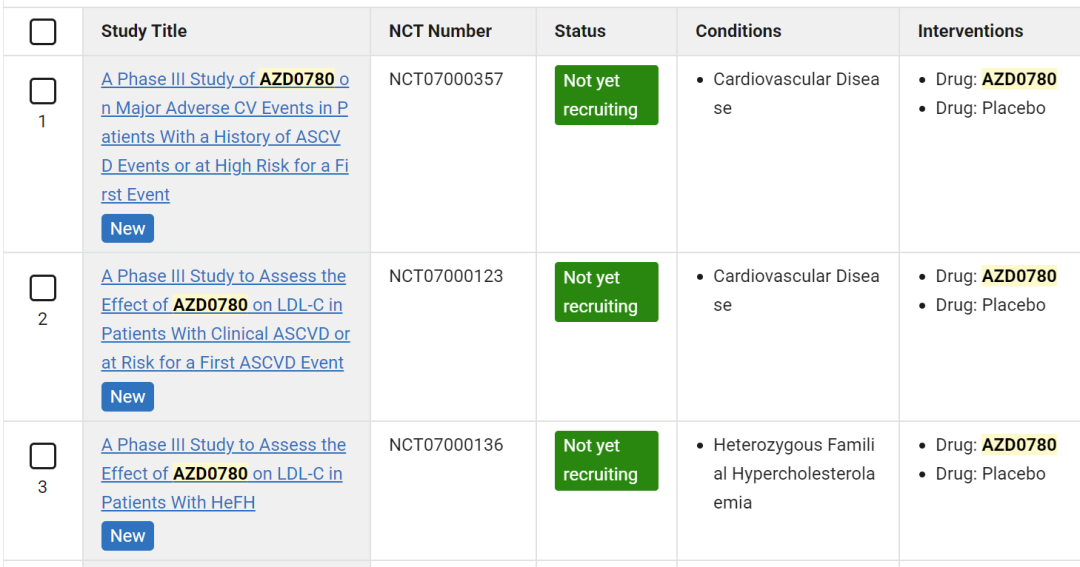
The first Phase III clinical trial targets HeFH, planning to enroll 405 patients, with an expected completion date of March 2027.

The second Phase III clinical trial for ASCVD is planned to enroll 2,800 patients and is expected to be completed in March 2027.
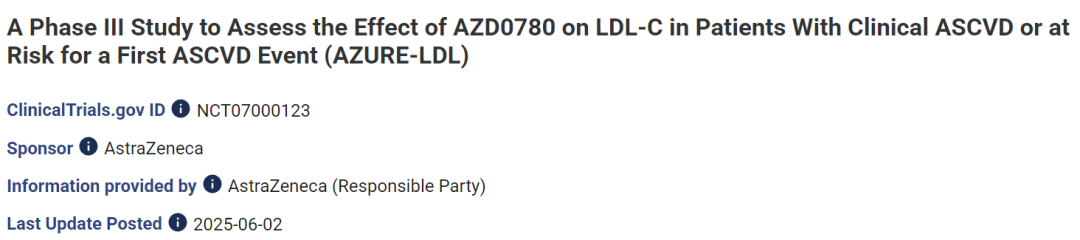
The third Phase III clinical trial targeting cardiovascular benefits for ASCVD patients plans to enroll 15,100 patients and is expected to be completed in October 2029.
'%20fill='%23FFFFFF'%3E%3Crect%20x='249'%20y='126'%20width='1'%20height='1'%3E%3C/rect%3E%3C/g%3E%3C/g%3E%3C/svg%3E)
AZD0780 is a small-molecule oral PCSK9 inhibitor.
AstraZeneca is also considering advancing the combination of AZD0780 and GLP-1 for weight loss and glucose reduction to achieve organ protection.
Summary
PCSK9 is the most complex target in the cardio-renal metabolism competitive landscape. In 2014, Amgen and Sanofi's PCSK9 antibodies were approved for marketing, with Amgen's Repatha achieving sales of $2.2 billion in 2024. In 2021, Novartis' PCSK9 siRNA was approved for marketing, requiring only one injection every six months, with sales reaching $333 million in Q1 2025. Merck's oral PCSK9 cyclic peptide has entered phase III clinical trials, and AstraZeneca's small-molecule PCSK9 inhibitor has also advanced to phase III clinical trials. Additionally, in vivo gene editing of PCSK9 is being actively pursued. This ultimately results in a competitive landscape where multiple drug formats, including small molecules, antibodies, siRNA, cyclic peptides, and in vivo gene editing, are competing simultaneously.
Comprehensive Overview of Armstrong Technology Series
A Comprehensive Review of Complement-Targeted Drug Technologies;
Complement Drugs: An Important Direction in Ophthalmic Treatment;
A Comprehensive Overview of China's Bispecific Antibody Technology;
A Comprehensive Review of Antengene's Pharmaceutical Technologies;
Comprehensive Review of Harbour BioMed Technologies; Comprehensive Overview of Rongchang Biotechnology; A Comprehensive Review of Zai Lab's Technologies; Comprehensive Overview of WuXi Biologics; Hengrui Medicine Technology: A Comprehensive Overview; A Comprehensive Review of Hansoh Pharma's Technology; Comprehensive Review of Chia Tai Tianqing's Technology; Comprehensive Overview of Genechem Technologies; Comprehensive Review of CStone Pharmaceuticals' Technology; Comprehensive Overview of BeiGene Technologies; Comprehensive Review of BeiGene Technologies, 2nd Edition; A Comprehensive Review of Innovent Biologics Technology; Comprehensive Review of Innovent Biologics Technology, 2nd Edition; Comprehensive Review of Zhongshan Kangfang Technology; Comprehensive Review of Henlius Technologies; A Comprehensive Review of Simcere Pharmaceutical Technologies; Comprehensive Overview of Junshi Biotechnology; Comprehensive Overview of Genor Biopharma; Comprehensive Overview of Zhi Dao Biotechnology; A Comprehensive Overview of Doer Biotechnology; Full Review of Shangjian Biotechnology; A Comprehensive Review of Alphamab Oncology's Technology; Comprehensive Overview of KeyMed Technologies; Comprehensive Overview of Shoreline Biotechnology; Comprehensive Overview of Lijin Biotechnology; Full Technical Review of Canbridge Capital; Yu Guoliang's Antibody Drug Layout; Full Review of Quanxin Biotechnology; Comprehensive Review of An Yuan Pharmaceutical Technology; 3SBio Technology: A Comprehensive Overview; Comprehensive Review of Renhui Biotechnology; Comprehensive Overview of LePu Biotechnology; Comprehensive Overview of Tongrun Biotechnology; Comprehensive Overview of Immunotech Technologies; Comprehensive Overview of PegBio; Comprehensive Overview of Mabwell Biotech; Comprehensive Overview of Momenta Technology; Comprehensive Overview of NGM Technology; Comprehensive Overview of Promab Biotechnologies; Full Review of Primus Biotechnology 2.0; Comprehensive Overview of Clover Biotechnologies; Zelgen Pharma Antibody Drug Overview; Hengrui Medicine Antibody Drug Overview; A Comprehensive Review of Qilu Pharmaceutical's Antibody Drugs; Full Review of CSPC Pharmaceutical Group's Antibody Drugs; Hansoh Pharma Antibody Drug Overview; Huahai Pharmaceutical Antibody Drug Overview; A Comprehensive Overview of Kelun Pharmaceutical's Antibody Drugs; A Comprehensive Review of Bio-Thera Technologies; Full Review of Fennec Technologies。