Regeneron Bets $2 Billion on GLP-1/GIP Dual Agonist HS-20094 in Global Obesity Push
Hansoh Pharma
Pharmaceutical Research, Production, and Sales
On June 2, Regeneron announced a collaboration with Hansoh Pharma to obtain global rights outside of China for HS-20094. Hansoh Pharma received an upfront payment of $80 million, development, regulatory approval, and commercial milestone payments of up to $1.93 billion, as well as royalties based on product sales.
HS-20094 is a GLP-1/GIP dual receptor agonist, sharing the same target as Eli Lilly's blockbuster drug tirzepatide. Regeneron stated that the observed data indicates HS-20094 has a "potential efficacy and safety profile" similar to tirzepatide.
Currently, HS-20094 is undergoing Phase III clinical trials in China for the indications of obesity and overweight. Additionally, Phase II clinical trials for Type 2 diabetes are also underway.
Previously, Regeneron had made multiple attempts in the weight loss field, including efforts to develop long-acting GLP-1R agonist ATDCs (antibody-tethered drug conjugates): conjugating a non-antagonistic GLP-1R antibody with a GLP-1RA to enhance the stability and half-life of GLP-1 peptide analogs. Later, the company shifted its focus to the "fat reduction and muscle gain" area, exploring the dual functionality of semaglutide + trevogrumab (anti-GDF8/anti-myostatin) combination therapy, with or without garetosmab (anti-activin A), for both weight loss and muscle protection.
Regeneron Pharmaceuticals Spent Over $2 Billion to Acquire Hansoh Pharma's GLP-1/GIP Dual Receptor Agonist, Aiming to Strengthen Its GLP-1 Drug Portfolio and Reflecting Strategic Desire for Late-Stage Pipeline Assets to Address the Shortage of Late-Stage Projects in Its Current R&D Pipeline.
"The Midlife Crisis of the 'Antibody King'"
As a Biotech pioneer, Regeneron Pharmaceuticals has established itself with its outstanding technology platforms and gained considerable renown in the field of antibody-based large molecule drugs, successively creating two blockbuster drugs with sales exceeding tens of billions of dollars: aflibercept and dupilumab.
Relying on the strong performance of these two major products, Regeneron's market value reached $133 billion in 2024.
However, entering 2025, the landscape of global blockbuster drugs is undergoing significant changes, with GLP-1 drugs leading the growth, while aflibercept and dupilumab encounter bottlenecks.
Eylea Series (Aflibercept and Its High-Dose Version) Faces Generic Competition Post-Patent Expiration and Iterative Competition from Roche's VEGF-A/Ang2 Bispecific Antibody Vabysmo, Leading to a Sharp Decline in Sales. Regeneron's financial report shows that Eylea series' Q1 2025 sales in the U.S. market were $1.043 billion, a year-on-year decrease of 26%. Global sales (including the Bayer collaboration portion) were $1.901 billion, a year-on-year decrease of 16%.
Dupixent (dupilumab), despite successfully becoming the top-selling autoimmune drug, has experienced sluggish growth due to challenges in expanding new indications. In Q1 2025, the drug's global sales reached €3.48 billion, marking a year-over-year increase of 20.3%. However, the quarter-over-quarter growth was only 0.69% compared to the previous quarter.
Apart from the two blockbuster products, aflibercept and dupilumab, Regeneron also has a PD-1 inhibitor, Libtayo, but its sales growth has been slow, only breaking through the one billion dollar mark in 2024, making it hard to compete with the first two heavyweights.
In terms of drugs under research, Regeneron has extensively laid out in multiple fields such as anti-tumor bispecific antibodies, the new generation of immunological drug Itepekimab, AAV gene therapy DB-OTO, and combination therapies for obesity.
But these pipelines have repeatedly encountered setbacks.
The Phase III trial AERIFY-1 of IL-33 monoclonal antibody Itepekimab for chronic obstructive pulmonary disease (COPD) met its primary endpoint, but the Phase III trial AERIFY-2 did not achieve the same primary endpoint. The inconsistency in the results of the two studies requires further data analysis.
Although Odronextamab and Linvoseltamab, two bispecific antibodies for hematological tumors, have been approved in the EU, they faced setbacks in the U.S. market, losing a significant market.
Under the dual pressures of intensified competition for core products and pipeline progress challenges, Regeneron's market value plummeted by 60%, currently standing at approximately $53 billion.
Heavy Bets on the Weight Loss Track
Under pressure, Regeneron has placed its bets on combination therapies for obesity.
Currently, trevogrumab is Regeneron's leading pipeline in the obesity field, a monoclonal antibody targeting GDF8. Regeneron recently released data from the Phase 2 COURAGE study: adding trevogrumab increased muscle preservation by 51.3%, and adding garetosmab on top of that further boosted preservation to 80.9%. Moreover, the overall weight loss achieved by the two-drug and three-drug combination regimens was 11.3% and 13.2%, respectively, surpassing the 10.4% achieved with semaglutide alone. However, the safety of this combination therapy has been questioned, with 10.1% of patients experiencing severe adverse reactions and 28.3% discontinuing treatment entirely.
In any case, this combination therapy is a promising new weight loss solution.
Based on this, Regeneron quickly partnered with Chinese pharmaceutical company Hansoh Pharma to introduce HS-20094, a GLP-1/GIP dual receptor agonist in the late clinical stage. The aim is to pair it with their existing pipeline drug, trevogrumab, as a combination therapy to gain an advantage in the "fat reduction and muscle gain" field, while exploring applications in other comorbidities such as cardiovascular disease, diabetes, and liver diseases.
HS-20094 for weight management in overweight adult patients with obesity or at least one weight-related comorbidity has entered Phase III clinical trials in 2024.
Hansoh Pharma Presented Phase II Clinical Trial Data of HS-20094 at the 2024 EASD Annual Meeting. The study involved a total of 54 subjects who received at least one dose of HS-20094, semaglutide, or placebo.
On Day 23, compared with placebo, HS-20094 significantly reduced the blood glucose AUC0-2h in the oral glucose tolerance test (OGTT) in a dose-dependent manner. The reduction in the HS-20094 15mg group was significantly greater than that in the semaglutide 1.0mg group. On Day 23, compared with placebo, the blood glucose levels at both 0 minutes and 120 minutes in the OGTT were significantly decreased in all dose groups of HS-20094. On Day 29, compared with placebo, HbA1c was significantly reduced in all dose groups of HS-20094 and in the semaglutide group. Body weight in all dose groups of HS-20094 showed a continuous decrease in a dose-dependent manner, and the reductions were all significantly better than those in the placebo group. The decrease in body weight from baseline in the HS-20094 15mg group was significantly better than that in the semaglutide group (3.29kg vs 1.27kg, p=0.0024).
In terms of safety, among the reported adverse events (AEs), the vast majority (98%) were mild or moderate. No serious adverse events related to the drug were reported, no discontinuation due to adverse events, no deaths, and no severe hypoglycemic events.
With the addition of HS-20094, Regeneron is poised to create another blockbuster therapy in the weight loss field.
Conclusion
Currently, the Chinese market has become an important strategic procurement source for global pharmaceutical companies. Whether it is biotechnology companies striving to break through performance bottlenecks or large pharmaceutical enterprises seeking to secure a competitive position, China's innovative pipeline offers a cost-effective choice.
In the GLP-1 field, besides Regeneron, companies like Merck, Novo Nordisk, and AstraZeneca have also introduced candidate drugs from Chinese pharmaceutical enterprises, demonstrating the significant global competitiveness of China's pharmaceutical innovation in terms of cost control, R&D efficiency, and differentiated innovation.
Table 1 Summary of GLP-1 Drug Transactions Produced in China in Recent Years
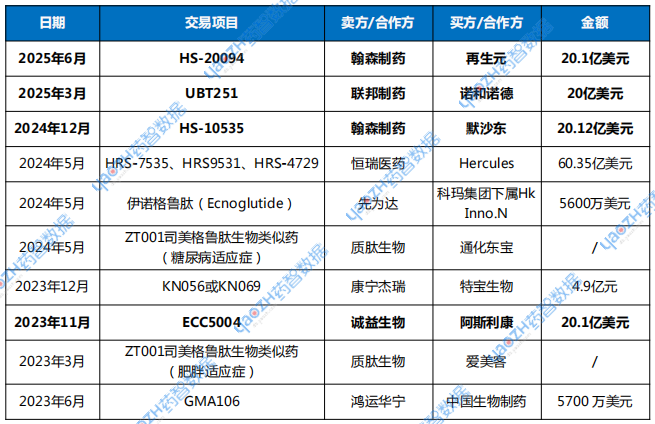
Data Source: PharmCube Data, Public Information Compilation
Source: Hansoh Pharma corporate announcements, PharmCube data, and other public sources

Editor: Liuli
Disclaimer: The views expressed in this article are solely those of the author and do not represent the position of PharmCube. We welcome exchanges and additional insights in the comment section; for reprints, please be sure to credit the author and source. If there are any issues regarding the content, copyright, or other aspects of the work, please leave a message on this platform, and we will address it promptly.