HomeHansoh Pharmaceutical's Lung Cancer Targeted Therapy Aumetinib (Aumseqa®) Marks First Chinese-Origin EGFR-TKI Approved in Overseas Market with UK MHRA Clearance
Hansoh Pharmaceutical's Lung Cancer Targeted Therapy Aumetinib (Aumseqa®) Marks First Chinese-Origin EGFR-TKI Approved in Overseas Market with UK MHRA Clearance
On June 4, Hansoh Pharma announced that its innovative drug, Aumseqa® (generic name: Almonertinib Mesylate Tablets), received approval from the UK Medicines and Healthcare products Regulatory Agency (MHRA) for marketing. It is indicated as a monotherapy for the first-line treatment of adult patients with locally advanced or metastatic non-small cell lung cancer (NSCLC) harboring activating epidermal growth factor receptor (EGFR) mutations, as well as for the treatment of adult patients with locally advanced or metastatic EGFR T790M mutation-positive NSCLC.
Almonertinib Mesylate Tablets (hereinafter referred to as "Almonertinib") have become the first innovative drug from Hansoh Pharma to be approved for entry into overseas markets, and it is also the first China-developed EGFR-TKI (epidermal growth factor receptor tyrosine kinase inhibitor) to be launched abroad.
On June 4, a reporter from The Paper inquired Hansoh Pharma about the relevant matters after the new drug's launch in the UK. The company replied that Aumolertinib had just been approved for marketing in the UK. The currently available information indicates that the company will continue to promote the overseas regulatory recognition of Aumolertinib by the European Medicines Agency (EMA). However, the specific follow-up plans are not yet convenient to disclose.
As of the closing on June 4, Hansoh Pharma was trading at HKD 27.3 per share, up 3.02%, with a market value of HKD 162.4 billion.
On April 17, 2020, Aumolertinib was approved for marketing by the National Medical Products Administration (NMPA). It is China's first and the world's second third-generation EGFR-TKI innovative drug for lung cancer. Currently, this drug has been approved for four indications in China, making it the Chinese-developed third-generation EGFR-TKI with the most approved indications and the broadest treatment scope. The approved indications for this drug include:
Second-line treatment for patients with locally advanced or metastatic non-small cell lung cancer who have progressed after prior EGFR-TKI treatment and are T790M mutation-positive;
First-line treatment for adult patients with locally advanced or metastatic non-small cell lung cancer positive for EGFR exon 19 deletion or exon 21 (L858R) substitution mutations;
Treatment for patients with unresectable locally advanced EGFR exon 19 deletion or exon 21 (L858R) substitution mutation non-small cell lung cancer who have not experienced disease progression after platinum-based radical chemoradiotherapy;
And for the treatment of adult patients with Stage Ⅱ-ⅢB non-small cell lung cancer harboring EGFR exon 19 deletions or exon 21 (L858R) substitution mutations, who have previously undergone surgical resection and whose use of adjuvant chemotherapy is determined by their physician.
In addition, the marketing authorization application for Aumolertinib combined with chemotherapy for the first-line treatment of locally advanced or metastatic non-small cell lung cancer with EGFR-sensitive mutations was accepted by the National Medical Products Administration in November 2024.
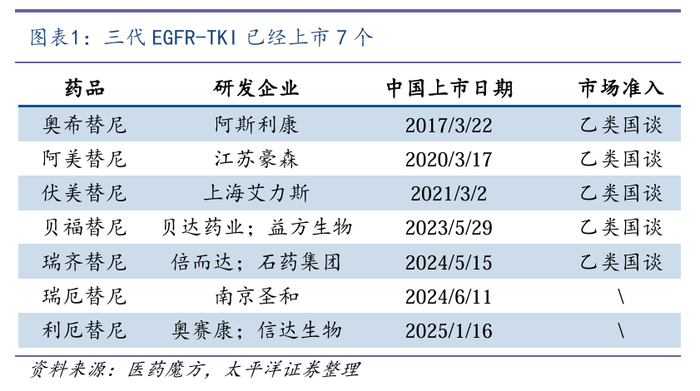
The target of EGFR-TKI is similar to PD-1, known for its "internal competition." As of March 19, 2025, seven third-generation EGFR-TKI products have been launched in China. Apart from Hansoh Pharma's Almonertinib, there are Osimertinib (AstraZeneca), Furmonertinib (Allist Pharmaceuticals), Befotertinib (Betta Pharmaceuticals/Yifang Bioscience), Rezivertinib (Birrd Biotech/SinoPharm Group), Reervertinib (Sanhome Pharmaceutical), and Liaertinib (Aosaikang Pharmaceutical/Innovent Biologics).
Source of the image: Pacific Securities Data as of March 19, 2025
However, the disease area has broad prospects and a high rate of return. According to a report published in the International Journal of Oncology in 2024, it is estimated that 1.8 million people died from lung cancer, accounting for 18.7% of the total global cancer deaths in 2022. Among them, non-small cell lung cancer (NSCLC) is the most common type of lung cancer, accounting for approximately 85% of all lung cancer cases. Moreover, EGFR has the highest mutation rate among the mutation types in NSCLC patients and has become one of the main targets for NSCLC treatment.
At the beginning of the 21st century, Gefitinib, the world's first first-generation EGFR-TKI product developed by AstraZeneca, was launched. According to the official website of the China Pharmaceutical Innovation and Research Development Association, in its first year on the market in 2002, Gefitinib generated sales of $67 million; by 2013, sales had reached $647 million. However, the first-generation EGFR-TKI is prone to drug resistance. The subsequently launched second-generation EGFR-TKIs showed similar efficacy to the first generation but also had complex mechanisms of resistance, and patients still experienced disease progression after treatment.
To address the drug resistance issues of first-generation and second-generation EGFR-TKIs, in 2015 and 2017, the world's first third-generation EGFR-TKI product, Osimertinib (AstraZeneca), was launched in the United States and China, respectively. Subsequently, multiple third-generation EGFR-TKIs have been marketed both domestically and internationally. Currently, some companies are still conducting research in this area. For example, in March 2025, Tongyuan Kang announced that it would submit a new drug application for its third-generation EGFR-TKI to the National Medical Products Administration.
The third-generation EGFR-TKI is characterized by high efficiency and low toxicity, and has now become a first-line targeted therapy drug. In 2024, the global sales of AstraZeneca's Osimertinib exceeded 6 billion US dollars, and the sales of Alis's Furmonertinib in China exceeded 3.5 billion yuan.
However, the issue of target resistance has not ended with the third-generation EGFR-TKI. Current innovative drug development for this target is focused on addressing resistance to third-generation EGFR-TKIs, such as combination therapies involving EGFR/C-MET bispecific antibodies and third-generation targeted drugs, as well as EGFR ADC drugs.
Interface News reporter |Tang Zhuoya
Interface News Editor |Xu Yue
On June 4, Hansoh Pharma announced that its innovative drug, Aumseqa® (generic name: Almonertinib Mesylate Tablets), received approval from the UK Medicines and Healthcare products Regulatory Agency (MHRA) for marketing. It is indicated as monotherapy for the first-line treatment of adult patients with locally advanced or metastatic non-small cell lung cancer (NSCLC) harboring activating epidermal growth factor receptor (EGFR) mutations, as well as for the treatment of adult patients with locally advanced or metastatic EGFR T790M mutation-positive NSCLC.
Almonertinib Mesylate Tablets (hereinafter referred to as "Almonertinib") have become the first innovative drug from Hansoh Pharma to be approved for entry into overseas markets, and it is also the first China-developed EGFR-TKI (epidermal growth factor receptor tyrosine kinase inhibitor) to be marketed overseas.
On June 4, a reporter from The Paper inquired Hansoh Pharma about the relevant matters after the new drug's launch in the UK. The company replied that Aumolertinib had just been approved for marketing in the UK. The currently available information indicates that the company will continue to promote the overseas regulatory recognition of Aumolertinib by the European Medicines Agency (EMA). However, the specific follow-up plans are not yet convenient to disclose.
As of the closing on June 4, Hansoh Pharma was trading at HK$27.3 per share, up 3.02%, with a market value of HK$162.4 billion.
On April 17, 2020, Aumolertinib was approved for marketing by the National Medical Products Administration (NMPA). It is the first domestically developed third-generation EGFR-TKI innovative drug for lung cancer in China and the second such drug globally. Currently, this medicine has been approved for four indications in China, making it the Chinese-developed third-generation EGFR-TKI with the most approved indications and the broadest therapeutic scope. The approved indications for this drug include:
Second-line treatment for patients with locally advanced or metastatic non-small cell lung cancer who have progressed after prior EGFR-TKI treatment and are T790M mutation-positive;
First-line treatment for adult patients with locally advanced or metastatic non-small cell lung cancer positive for EGFR exon 19 deletion or exon 21 (L858R) substitution mutations;
Treatment for patients with unresectable locally advanced EGFR exon 19 deletion or exon 21 (L858R) substitution mutation non-small cell lung cancer who have not experienced disease progression after platinum-based radical chemoradiotherapy;
And for the treatment of adult patients with Stage II-IIIB non-small cell lung cancer who have EGFR exon 19 deletions or exon 21 (L858R) substitution mutations, patients must have previously undergone surgical resection and be determined by a physician to receive or not receive adjuvant chemotherapy.
In addition, the marketing authorization application for Aumolertinib combined with chemotherapy for the first-line treatment of locally advanced or metastatic non-small cell lung cancer with EGFR-sensitive mutations was accepted by the National Medical Products Administration in November 2024.
The target of EGFR-TKI is similar to PD-1, known for its "internal competition." As of March 19, 2025, seven third-generation EGFR-TKI products have been launched in China. Apart from Hansoh Pharma's Almonertinib, these include Osimertinib (AstraZeneca), Furmonertinib (Allist Pharmaceuticals), Befotertinib (Betta Pharmaceuticals/Endoray Biotech), Rezivertinib (Bridge Biotherapeutics/SinoPharm Group), Ruiertinib (Sanhome Pharmaceutical), and Liaertinib (Aosaikang Pharmaceutical/Innovent Biologics).
Source of image: Pacific Securities Data as of March 19, 2025
However, the disease area has broad prospects and a high rate of return. According to a report published in the International Journal of Oncology in 2024, it is estimated that 1.8 million people died from lung cancer, accounting for 18.7% of the total global cancer deaths in 2022. Among these, non-small cell lung cancer (NSCLC) is the most common type, comprising approximately 85% of all lung cancer cases. EGFR has the highest mutation rate among NSCLC patient mutation types and has become one of the main targets for NSCLC treatment.
At the beginning of the 21st century, Gefitinib, the world's first first-generation EGFR-TKI product developed by AstraZeneca, was launched. According to the official website of the China Pharmaceutical Innovation and Research Development Association, in its first year on the market in 2002, Gefitinib generated sales of $67 million; by 2013, sales had reached $647 million. However, the first-generation EGFR-TKI is prone to drug resistance, and the subsequently launched second-generation EGFR-TKI, while having similar efficacy to the first generation, also has complex mechanisms of resistance, leading to continued disease progression in patients after treatment.
To address the drug resistance issues of first-generation and second-generation EGFR-TKIs, osimertinib (AstraZeneca), the world’s first third-generation EGFR-TKI product, was launched in the United States and China in 2015 and 2017, respectively. Subsequently, multiple third-generation EGFR-TKIs have been marketed both domestically and internationally, and research is still ongoing in some companies. For instance, in March 2025, Tongyuan Kang announced that it would submit a new drug application for its third-generation EGFR-TKI to the National Medical Products Administration.
The third-generation EGFR-TKI is characterized by high efficiency and low toxicity, and has now become a first-line targeted therapy drug. In 2024, the global sales of AstraZeneca's Osimertinib exceeded 6 billion US dollars, and the sales of Alis's Furmonertinib in China exceeded 3.5 billion yuan.
However, the issue of target resistance has not ended with the third-generation EGFR-TKI. Current innovative drug research and development for this target is focused on solving the problem of resistance to third-generation EGFR-TKIs, such as combination therapies involving EGFR/C-MET bispecific antibodies and third-generation targeted drugs, as well as EGFR ADC drugs.
Image Source: Jiemian News, Kuang Da
Interface News Reporter |Tang Zhuoya
Interface News Editor |Xu Yue
On June 4, Hansoh Pharma announced that its innovative drug, Aumseqa® (Methanesulfonate Ametinib Tablets), received approval from the UK Medicines and Healthcare products Regulatory Agency (MHRA) for marketing. It is indicated as monotherapy for the first-line treatment of adult patients with locally advanced or metastatic non-small cell lung cancer (NSCLC) harboring activating epidermal growth factor receptor (EGFR) mutations, as well as for the treatment of adult patients with locally advanced or metastatic EGFR T790M mutation-positive non-small cell lung cancer.
Almonertinib Mesylate Tablets (hereinafter referred to as "Almonertinib") have become the first innovative drug from Hansoh Pharma to be approved for entry into overseas markets, and also the first China-developed EGFR-TKI (Epidermal Growth Factor Receptor Tyrosine Kinase Inhibitor) to be launched abroad.
On June 4, a reporter from The Paper inquired Hansoh Pharma about the relevant matters of the new drug's launch in the UK. The company replied that Aumolertinib had just been approved for marketing in the UK. The current public information indicates that the company will continue to promote the overseas regulatory recognition of Aumolertinib by the European Medicines Agency (EMA), but the specific follow-up plans are not yet convenient to disclose.
As of the closing on June 4, Hansoh Pharma was trading at HKD 27.3 per share, up 3.02%, with a market value of HKD 162.4 billion.
On April 17, 2020, Aumolertinib was approved for marketing by the National Medical Products Administration (NMPA). It is China’s first and the world’s second third-generation EGFR-TKI innovative drug for lung cancer. Currently, this drug has been approved for four indications in China, making it the third-generation EGFR-TKI developed in China with the most approved indications and the broadest therapeutic areas. The approved indications for this drug include:
Second-line treatment for patients with locally advanced or metastatic non-small cell lung cancer who have progressed after prior EGFR-TKI treatment and are T790M mutation-positive;
First-line treatment for adult patients with locally advanced or metastatic non-small cell lung cancer positive for EGFR exon 19 deletion or exon 21 (L858R) substitution mutations;
Treatment for patients with unresectable locally advanced EGFR exon 19 deletion or exon 21 (L858R) substitution mutation non-small cell lung cancer who have not experienced disease progression after platinum-based radical chemoradiotherapy;
And for the treatment of adult patients with Stage II-IIIB non-small cell lung cancer who have EGFR exon 19 deletions or exon 21 (L858R) substitution mutations, patients must have previously undergone surgical resection and be determined by their physician to receive or not receive adjuvant chemotherapy.
In addition, the marketing authorization application for Aumetinib combined with chemotherapy for the first-line treatment of locally advanced or metastatic non-small cell lung cancer with EGFR-sensitive mutations was accepted by the National Medical Products Administration in November 2024.
The EGFR-TKI target, similar to PD-1, is notorious for its "internal competition." As of March 19, 2025, seven third-generation EGFR-TKI products have been launched in China, including Aumolertinib from Hansoh Pharma, Osimertinib (AstraZeneca), Furmonertinib (Allist Pharmaceuticals), Befotertinib (Betta Pharmaceuticals/Endovent Biotech), Rezivertinib (Biruida/SinoPharm Group), Ruiertinib (Sanhome Pharmaceutical), and Liaertinib (Aosaikang Pharmaceutical/Innovent Biologics).
Source of the image: Pacific Securities Data as of March 19, 2025
However, the disease area has broad prospects and a high rate of return. According to a report published in the International Journal of Oncology in 2024, it is estimated that 1.8 million people died from lung cancer, accounting for 18.7% of the total global cancer deaths in 2022. Among them, non-small cell lung cancer (NSCLC) is the most common type of lung cancer, accounting for approximately 85% of all lung cancer cases. Moreover, EGFR has the highest mutation rate among the types of mutations found in NSCLC patients and has become one of the main targets for NSCLC treatment.
At the beginning of the 21st century, Gefitinib, the world's first first-generation EGFR-TKI product developed by AstraZeneca, was launched. According to the official website of the China Pharmaceutical Innovation and Research Development Association, in its first year on the market in 2002, Gefitinib generated sales of $67 million; by 2013, sales had reached $647 million. However, the first-generation EGFR-TKI is prone to drug resistance. The subsequently launched second-generation EGFR-TKIs showed similar efficacy to the first generation but also had complex mechanisms of resistance, and patients still experienced disease progression after treatment.
To address the drug resistance issues of first-generation and second-generation EGFR-TKIs, in 2015 and 2017, the world's first third-generation EGFR-TKI product, Osimertinib (AstraZeneca), was launched in the United States and China, respectively. Subsequently, multiple third-generation EGFR-TKIs have been marketed both domestically and internationally, and research is still ongoing in some companies. For instance, in March 2025, Tongyuan Kang announced that it would submit a new drug application for its third-generation EGFR-TKI to the National Medical Products Administration.
The third-generation EGFR-TKI is characterized by high efficiency and low toxicity, and has now become a first-line targeted treatment drug. In 2024, the global sales of AstraZeneca's Osimertinib exceeded 6 billion US dollars, and the sales of Alis's Furmonertinib in China exceeded 3.5 billion yuan.
However, the issue of target resistance has not ended with the third-generation EGFR-TKI. Current innovative drug development for this target is focused on addressing resistance to third-generation EGFR-TKIs, such as combination therapies involving EGFR/C-MET bispecific antibodies and third-generation targeted drugs, as well as EGFR ADC drugs.
Interface News Reporter |Tang Zhuoya
Interface News Editor |Xu Yue
On June 4, Hansoh Pharma announced that its innovative drug, Aumseqa® (generic name: Almonertinib Mesylate Tablets), received approval from the UK Medicines and Healthcare products Regulatory Agency (MHRA) for marketing. It is indicated as a monotherapy for the first-line treatment of adult patients with locally advanced or metastatic non-small cell lung cancer (NSCLC) harboring activating epidermal growth factor receptor (EGFR) mutations, as well as for the treatment of adult patients with locally advanced or metastatic EGFR T790M mutation-positive non-small cell lung cancer.
Almonertinib Mesylate Tablets (hereinafter referred to as "Almonertinib") have become the first innovative drug from Hansoh Pharma to be approved for entry into overseas markets, and it is also the first China-developed EGFR-TKI (epidermal growth factor receptor tyrosine kinase inhibitor) to be launched overseas.
On June 4, a reporter from The Paper inquired Hansoh Pharma about the relevant matters after the new drug's launch in the UK. The company replied that Aumolertinib had just been approved for marketing in the UK. The currently available information indicates that the company will continue to promote the overseas regulatory approval of Aumolertinib with the European Medicines Agency (EMA). However, the specific follow-up plans are not yet convenient to disclose.
As of the closing on June 4, Hansoh Pharma was trading at HKD 27.3 per share, up 3.02%, with a market value of HKD 162.4 billion.
On April 17, 2020, Aumolertinib was approved for marketing by the National Medical Products Administration (NMPA). It is the first domestically developed third-generation EGFR-TKI for lung cancer in China and the second such drug globally. Currently, this medicine has been approved for four indications in China, making it the Chinese-developed third-generation EGFR-TKI with the most approved indications and the broadest therapeutic scope. The approved indications for this drug include:
Second-line treatment for patients with locally advanced or metastatic non-small cell lung cancer who have progressed after prior EGFR-TKI treatment and are T790M mutation-positive;
First-line treatment for adult patients with locally advanced or metastatic non-small cell lung cancer positive for EGFR exon 19 deletion or exon 21 (L858R) substitution mutations;
Treatment for patients with unresectable locally advanced non-small cell lung cancer harboring EGFR exon 19 deletions or exon 21 (L858R) substitution mutations who have not experienced disease progression after platinum-based radical chemoradiotherapy;
And for the treatment of adult patients with Stage Ⅱ-ⅢB non-small cell lung cancer who have EGFR exon 19 deletions or exon 21 (L858R) substitution mutations, the patients must have previously undergone surgical resection and be determined by their physician to receive or not receive adjuvant chemotherapy.
In addition, the marketing authorization application for Aumetinib combined with chemotherapy for the first-line treatment of locally advanced or metastatic non-small cell lung cancer with EGFR-sensitive mutations was accepted by the National Medical Products Administration in November 2024.
The target of EGFR-TKI is similar to PD-1, known for its "internal competition." As of March 19, 2025, seven third-generation EGFR-TKI products have been launched in China. Apart from Hansoh Pharma's Almonertinib, there are also Osimertinib (AstraZeneca), Furmonertinib (Allist Pharmaceuticals), Befotertinib (Betta Pharmaceuticals/Edifice Biotech), Rezivertinib (Birudax/ CSPC Group), Reiernitinib (Sanhome Pharmaceutical), and Liezernitinib (Aosaikang Pharmaceutical/Innovent Biologics).
Source of image: Pacific Securities Data as of March 19, 2025
However, the disease area has broad prospects and a high return rate. According to a report published in the International Journal of Oncology in 2024, it is estimated that 1.8 million people died from lung cancer, accounting for 18.7% of the total global cancer deaths in 2022. Among them, non-small cell lung cancer (NSCLC) is the most common type of lung cancer, accounting for approximately 85% of all lung cancer cases. Moreover, EGFR has the highest mutation rate among the mutation types in NSCLC patients and has become one of the main targets for NSCLC treatment.
At the beginning of the 21st century, Gefitinib, the world's first first-generation EGFR-TKI product developed by AstraZeneca, was launched. According to the official website of the China Pharmaceutical Innovation and Research Development Association, in its first year on the market in 2002, Gefitinib generated sales of $67 million; by 2013, sales had reached $647 million. However, the first-generation EGFR-TKI is prone to drug resistance, and the subsequently launched second-generation EGFR-TKI, while having similar efficacy to the first generation, also has complex drug resistance mechanisms, leading to disease progression in patients after treatment.
To address the drug resistance issues of first-generation and second-generation EGFR-TKIs, in 2015 and 2017, the world's first third-generation EGFR-TKI product, Osimertinib (AstraZeneca), was launched in the United States and China, respectively. Subsequently, multiple third-generation EGFR-TKIs have been marketed both domestically and internationally, and research is still ongoing in some companies. For instance, in March 2025, Tongyuan Kang announced that it would submit a new drug application for its third-generation EGFR-TKI to the National Medical Products Administration.
The third-generation EGFR-TKI is characterized by high efficiency and low toxicity, and has now become a first-line targeted therapy drug. In 2024, the global sales of AstraZeneca's Osimertinib exceeded $60 billion, and the sales of Alis's Furmonertinib in China exceeded 3.5 billion yuan.
However, the issue of target resistance has not ended with the third-generation EGFR-TKI. Current innovative drug development for this target is focused on addressing resistance to third-generation EGFR-TKIs, such as combination therapies involving EGFR/C-MET bispecific antibodies and third-generation targeted drugs, as well as EGFR ADC drugs.