

Domestic CGM Players Capture Half of the $10B+ Market Amid Rapid Commercialization and Policy Tailwinds

MicroTech Medical
Developer of Medical Device Products for Diabetes Management

Sinocare
Rapid Detection of Chronic Disease: Product R&D, Production, and Sales

yuwell
Developer and Manufacturer of Basic Medical Devices

Sibionics
Medical Device R&D and Manufacturing Company

Abbott
Diagnostic and pharmaceutical product manufacturers

Cofoe
Intelligent Medical Device R&D, Production, and Sales Company
Commercialization of China-produced Continuous Glucose Monitors (CGM) is taking off. In 2024, the medical device market showed weak growth, but CGM products achieved counter-trend growth.
Chinese companies in the dynamic blood glucose monitoring business have been growing rapidly, achieving high growth rates.Among listed companies, MicroTech Medical achieved the highest growth rate. In 2024, the revenue from MicroTech's dynamic blood glucose monitor products reached 180 million yuan, representing a year-on-year increase of 138%.
Sinocare, a veteran player in the home blood glucose meter market, is also highly competitive in the continuous glucose monitoring system (CGMS) business. Sinocare revealed that its CGMS sales revenue is expected to reach approximately 200-300 million yuan in 2024. In Q1 of 2025, the CGMS business showed outstanding performance, with revenue growth exceeding 50%.
Yuyue Medical's Continuous Glucose Monitor Achieves More Than Double Growth in 2024; Blood Glucose Management and POCT Solutions Business Generates Revenue of 1.03 Billion Yuan, a Year-on-Year Increase of 40.20%. Yuyue is Very Optimistic About the Continuous Glucose Monitor Business and Invested Heavily in Advertising for the Latest Generation of Continuous Glucose Monitors During This Year's 618 Shopping Festival.
Unicorn company Sibionics also delivered impressive results. In 2024, Sibionics' overseas revenue reached nearly 18 million US dollars.
Global Continuous Glucose Monitoring (CGM) Market: Global Market Size Exceeds Tens of Billions of US Dollars. According to industry insiders, currently, the market size of CGM in China is approximately 2 billion yuan. Based on the rapid growth rate of domestic enterprises, it is estimated that the overall market share of Chinese-produced CGMs will soon surpass Abbott.
At present, China's dynamic blood glucose meter market is at a critical node of rapid growth, where a larger user base is essential for long-term market dominance and profitability.
In 2017, Abbott's FreeStyle Libre dynamic glucose monitor began its promotion in China. It only took three years for the FreeStyle Libre product series to surpass 700 million yuan in sales by 2020. The key to FreeStyle Libre’s rapid success was: All in e-commerce channels. At that time, the rapidly growing e-commerce channels, combined with Abbott's affordable pricing strategy, initiated the high-speed growth of FreeStyle Libre in China.
The reverse growth of Chinese enterprises this time is due to two reasons: First, successful channel layout - Xiaohongshu has become the top new user acquisition platform; Second, national subsidies as a catalyst.
Xiaohongshu Content Seeding Boosts Penetration Rate, Drives New Customer Growth.Xiaohongshu has over 300 million monthly active users. According to corporate statistics, Xiaohongshu has become the primary channel for users to learn about continuous glucose monitors (CGMs). Whether they are Type 1 diabetes patients, Type 2 diabetes patients, or even users experiencing insulin resistance, many seek disease management experiences on Xiaohongshu. The penetration rate of CGMs in China remains relatively low, with insufficient awareness among patient groups. However, domestic companies can collaborate with diabetes-focused influencers and health science bloggers to educate the market and instill product concepts. Companies can leverage influencer-generated content to establish user perceptions and utilize live-streaming e-commerce models to drive sales.
Shenzhen Sibionics Co., Ltd. was one of the early companies in the industry to embrace Xiaohongshu.Through diabetes-focused influencers promoting content, a deep accumulation of content has been formed on Xiaohongshu. Xiaohongshu has also brought satisfactory returns to Shenzhen Sibionics Co., Ltd., becoming the main channel for acquiring new customers. With the first quarter of this year now over, the daily average sales of Sibionics' continuous glucose monitor have grown more than threefold compared to previous levels.
"National Subsidy" Policy Opportunity Boosts, Continuous Glucose Monitors See Explosive Growth in Q1After the introduction of national subsidies, ventilators, hearing aids, and continuous glucose monitors (CGMs) all experienced growth stimulated by these subsidies. As a category covered by national subsidies, CGMs receive up to 30% government subsidy, significantly reducing their price.
Cofoe Medical Technology Co., Ltd. stated: "Currently, many cities have introduced national subsidy policies, but these come with regional restrictions. A few cities offer nationwide subsidies, and the subsidy percentages also vary slightly. After the implementation of the national subsidy policy, there has been a noticeable increase in sales, driving related products to achieve good growth."
According to industry insiders, the national subsidy has brought at least a 1.5-fold increase in sales for continuous glucose monitors, with a very significant boost in sales.
The application potential of continuous glucose monitors is being unleashed from the consumer end to the vast in-hospital market. In addition to the endocrinology department, there is a demand for blood glucose monitoring across multiple departments within hospitals, and the requirements for product accuracy are also very high. This is a high-frequency, high-value market. Domestic companies all attach great importance to this market, including MicroTech Medical,Sinocare has developed a dedicated version of the continuous glucose monitor for the in-hospital market.
VCBeat observed that many hospitals in China have introduced intelligent blood glucose management systems. Surveys show that the incidence of hyperglycemia in hospitalized patients is as high as 38%, and perioperative blood glucose abnormalities significantly increase the risk of complications and mortality, prolong hospital stays, and adversely affect long-term rehabilitation.
Currently, the traditional in-hospital blood glucose monitoring model generally adopts the method of independent fingertip capillary blood glucose testing conducted by various departments. Doctors make rounds based on these scattered data and need to request consultations from the Endocrinology Department as needed. However, this model has significant pain points: low efficiency in blood glucose management, poor hospital-wide blood glucose target achievement rates, poor data integration leading to inaccuracy, and frequent occurrences of abnormal high/low blood glucose events in non-endocrinology departments.
Riding the wave of intelligent blood glucose management within hospitals, domestic companies can enhance the in-hospital application of continuous glucose monitors. MicroTech Medical has developed the Jiantang Doctor Information Blood Glucose Management System. Within the hospital, the Jiantang Doctor system integrates devices such as continuous glucose monitors, patch insulin pumps, and fingertip blood glucose meters to achieve blood glucose monitoring, treatment device coordination, and automatic 24-hour data uploads. This allows doctors to view patients' blood glucose trends at any time through the system, adjust treatment plans promptly, effectively improve medical staff efficiency, and increase the rate of patients achieving target blood glucose levels. It is reported that currently, the Jiantang Doctor system has successfully been implemented in over 3,500 hospitals nationwide, serving more than 200,000 patients.
Sinocare has launched a "dynamic and static combination" four-in-one hospital-wide blood glucose management system, providing patients with continuous blood glucose information. The Ambulatory Glucose Profile (AGP) generated after wearing a Continuous Glucose Monitor (CGM) can comprehensively evaluate the patient's blood glucose control situation, enabling proactive alerts for hospital-wide blood glucose management. Shenzhen Sibionics Co., Ltd. has also introduced a dynamic digital hospital-wide blood glucose management system.
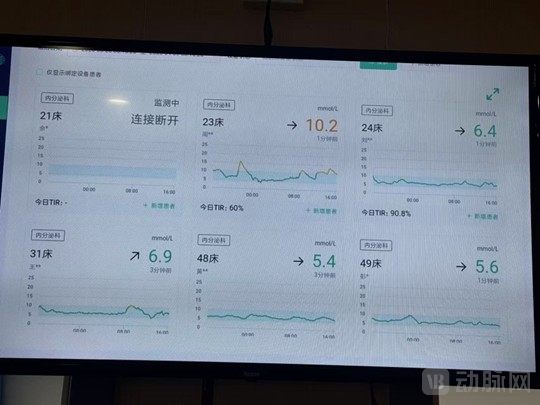
In-Hospital Intelligent Blood Glucose Management System
Abbott's insufficient investment in the Chinese market has also reduced obstacles for domestic companies to seize the market. Although China is the largest self-paying market for Abbott's continuous glucose monitors, its scale is smaller compared to other markets with medical insurance reimbursement. Abbott places more emphasis on markets with medical insurance reimbursement, especially countries where the reimbursement scope for continuous glucose monitors is expanding, such as France, Germany, Japan, and Canada.
The explosive growth of dynamic blood glucose meter companies is deeply reliant on the synergistic impact of three core strategies: exploring new channels, seizing policy subsidies, and tapping into new scenarios, which constitute the "growth code" for companies to secure future success.
Under the叠加of multiple favorable factors, domestic continuous glucose monitoring (CGM) enterprises are actively seizing market opportunities and increasing their market exposure. Almost all domestic CGM companies have chosen to scale up by increasing investment.
Sinocare once stated that choosing a model prioritizing scale over profit was based on three considerations: First, in emerging markets with very low penetration rates, rapidly establishing a user base and brand awareness is crucial; second, economies of scale can effectively reduce unit costs, laying a foundation for future development; third, expanding coverage holds strategic significance under the promotion of the tiered medical treatment policy.
In this market competition, the strategy of seeking to establish scale first requires a large amount of sales expenses for support. Taking Sinocare as an example, in 2024, due to increased investment in online sales expenses and market investment in continuous glucose monitoring (CGM) products, Sinocare's sales expenses reached 1.192 billion yuan, increasing by 21.53% compared to the same period last year. This also impacted profit performance. In Q1 2025, due to increased strategic investment in CGM, including marketing investment and overseas certification costs, Sinocare’s sales expenses rose, leading to a decline in profits. In Q1 2025, Sinocare’s total operating revenue was 1.042 billion yuan, a year-on-year increase of 2.76%, while net profit attributable to shareholders was 72.1151 million yuan, a year-on-year decrease of 10.9%.
The investment at present holds strategic significance for future development. Amid fierce competition, the price war for continuous glucose monitors (CGMs) is intensifying. In 2024, when the price war for CGMs first emerged, the unit price dropped to 100 yuan per unit when purchasing multiple units, and recently, the lowest unit price has fallen to 73 yuan!
An industry insider stated: Price wars will lower user expectations. The price of a single dynamic blood glucose monitor has dropped from over 400 yuan to less than 100 yuan, making it very difficult to raise prices in the future.
Sinocare once stated that this competitive situation is expected to shift the focus of competition to product differentiation and service quality as market penetration increases, or create new value space through product upgrades driven by technological service innovation.
Winning the dynamic blood glucose monitoring industry requires a "long-distance run." Companies need top-notch continuous product innovation capabilities, precise market positioning and marketing power, global resource integration and payment breakthrough capabilities, as well as the ability to build collaborative industry ecosystems—this is a field with extremely high comprehensive capability requirements.
Continuous Glucose Monitors Demand High R&D Investment. Sinocare's R&D investment in 2024 was 319 million yuan, a year-on-year increase of 16.27%; MicroTech Medical's R&D investment in 2024 was 76.56 million yuan.
How Will Hundreds of Millions in R&D Funding Shape the Next Generation of Continuous Glucose Monitors?
First, continuously improve sensor performance. Enhance the accuracy and stability of products, reduce product size, and extend product usage time. The update iteration speed of CGM is very fast, requiring enterprises to constantly optimize products to meet the diversified needs of the market for continuous glucose monitoring.
Secondly, the integration of continuous glucose monitors and insulin pumps is a focus for Abbott, Dexcom, MicroTech Medical, and Sinocare. MicroTech Medical's PanCares closed-loop artificial pancreas system has been submitted for registration to the National Medical Products Administration (NMPA); Sinocare's "intelligent decision support system for diabetes insulin dosing that integrates multi-source physiological information" is under development; Dexcom has long been committed to the artificial pancreas field; Abbott has reached strategic cooperation with insulin pump companies Tandem and Medtronic.
The third is to optimize the production process to reduce manufacturing costs and usage costs. A reduction in the cost of continuous glucose monitors (CGMs) is expected to open up a larger market. Overseas IVD company Trinity Biotech is developing a reusable, rechargeable CGM, with an anticipated FDA registration submission in 2026.
The fierce competition in the continuous glucose monitoring market is unavoidable. Companies can only establish irreplicable unique value amid the turmoil, strengthen the distinctive value of products and services, attract and retain truly valuable customers, while improving technology and reducing costs to lay a foundation for competition after the market becomes more rational.