

siRNA Therapies Surge Forward: Multiple Innovative Drugs Race Toward Functional Cure for Chronic HBV

Argo
RNAi Drug Developer

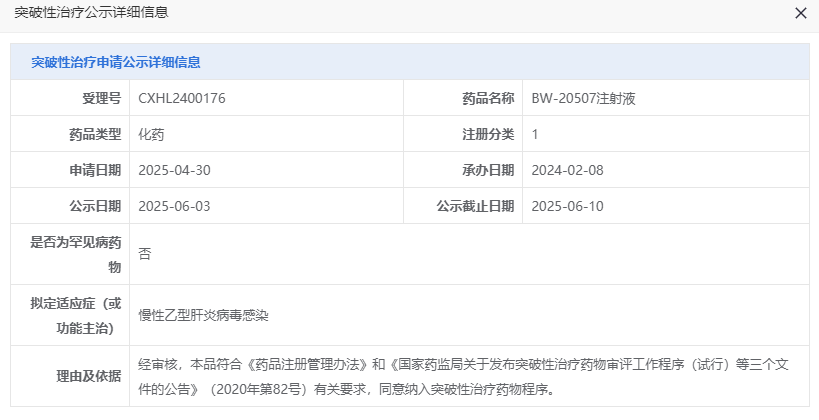
On June 3, BW-20507 Injection, a Class 1 new drug developed by Hangzhou Argo Biopharma Co., Ltd., was proposed by the CDE to be included in the breakthrough therapy category for the treatment ofChronic Hepatitis B Virus Infection。
Hepatitis B virus (HBV) infection is a major global public health issue. Statistics show that chronic HBV infection affects approximately 296 million people worldwide, causing around 820,000 deaths annually due to severe complications such as cirrhosis, liver decompensation, and hepatocellular carcinoma (HCC).
Functional cure is recognized as the ideal treatment goal in the current guidelines for the prevention and treatment of chronic HBV both in China and internationally. It refers to the maintenance of a negative hepatitis B surface antigen (HBsAg) after cessation of treatment, with or without the presence of anti-HBs (hepatitis B core antibody), HBV DNA below the lower limit of detection, normal liver biochemical indicators, and the possible continued presence of covalently closed circular DNA (cccDNA) in the nuclei of hepatocytes. However, there remains a significant unmet medical need for treatments that can achieve a functional cure for chronic HBV.
BW-20507 is a small interfering RNA (siRNA) molecule targeting the S region of hepatitis B virus (HBV) messenger RNA developed by Argo based on its proprietary RNAi platform and unique proprietary technology. It is currently in Phase 2 clinical trials in patients with chronic hepatitis B virus infection.
Data from the Phase 1/2a clinical study of BW-20507 for the treatment of chronic hepatitis B, presented at the 2025 European Association for the Study of the Liver (EASL) Annual Meeting, showed that: BW-20507 administered subcutaneously once every four weeks for a total of three doses significantly reduced HBsAg levels in a dose-dependent manner, with maximum reductions of 2.9~3.2 log IU/mL observed in the 200mg and 400mg dose groups; among subjects with baseline HBsAg levels below 1000 IU/mL, 56% achieved HBsAg clearance during the study period; robust HBV DNA suppression was also observed in treatment-naïve subjects not concurrently receiving virologic suppression or nucleos(t)ide (NUC) therapy; BW-20507 demonstrated a favorable safety and tolerability profile.
Some patients treated with three doses of BW-20507 have already shown HBsAg clearance, bringing new hope for functional cure to patients with chronic HBV. This is extremely rare in siRNA monotherapy. In addition to monotherapy for chronic HBV, Argo Biopharma also plans to initiate a Phase 2b clinical trial of BW-20507 in combination therapy for chronic HBV.
In addition to BW-20507, according to incomplete statistics, there are multiple siRNA therapies under research in China for the treatment of chronic HBV infection, such as HT-101 from Argo Biopharma, RBD1016 from Ribo Biotech, VIR-2218 (elebsiran, BRII-835) from Brii Biosciences, TQA3038 from CT Tianqing, and HRS-5635 from Hengrui Medicine.
• RBD1016Using N-acetylgalactosamine (GalNAc) delivery technology, it targets the conserved region of the X gene of HBV and inhibits all four transcripts of HBV through the RNA interference mechanism. It has the ability to simultaneously inhibit HBV DNA replication, reduce HBsAg derived from cccDNA and integrated DNA, and lower other antigens. Clinical research data on RBD1016 presented at the 2023 European Association for the Study of the Liver (EASL 2023) annual meeting showed that RBD1016 consistently suppressed HBsAg, HBV DNA, HBV RNA, and HBcrAg. In October 2024, RBD1016 received clinical approval in China.
• HT-101It is the first China-produced anti-hepatitis B siRNA to enter the clinical stage and is currently in Phase 2 clinical trials. This drug is a GalNAc-conjugated siRNA innovative drug that inhibits hepatitis B virus particles by interfering with the mRNA of the hepatitis B virus, disrupting its function as a post-transcriptional translation template, and preventing the synthesis of related viral proteins. It is used for the treatment of chronic HBV infection.
The results of the published Phase 1b and Phase 1c clinical studies show that: After only two injections of HT-101, HBsAg continued to decrease in some patients even 48 weeks after discontinuation of the drug, and some even achieved serological clearance. Other viral parameters such as HBV DNA, RNA, HBcrAg, and HBeAg also improved in patients. Moreover, HT-101 demonstrated excellent safety and tolerability in the clinical studies.
• VIR-2218It is a GalNAc-modified siRNA therapy that utilizes Enhanced Stabilization Chemistry Plus (ESC+) technology, targeting the conserved X region of HBV. It aims to silence all HBV transcripts of all 10 HBV genotypes, including cccDNA and integrated DNA.
In May 2024, VIR-2218 was included by the CDE as a breakthrough therapy for the treatment of chronic HBV infection.
• HRS-5635HRS-5635 is a novel covalently conjugated triantennary N-acetylgalactosamine (GalNAc) siRNA developed by Hengrui Medicine. It selectively delivers into hepatocytes through the binding of GalNAc to the asialoglycoprotein receptor (ASGPR) on the surface of liver cells. Inside hepatocytes, HRS-5635 specifically targets the HBV X gene via the RNAi interference pathway, inhibiting the expression of HBV virus-related proteins and exerting antiviral effects.
Non-clinical efficacy studies show that HRS-5635 exhibits excellent antiviral activity against all HBV genotypes and can exert potent and long-lasting antiviral effects in vivo. Non-clinical safety evaluation studies indicate that HRS-5635 has no off-target activity and high safety. Currently, the drug is in Phase 2 clinical trials.
'%20fill='%23FFFFFF'%3E%3Crect%20x='249'%20y='126'%20width='1'%20height='1'%3E%3C/rect%3E%3C/g%3E%3C/g%3E%3C/svg%3E)
Click "Pharmacology" below to follow more exciting content.
Disclaimer
The push rules of WeChat Official Accounts have changed again. If you don't tap"Under Observation"Or not set to"Star Mark", we might just dissipate in the vast ocean of literature~ Click here, don't miss out on the latest news from PharmaDJ!??