

AlphaFold 3 Unveiled: $250M Seed-Funded AI Breakthrough in Molecular Interaction Prediction

DeepMind
Artificial Intelligence Enterprises

Isomorphic Labs
AI Drug Developer
May 8, 2024, GoogleDeepMindJointly published with Isomorphic Labs in the journal *Nature* the latest AI model AlphaFold 3 in the field of proteins! This model can accurately predict the structures of biomolecules such as proteins, DNA, RNA, and ligands, as well as their interaction patterns. This follows...AlphaFold 2Another Major Breakthrough Afterwards
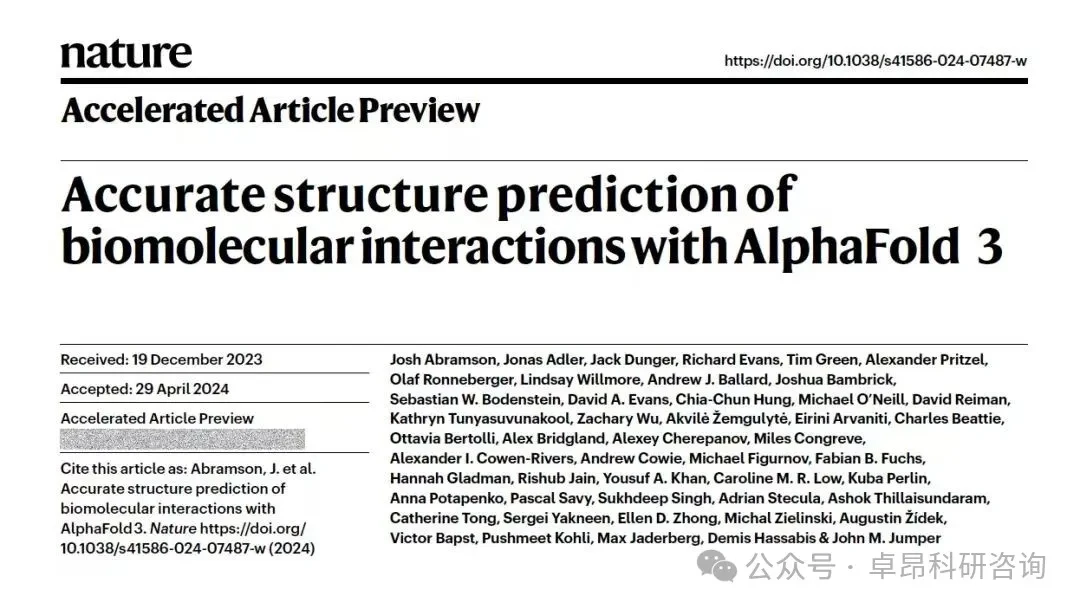
In predicting drug interactions, AlphaFold 3 has achieved unprecedented accuracy, including the binding of proteins with ligands and antibodies with their target proteins.PoseBustersIn the benchmarking of,AlphaFold 3 is 50% more accurate than the best existing traditional methods, and it requires no structural information input, making it the first artificial intelligence system to surpass traditional physics-based prediction tools.This ability to predict antibody-protein binding is crucial for understanding various aspects of the human immune response and new antibodies.The design is crucially importantYes.
With the development of high-throughput biotechnology, various omics technologies have been developed to characterize different but complementary biological information, includingGenomics, Epigenomics, Transcriptomics, Proteomics, and Metabolomics, etc.
Recent advances in artificial intelligence have evolved from "shallow" learning architectures to "deep" learning architectures. As an important branch of artificial intelligence, machine learning (ML) can automatically learn to capture complex patterns and make intelligent decisions based on data. ML has a very wide range of applications in cancer research and clinical oncology. In particular, driven by the rapid growth of multi-omics data, deep learning (DL)-based methods, which belong to the subfield of ML, have become a powerful tool for biomedical data analysis.
How hot are the research fields of artificial intelligence and omics, and why is it necessary to hold training sessions? The following content provides answers.
In the past two years, top research groups from MIT, Harvard University, UPenn, Tsinghua University, Fudan University, Westlake University, and others have been engaged in research on artificial intelligence and biomedicine. These research achievements have been repeatedly published in well-known international top journals such as Nature Reviews Genetics, Nature Methods, Science Advances, Cancer Cell, and Nature Biotechnology, laying the foundation for our publication in top journals.
Due to the limited research materials and learning platforms, non-disclosure of information technology, and the urgent need for training, we sincerely invite you to attend the "Artificial Intelligence and Omics" online training course. The number of participating members has reached over 2000! Publish in top journals! Hop on board quickly!
'%20fill='%23FFFFFF'%3E%3Crect%20x='249'%20y='126'%20width='1'%20height='1'%3E%3C/rect%3E%3C/g%3E%3C/g%3E%3C/svg%3E)
Eight Major Courses to Help Publish in Top Journals
AI Protein Design
CADD Computer-Aided Drug Design
AIDD Artificial Intelligence Drug Discovery and Design Top Journal Reproduction
Machine Learning Microbiome Multi-Omics Joint Analysis
Deep Learning Genomics
Machine Learning Metabolomics
Deep Learning Analysis of Proteomics
Introduction of the Lecturer
AI Protein Design
The lecturer, Dr. Liu, holds a Ph.D. in Bioinformatics and has been engaged in bioinformatics and medical artificial intelligence research for 15 years. He has developed several bioinformatics tools, published over 20 SCI papers, including nearly 10 articles on artificial intelligence algorithms, and authored a practical textbook on medical data analysis. His research focuses on the application of medical artificial intelligence in the diagnosis and treatment of complex diseases.
CADD Computer-Aided Drug Design
The lecturer is from the Institute of Biophysics, Chinese Academy of Medical Sciences (PUMC). The lecturer specializes in deep learning, machine learning, virtual drug screening, computer-aided drug design, AI-driven drug discovery, molecular docking, and molecular dynamics. They have published several articles in CNS journals and possess extensive training experience, having trained over 5,000 students.
AIDD Artificial Intelligence Drug Discovery Top Journal Reproduction
The lecturer is from Tianjin University, with over a decade of experience in computer algorithm research and programming. Research areas include bioinformatics, deep learning, drug synthesis pathway design, and adverse drug reactions. The lecturer holds 5 invention patents, has participated in 4 key national scientific research projects, and has published 10 high-level SCI papers in well-known journals such as BMC Bioinformatics, Journal of Biomedical Informatics, and International Journal of Molecular Sciences.
Machine Learning Metabolomics
The lecturer is a Ph.D. in neuroscience from a 985 university, primarily utilizing technologies such as metabolomics, transcriptomics, and molecular biology to study the pathogenesis and biomarkers of chronic diseases in neurology. Skilled in conducting comprehensive research on untargeted and targeted metabolomics using liquid chromatography-mass spectrometry (LC-MS) technology, from sample preparation to data analysis, as well as bioinformatics integration analysis of multi-omics big data. In the past five years, they have published 10 SCI papers in journals such as J Clin Invest, EBioMedicine, Cell Death Dis, Cell Death Discov, and Nanotoxicology.
Machine Learning Microbiomics
The main speaker, Dr. Li, holds a Ph.D. in Bioinformatics and has over a decade of experience in sequencing data analysis. His research areas include machine learning, microarray data analysis, nucleic acid and protein sequence analysis, metagenomics, DNA, RNA, methylation sequencing data analysis, single-cell sequencing data analysis, miRNA and target gene analysis, survival analysis, and prognostic model construction. He has extensive training experience, having conducted more than 50 online and offline training sessions. The training content covers the application of machine learning in biomedicine, microbiology, and proteomics, single-cell multi-omics data mining, WGCNA co-expression network construction, ceRNA network construction, and R programming basics. He has published over 30 SCI papers, including 15 as the first author or co-first author, with an h-index of 20.
Deep Learning Genomics
The lecturer, Dr. Chen, is a Ph.D. candidate from the Netherlands. He has published several papers in domestic and international academic journals, including renowned journals such as Nature Communications and Cell Regeneration. His research focuses mainly on the three-dimensional structure of chromatin, bioinformatics, developmental biology, and genetics. By utilizing multi-omics data and deep learning algorithms, he conducts data analysis and mining, including ChIP-seq, ATAC-seq, RNA-seq, CNV, etc., to address and answer fundamental biological mechanisms within the field.
Deep Learning Analysis of Proteomics
The lecturer, Dr. Liu, holds a Ph.D. in Bioinformatics and has been engaged in bioinformatics and medical artificial intelligence research for 15 years. He has developed several bioinformatics tools, published over 20 SCI papers, including nearly 10 articles on artificial intelligence algorithms, and authored a practical textbook on medical data analysis. His research focuses on the application of medical artificial intelligence in the diagnosis and treatment of complex diseases.
CRISPR-Cas9 Gene Editing Technology
The lecturer, from the Chinese Academy of Agricultural Sciences, has over a decade of experience in gene editing research. They are familiar with the application of gene editing across various fields and have deep expertise in the development and optimization of gene editing systems. With dozens of SCI publications, they also possess extensive teaching experience!
Swipe to view
Case Study Images:
Swipe to view
Case Practice Images:
Swipe to view
Case Study Images:
Swipe to view
Case Study Images:
Swipe to view
Case Practice Images:
Swipe to view
Case Practice Images:
Swipe to view
Case Practice Images:
Swipe to view
Case Practice Images:
Training Objectives
01.AI Protein Design: The course will provide a detailed explanation of various protein structure prediction models, including Alphafold2, Rosettafold2, ESMfold, RosettafoldNA, Rosettafold All Atom, and AlphaFold3, enabling students to master the use of multiple protein structure prediction models and compare different protein sampling methods. Students will also learn protein multi-conformation sampling methods and model usage tools, deep learning protein dataset mining tools, and protein pocket search tools with hands-on demonstrations. Students will understand the theoretical foundations of these two tools and, through practical operation, learn how to identify and analyze protein pockets. Deep learning-based protein RFDiffusion (structure generation model), ProteinMPNN (inverse folding model), and ProteinGenerator (structure and sequence generation model) utilize Alphafold2 to improve the success rate of protein design; enabling students to master David Baker's core technologies.
02.CADD Computer-Aided Drug Design: This training mainly covers 10 docking methods, including metalloenzyme-protein docking, protein-polysaccharide docking, nucleic acid-small molecule docking, flexible docking, covalent docking, protein-hydrated docking, protein-water-ligand docking, antibody docking, macromolecule docking (protein-peptide docking), macromolecule protein-protein docking, as well as virtual screening and molecular dynamics simulation.
03.AIDD Artificial Intelligence Drug Discovery Top Journal Reproduction: This training focuses on mastering the application of deep learning in chemical reaction prediction, establishing a systematic understanding from protein modeling to downstream tasks (such as drug screening, mechanism of action analysis) for real drug development scenarios, enhancing the ability to apply AI methods to practical biomedicine problems, the application of Natural Language Processing (NLP) in molecular generation, the application of diffusion models in molecular generation, and through case studies (e.g., Interformer screening for high-affinity small molecules), learning how to apply these predictive technologies to enzyme engineering and drug discovery to accelerate the screening and optimization of candidate molecules.
04. Deep Learning Genomics: Deeply study and understand the basic frameworks and logic of deep learning while mastering the use of fundamental bioinformatics software (Linux, R, Python, etc.), enabling learners to better handle genomic data and uncover new knowledge beyond existing understanding. Constructing robust deep learning models to explore new research ideas and identify potential biological mechanisms, thereby better serving one’s own scientific research and exploration.
05. Machine Learning Metabolomics: 1. Familiar with the background knowledge of metabolomics and machine learning, as well as hardware and software; 2. Introduction to R language and machine learning theory and common usage; 3. Master the entire process of metabolomics from sample processing to upstream and downstream data analysis and graphing; 4. Able to reproduce figures from metabolomics-related articles in CNS and its subsidiary journals; 5. Able to analyze one's own metabolomics data flexibly and proficiently.
06.Deep Learning for Proteomics Analysis: The course provides in-depth explanations and hands-on practice on the application of deep learning in proteomics, enabling students to master the process of analyzing proteomics data using deep learning. It offers systematic learning of deep learning and proteomics theory, familiarizes students with software coding operations, and ensures proficiency in using these cutting-edge analytical tools as well as innovating deep learning algorithms to address biological and clinical disease-related issues and demands.
07. Machine Learning Microbiome Multi-omics Joint Analysis: AIDD Artificial Intelligence Drug Discovery and Design: This course allows students to understand the cutting-edge background of drug discovery, learn various common algorithms in the field of artificial intelligence, become familiar with the installation and use of toolkits, acquire certain algorithm programming skills, and be able to apply computational methods to study drug-related issues. Through extensive case studies and hands-on practice, students will develop some capacity for AIDD model construction and data analysis.
08.Application of CRISPR-Cas9 Gene Editing Technology: This course starts from a global perspective, covering the basic principles of cutting-edge tools like CRISPR-Cas9 to their practical applications in fields such as medicine and agriculture. It progresses from simple to complex, starting with fundamental principle explanations and ending with hands-on application practices. Upon completing this course, you will master the relevant principles and applications of gene editing technology. Additionally, you will learn optimization strategies for gene editing systems and how to operate commonly used biology software. Whether you are a biology student or a researcher interested in gene editing, this course will provide you with valuable knowledge and skills to help you make breakthroughs in this revolutionary field!
Teaching Time
01.AI Protein Design
2025.07.12-2025.07.13 (09:00-11:30--13:30-17:00)
2025.07.19-2025.07.20 (09:00-11: 30--13:30-17:00)
2025.07.26-2025.07.27 (09:00-11: 30--13:30-17:00)
2025.08.02 (09:00-11: 30--13:30-17:00
02.CADD Computer-Aided Drug Design
2025.07.12-2025.07.13 (09:00-11:30--13:30-17:00)
2025.07.19-2025.07.20 (09:00-11: 30--13:30-17:00)
2025.07.26-2025.07.27 (09:00-11: 30--13:30-17:00)
2025.08.02 (09:00-11: 30--13:30-17:00
03.AIDD Artificial Intelligence Drug Discovery Top Journal Reproduction
2025.07.15-06.07.18 (19:00--22:00)
2025.07.20-06.07.23 (19:00--22:00)
2025.07.28-06.07.29 (19:00--22:00)
04.Deep Learning Analysis of Proteomics
2025.07.12-2025.07.13 (09:00-11:30--13:30-17:00)
2025.07.19-2025.07.20 (09:00-11: 30--13:30-17:00)
2025.07.26 (09:00-11: 30--13:30-17:00)
05.Deep Learning Genomics
2025.07.19-2025.07.20 (09:00-11: 30--13:30-17:00)
2025.07.26-2025.07.27 (09:00-11: 30--13:30-17:00)
2025.08.02 (09:00-11: 30--13:30-17:00)
06.Machine Learning Multi-Omics Joint Analysis of Microbiota
2025.07.19-2025.07.20 (09:00-11: 30--13:30-17:00)
2025.07.26-2025.07.27 (09:00-11: 30--13:30-17:00)
2025.08.02 (09:00-11: 30--13:30-17:00)
07. Machine Learning Metabolomics
2025.07.14-2025.07.17 (19:00--22:00)
2025.07.21-2025.07.24 (19:00--22:00)
2025.07.29-07.30 (19:00--22:00)
08.Application of CRISPR-Cas9 Gene Editing Technology
2025.07.12-2025.07.13 (09:00-11:30--13:30-17:00)
2025.07.19-2025.07.20 (09:00-11: 30--13:30-17:00)
2025.07.26 (09:00-11: 30--13:30-17:00
Tencent Meeting Live Streaming Classes Live Playback Available After Class
Training Costs
Course Registration Fee:
Deep Learning Genomics, Machine Learning Metabolomics, Deep Learning Proteomics Analysis, Machine Learning Multi-Omics Joint Analysis of Microbiota, Application of CRISPR-Cas9 Gene Editing Technology
Public Price: ¥4980 per person per class (including registration fee, training fee, and material fee)
Self-funded Price: ¥4680 per person per class (including registration fee, training fee, and material fee)
AI Protein Design:
Public Price: ¥6880 per person per class (including registration fee, training fee, and material fee)
Self-funded price: ¥6,580 per person per class (including registration fee, training fee, and material fee)
AIDD and CADD:
Public Price: ¥5880 per person per class (including registration fee, training fee, and material fee)
Self-funded price: ¥5,580 per person per class (including registration fee, training fee, and material fee)
Heavyweight Discounts:
Discount 1:
Buy Two, Get One Free (Sign up for two classes and get one learning spot free, the free class can be chosen freely)
Two Classes Together: 10,880 RMB (Can attend three live courses)
Three Classes Together: 14,880 RMB (Can study four live courses)
Four classes together: 18,880 yuan (Free access to any courses held by our institution for a whole year)
Special Offer 2: 28,880 RMB (Free access to any courses hosted by this institution for two full years)
Discount 3: Early registration and payment can enjoy a 300 yuan discount (limited to fifteen participants).
Special Offer: Buy One Get One Free (Bonus Replay) (Including full course replays and lecture materials PPT)
Free Gift Course | Machine Learning Biomedical Online Replay Course
Free Gift Course | Single-Cell Spatial Transcriptomics Online Replay Course
Free Gift Course | Comparative Genomics Online Replay Course
Free Gift Course | Machine Learning Proteomics Online Replay Course
1. Course Features -- Comprehensive Coverage of Technical Applications, Principles and Processes, and Practical Examples
2. Learning Mode -- Combining theoretical knowledge with hands-on operation, enabling beginners to quickly master the skills.
3. Course Service Q&A -- The main instructor will provide professional answers to the questions you encounter in your actual work.
Teaching Method: Online live streaming via Tencent Meeting, theory+Hands-on teaching mode, where the teacher guides students step by step through operations.Starting from scratch, electronicPPTAnd TutorialsOne week before the course starts, all training software will be sent to the students in advance. If there are any questions, they can be resolved through voice activation, screen sharing, and WeChat group discussions. Students and teachers communicate with each other, as well as students with other students. After the training is completed, the teacher will continue to answer questions for a long time. The training group will not be disbanded. Past trainees have consistently given very high evaluations of the training quality and teaching methods!
Tencent Meeting Live Streaming Q&A | Step-by-Step Guidance
Contact: Teacher Ye
Registration phone: 13838281574(WeChat same number)
Email: y13838281574@163.com