

Signet BioSciences Showcases First-in-Class Diffuse Gastric Cancer Drug SIGX1094 at CGOG Annual Meeting Amid IPO Filing
SIGNET
Innovative Targeted Cancer Drug Developer
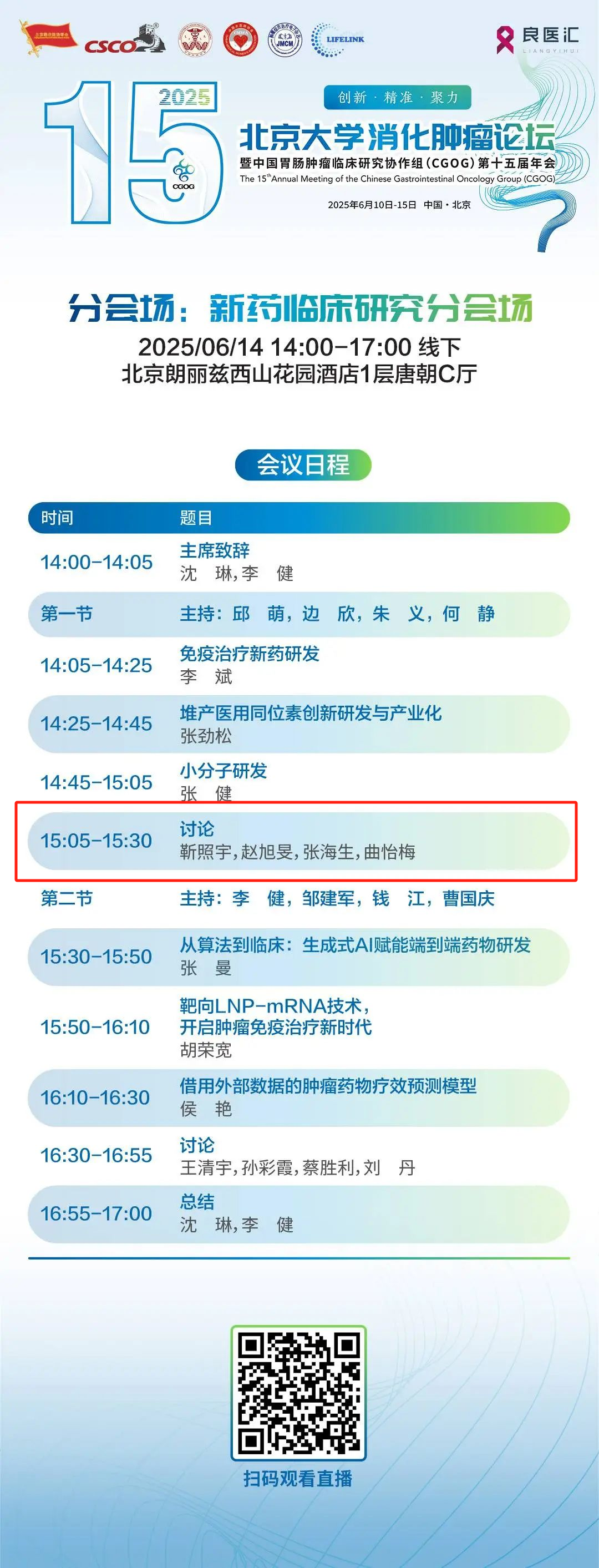
The 15th Peking University Digestive Tumor Forum and the Annual Meeting of the China Gastrointestinal Oncology Clinical Research Collaboration Group (CGOG) was recently held in Beijing. Dr. Hai Sheng Zhang, founder and CEO of Signet Therapeutics, was invited to participate in this conference and will attend the roundtable discussion session of the "New Drug Clinical Research Sub-venue" from 15:05 to 15:30 on the afternoon of June 14.
SIGNET currently has four first-in-class targeted drug pipelines, with the first pipeline, SIGX1094, being the first targeted therapy for diffuse gastric cancer. It is currently undergoing Phase I clinical trials at the Peking University Cancer Hospital and has demonstrated good safety and preliminary anti-tumor activity during the dose-escalation phase of the trial.
The CGOG Annual Meeting brings together top experts in the field of gastrointestinal oncology, including Professor Lin Shen, who is leading the Phase I clinical trial of Signet Therapeutics. The conference will delve into in-depth discussions on basic research, clinical diagnosis and treatment, and new drug development for gastrointestinal tumors. We sincerely invite all scholars, experts, and industry peers to participate in this academic feast.
About CGOG
China Gastrointestinal Oncology Group (CGOG) was founded on November 27, 2010. It is a non-profit academic organization composed of medical professionals, researchers, and industry colleagues in the field of digestive system tumors across China, represented by Professor Lin Shen. Exploring the unknown in basic research, refining true knowledge in clinical practice, and creating value in technology transformation, the perfect integration of clinical work and scientific research has driven the progress of medical development. The aim of CGOG’s establishment is to unite and organize workers in the field of digestive system tumors in China, build a platform for academic exchange and cooperation, promote the clinical work, research, and collaboration of digestive system tumors in China, address the challenges posed by these tumors with both "high incidence" and "regional characteristics," advance the development of innovative drugs in China and the establishment of precision treatment systems, and contribute Chinese wisdom to the global medical community. CGOG has successfully held 15 annual meetings to date, each presenting unique highlights and receiving strong support and widespread recognition from peers both domestically and internationally.
About SIGNET
SIGNET is a global pioneer in the "organoid + AI" drug development model, recognized as a specialized and innovative enterprise in Shenzhen and certified as a National High-tech Enterprise. The company originated on the campus of Harvard University and officially established its presence in Shenzhen by the end of 2020, having since secured nearly 220 million yuan in financing and project funding. Currently, the company has four drug pipelines, with the first pipeline developing SIGX1094, the world’s first targeted drug for diffuse gastric cancer. It has obtained IND approval from both the U.S. FDA and China's NMPA, and received Orphan Drug Designation and Fast Track Designation from the U.S. FDA. Phase I clinical trials are currently underway at the Peking University Cancer Hospital.
Signet is not only the phonetic translation of Signet but also adheres to the vision of "full of hope, studying things to gain knowledge." The company leverages the critical role of organoid disease models that closely resemble patients' genomic characteristics in drug efficacy evaluation and novel target discovery. Combined with AI-powered screening, synthesis, and optimization of small-molecule compounds, it develops first-in-class innovative targeted drugs. The company has approximately 1500 square meters of R&D space and 500 square meters of animal laboratory space. Signet Therapeutics’ organoid platform not only serves its own drug pipeline but also actively empowers large pharmaceutical companies in new drug development. Collaborative partners include Shenzhen Second People's Hospital, the University of Hong Kong, the Hong Kong University of Science and Technology, Shenzhen BioRay Pharma, and Genuine Biotech, among others, supporting the birth of more innovative drugs.
1
END
1
'%20fill='%23FFFFFF'%3E%3Crect%20x='249'%20y='126'%20width='1'%20height='1'%3E%3C/rect%3E%3C/g%3E%3C/g%3E%3C/svg%3E)
Click to read the original text and learn more about the detailed conference agenda.