

Supira Medical Secures $120M Series E Funding to Accelerate Clinical Trials of Its Innovative Percutaneous Ventricular Assist Device

Supira Medical
Medical Auxiliary Equipment Developer
Recently, Supira Medical, a developer of cardiovascular interventional devices, secured an oversubscribed $120 million Series E financing round (approximately RMB 860 million), co-led by Danish life sciences giant Novo Holdings and Middle Eastern sovereign fund Qatar Investment Authority (QIA).
The company has previously completed the enrollment for the U.S. SUPPORT I Early Feasibility Study (EFS). The proceeds from this round of financing will mainly be used to expand the scope of the SUPPORT I study, conduct multi-center clinical trials, and accumulate more clinical data to support the U.S. FDA Pre-Market Approval (PMA).
At the same time, Supira Medical will strengthen the company's R&D capabilities, further optimize product performance, expand the product line, and increase production capacity to fully prepare for the product's market launch.
Supira Medical, established in 2012, is a privately held company backed by the medical device incubator Shifamed, founded on a deep understanding of unmet needs in the field of cardiovascular disease treatment.
In the treatment of cardiovascular diseases, high-risk patients face dual clinical challenges:
The surgical risk is high.Patients with severe coronary artery disease (CAD) or multiple comorbidities face extremely high risks during traditional percutaneous coronary intervention (PCI) procedures. Complications such as hemodynamic instability and arrhythmias often arise due to issues like impaired cardiac function and complex vascular lesions, leading to significantly higher surgical mortality and complication rates compared to the general patient population.
High risk of infection.Existing ventricular assist devices, due to the larger size of the catheter, are prone to complications such as vascular injury, hematoma, and acute limb ischemia. Even if the surgery is successful, high-risk patients often experience slow postoperative recovery accompanied by various complications such as infection, bleeding, and renal insufficiency, which prolong hospital stays while increasing the medical burden.
Supira Medical's core product, the Supira System, as a percutaneous ventricular assist device (pVAD), is specifically designed to address the aforementioned clinical challenges. It is primarily used to provide temporary mechanical support for high-risk patients undergoing interventional procedures, assisting the heart’s native pumping function and enabling patients to safely undergo necessary interventional surgeries. Specific applications include high-risk percutaneous coronary intervention (HRPCI) and cardiogenic shock scenarios.
The core working principle of the system is reflected in two major aspects:
1. Hemodynamic support to create a safe treatment environment.In actual clinical applications, patients are prone to complications such as hypotension and heart failure during HRPCI. The Supira system establishes a mechanical channel between the left ventricle and the ascending aorta, directly pumping blood from the left ventricle into the ascending aorta. This reduces the burden on the left ventricle, increases cardiac output, and effectively improves the patient's hemodynamic status, stabilizes blood pressure, and enhances myocardial perfusion. As a result, it lowers surgical risks, increases success rates, and creates safer treatment conditions for high-risk patients.
Second, real-time monitoring and feedback enable precise adjustment of treatment strategies.For cardiogenic shock, a clinical syndrome characterized by severely impaired cardiac pumping function, the Supira system utilizes multiple sensors—including an aortic pressure sensor, left ventricular pressure sensor, and blood flow sensor—to monitor hemodynamic parameters in real time. It precisely reduces cardiac afterload, decreases oxygen consumption, protects myocardial function, and provides feedback to the control unit, assisting physicians in adjusting device operation parameters to optimize treatment outcomes and provide accurate support for surgical decision-making.
Supporting this innovative technology is Supira Medical's core team—a group of experts with profound expertise in cardiovascular medicine, bioengineering, and medical commercialization, each having over 20 years of experience in the medical device development field. Among them, Dr. Nitin Salunke, the company’s President and CEO, previously held senior executive positions at Medtronic, Altura Medical, and other healthcare enterprises, leading the research, development, and commercialization of multiple innovative medical device products before joining Supira Medical.

President and CEO Nitin Salunke Source: Supira Medical Official Website
As a percutaneous ventricular assist device (pVAD) specifically designed for high-risk cardiovascular patients, the Supira system provides comprehensive hemodynamic support for high-risk percutaneous coronary intervention (HRPCI) and cardiogenic shock (CS) patients through five major technological breakthroughs.
Its core advantages are reflected in multiple dimensions:
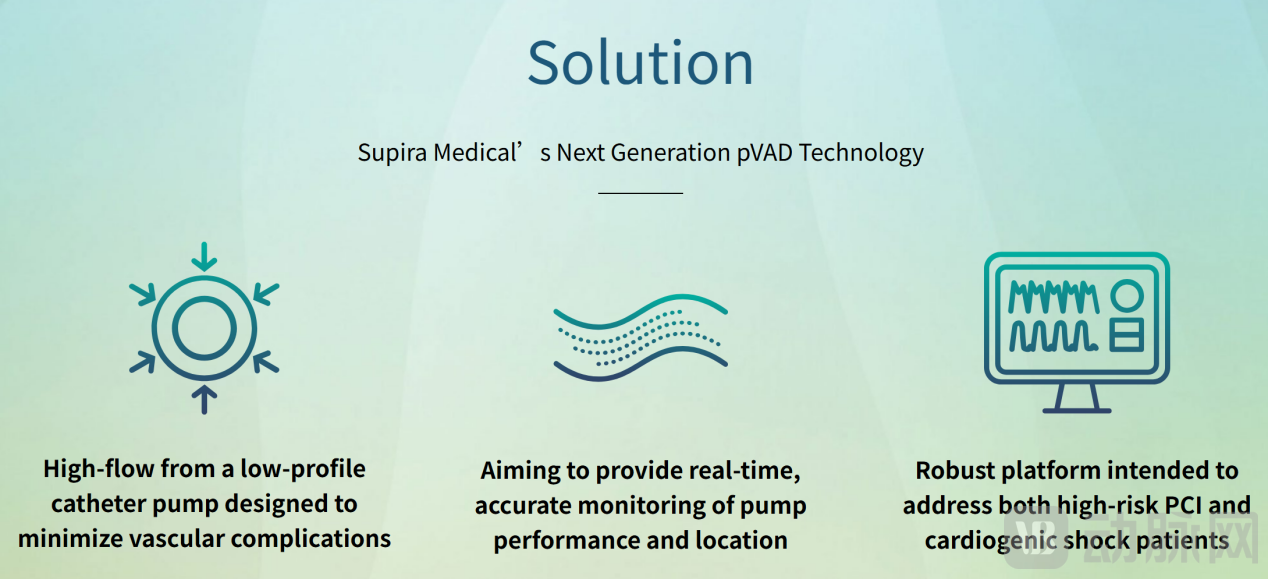 Supira Medical's Next-Generation pVAD Technology Source: Supira Medical Official Website
Low-profile design, combining minimally invasive and safety.The 10Fr (approximately 3.3mm) catheter of the Supira system is significantly smaller than the traditional pVAD's 14Fr-21Fr, effectively reducing the risk of vascular injury and hematoma, enhancing surgical flexibility, and accommodating more anatomical structures. Combined with the single ProGlide suture closure technique, it further simplifies the surgical process and reduces the risk of postoperative bleeding, promoting patient recovery.
High Flow Output Improves Tissue Perfusion and Reduces Surgical Risk.Providing a flow rate of up to 5.5 liters/min, it can better meet the cardiac output demands of high-risk patients during surgery, especially in treating severe hemodynamic disorders such as cardiogenic shock, effectively improving tissue perfusion and reducing mortality.
Self-expanding aortic impeller combined with flexible cannula design reduces blood damage.The system adopts advanced impeller technology and optimized flow channel design to improve the efficiency and flow output of the pump. The self-expanding aortic impeller can extend to a 22F diameter, enhancing system stability, meeting the treatment needs for cardiogenic shock, and reducing the risk of hemolysis; the flexible cannula design uses a segmented flexible structure to adapt to the aortic curvature anatomy, minimizing vascular wall friction.
High-precision sensors monitor in real time, enabling precise treatment.Equipped with a variety of high-precision sensors, it can monitor key hemodynamic parameters such as aortic pressure, left ventricular pressure, and blood flow velocity in real time, providing comprehensive and accurate patient physiological information. This helps doctors promptly identify potential issues like arrhythmia and insufficient ventricular filling, enabling precise and immediate treatment.
Rapid Exchange Delivery System, Enhancing Surgical Efficiency.Adopting a 0.018-inch rapid exchange delivery system, optimized for catheter delivery performance and enhanced flexibility. This allows physicians to place catheters quickly and accurately, reducing procedure time and radiation exposure. Additionally, the delivery system demonstrates excellent compatibility, working seamlessly with existing cardiovascular interventional devices, further expanding the product's application scope and clinical value.
This shows that, by integrating the five major technological advantages of "minimally invasive access, efficient blood pumping, intelligent monitoring, and quick operation," the Supira system provides a complete solution from technology to clinical application for patients with advanced coronary artery disease (CAD) and cardiogenic shock.
In 2023, Supira Medical completed its first-in-human trial, and the relevant clinical results were officially announced at the 2023 Society for Cardiovascular Angiography and Interventions (SCAI) Scientific Sessions. The data showed that the Supira system successfully performed high-risk percutaneous coronary intervention (PCI) surgeries with a 100% procedural success rate, no device-related adverse events, and no early signs of clinically significant hemolysis.
In November of the same year, the Supira system successfully obtained FDA Breakthrough Device Designation due to its innovation and clinical value. This designation not only brings policy benefits for expedited approval but also enhances the product's market trust through authoritative endorsement, becoming a key node connecting clinical data with capital injection.
As of now, Supira Medical has completed five rounds of financing from Series A to E, with each round providing crucial funding support for different stages of the company’s development, helping it overcome various challenges in research and development, clinical trials, and market expansion.
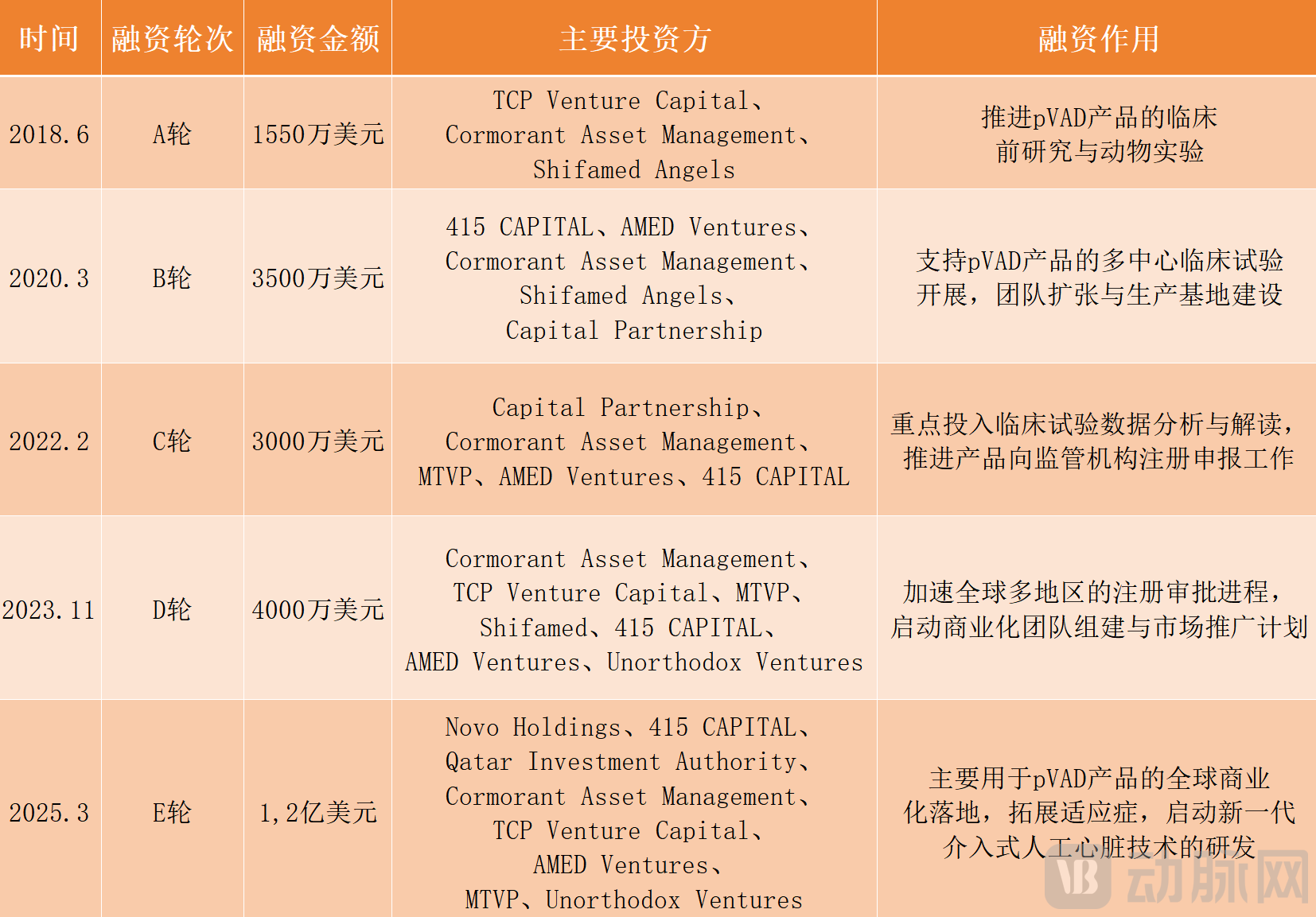
Overview of Supira Medical's Financing Journey
Against the backdrop of a global rise in cardiovascular disease incidence and an aging population, the ventricular assist device market, especially the pVAD segment, is experiencing rapid growth.
VCBeat previously reported in the article "This Interventional Modular Heart Pump Raises 225 Million Yuan in Financing + FDA Breakthrough Device Designation" and reviewed the R&D status of pVAD products from 19 companies both in China and internationally. Each company’s pVAD products have shown excellent performance in minimally invasive capabilities, convenience, and immediate support abilities. In the international market, products such as the Impella series and Elevate have provided new options for patients, while domestic companies like Tongling Bioengineering and Fengkaili are also accelerating technological breakthroughs.
Currently, although the Supira system is still in the research stage, with the support of five rounds of financing, Supira Medical is making full preparations for commercialization from research and development to clinical trials. As studies like SUPPORT I progress and FDA approval accelerates, the product will gradually enter the market. In the future, Supira Medical is expected to capture the pVAD market share with its technical advantages and clinical evidence, bringing innovative treatment options to more patients with cardiovascular diseases.