Home AbbVie and Oregon State University Introduce an E3 Ligand-Free Platform for Targeted Protein Degradation in JACS

AbbVie and Oregon State University Introduce an E3 Ligand-Free Platform for Targeted Protein Degradation in JACS

Jun 13, 2025 13:36 CST Updated 13:36

AbbVie

Innovative Drug Developer

Image

Early R&D Talking

Focus

Targeted Protein Degradation

Image
Image
Image
Image
Image

DOI: 10.1021/jacs.5c02741

Image

Talk Confidently, Apply Knowledge Practically


Image
Image
Currently, there are approximately 700 known and putative E3 ligases, and a major challenge in evaluating their suitability for targeted protein degradation (TPD) lies inLack of Ligase-Specific Binders
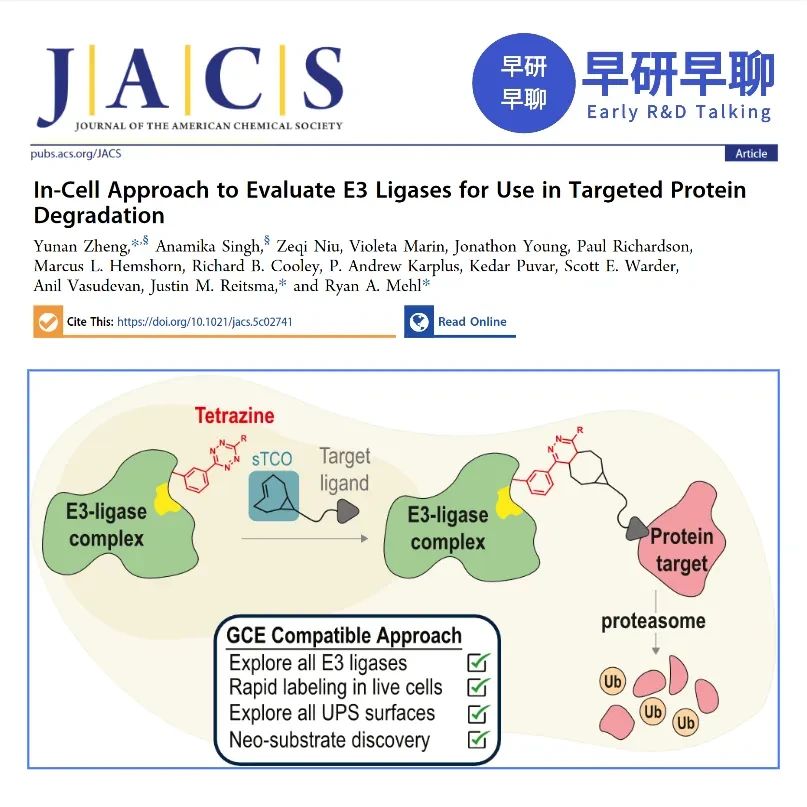
Recently (Jun. 10),AbbVieJointOregon State UniversityInJ. Am. Soc. Chem. Disclosed aNo E3 Ligase Ligand Required (FEL)Protein Targeting Degradation Platform.
The main workflow of the platform is as follows:
(1) UtilizationGenetic Code Expansion (GCE) Technology,Expressing an E3 ligase containing a tetrazine non-canonical amino acid (Tet-ncAA) encoded by a specific site in living cells;
(2) Integrate Tet with a strained trans-cyclooctene (sTCO) linked to a new substrate protein binder through click chemistry;
(3) The generated covalent E3 ligase-binder can then be used to evaluate the targeted protein degradation of new substrates.
The research team firstUse CRBN as POC validationDemonstrated that CRBN has a high degree of plasticity for TPD by studying CRBN containing Tet-ncAA at various surface positions; the CRBN-sTCO-JQ1 covalent body successfully recruited and degraded BRD2/4.
The efficiency of degradation depends on the position and length of the linker (Tet-ncAA).
This method excels in studying E3 surfaces, identifying optimal TPD interfaces and pockets.
Subsequently, the research team conducted applied research on an E3 ligase with an unknown specific ligand, speckle-type POZ protein (SPOP), and discovered that multiple sites on the surface of SPOP can support TPD, showing potential for TPD development.
This E3 ligase ligand-free degrader platform (ELF degrader platform) maintains the natural state of E3 ligases, enabling the study of any E3 surface region in living cells and is applicable to a wide range of E3 ligases.
This multifunctional approach is used forIdentification of functional degradation sites, guidance for degrader design, and unlocking new E3 ligases(especially E3 with no known ligands) for therapeutic applications.
Image

I. Research Background and Objectives

Image

01
The Importance and Limitations of Targeted Protein Degradation
Targeted Protein Degradation (TPD)Degradation of pathogenic proteins through the ubiquitin-proteasome system (UPS) offers therapeutic potential for "undruggable" targets, with representative strategies including molecular glue degraders (left figure below) and proteolysis-targeting chimeras (PROTACs, right figure below).
Image
The UPS-mediated protein degradation pathway requires the coordination of ubiquitin-activating enzyme (E1), ubiquitin-conjugating enzyme (E2), and ubiquitin-protein ligase (E3). Among these, the E3 ligase recognizes targets through its domain and facilitates the transfer of ubiquitin.
According to the ubiquitin transfer mechanism and domain composition, E3 ligases can be divided into three major families:
(1) RING finger family: Among which the CRL subfamily accounts for more than 40% of E3 ligases;
(2) HECT family: Homologous to the C-terminus of E3AP;
(3) RING- and -RING family (RBR).
CRLs are modular enzymes composed of four components: scaffold Cullin protein, RING finger protein that binds E2 enzyme, target recognition substrate receptor, and an adaptor protein that links the receptor to Cullin. The most well-known CRL is CRBN, which is the substrate receptor of the CRL4 complex.
Image
Currently, there are approximately 700 human E3 ligases, but only about a dozen have been applied in TPD, becauseOnly a few E3 ligases have known high-affinity ligands, which greatly limits the widespread application of TPD.
02
Evaluation Methods for Existing E3 Ligase TPD Applications
Currently, the evaluation of existing E3 ligases in TPD applications has limitations, mainly relying on two methods:
(1) Protein Tag-Induced Proximity Method: By adding protein tags to ligases to achieve tag-induced proximity, when strong interactions occur between the protein tags, the E3 ligase is brought into proximity with the target protein.
For example, HaloTag/FKBP12, dTAG, aTAG, or green fluorescent protein (GFP) nanobody.
(2) In Vitro Labeling Electroporation Method: Recombinant E3 ligases are generated in vitro, covalently functionalized with novel substrate protein binders based on cysteine-maleimide covalent modification, and then re-delivered into cells via E3 electroporation (COFFEE).
Image
The limitation of the protein tag-induced method lies in
(1) Unable to control site specificity,
(2) Large protein tags (15-30 kDa) are required, which may interfere with protein function.
(3) The tag can only be connected to the N-terminus or C-terminus.
The limitation of in vitro labeling electroporation is that: Only those modifications that can be purified, effectively labeled as a single Cys, and returned to a functional cellular UPS complex can be explored.
Due to these limitations, none of these methods can reveal the structural plasticity of untapped E3 ligases and their potential ligand binding sites.
03
Innovative Approaches and Research Objectives
In this paper, the research team developed a combination ofGenetic Code Expansion Technology, andClick Chemistry Conjugation TechnologyThe "E3 Ligase-free Degrader Platform" (ELF Degrader Platform) design scheme.
Image
Genetic Code Expansion (GCE): Expression of E3 ligase containing tetrazine non-canonical amino acid (Tet-ncAA) in living cells through site-specific incorporation of Tet3Bu via the amber stop codon (TAG).
Click Chemistry Coupling: Utilizing the efficient reaction between tetrazine (Tet) and trans-cyclooctene (sTCO), a new substrate binder (such as JQ1) linked with sTCO is covalently coupled with E3-Tet to form an ELF degrader, mimicking the function of PROTAC to bring E3 and the target protein closer.

2. Research Methods and Validation

Image

01
Proof of Concept (POC) Validation
The research team plans to first select the most common E3 ligase and a target of interest in the TPD field for conceptual model validation, then expand the application to E3 ligases with unknown ligands for methodological extension.
Therefore, the research team chose CRBN as the E3 with a known ligand for proof-of-concept validation and selected BRD2/4, members of the BET family proteins, as the target proteins of interest for POC verification.
As shown in Figure a, a containing3-Butyltetrazine Motif (Tet3Bu)The non-natural amino acid showed good binding with Hek293T cells and underwent rapid cellular click chemistry reactions with cell-permeable sTOC reagents, thus being selected for E3 ligase modification.
As shown in Figure b, two plasmids containing the Tet3Bu protein were effectively expressed in HEK293T cells.
Image
By varying the length of the sTCO linker, the researchers designed six chimeric "sTCO-JQ1 degraders," as shown in Figure c above.
As shown in Figure d, the researchers first selected five sites around the known IMiD binding pocket of CRBN and chose a distantly unrelated comparison site, R70, for comparative testing.
Researchers expressed Tet-protected CRBN within cells and achieved highly efficient validation of reactivity.
Image
Image
Through testing, all test sites (including the distal R70) can mediate BRD2/4 degradation; the degradation efficiency of proximal sites can reach up to 70%-75%; while the distal site R70 has a lower degradation efficiency of 20%-40%, but it is still effective.
Image
Image
Image
Image
In addition, the study also found that the length of the linker affects the degradation efficiency, wherein long-chain PEG5 > short-chain PEG1, probably because the long chain provides more flexible space.
02
SPOP Application: Unlocking Ligandless E3 Ligases
SPOP is an E3 ligase with no known high-affinity ligand, hindering the traditional development of PROTACs. As shown in Figure a, SPOP has 3 domains.
Wild-type SPOP naturally targets BRD2/4 for degradation; therefore, BRD2/4 was selected as the POI.
The research team used the ELF strategy to insert Tet3Bu at five sites on the SPOP surface (near the computationally predicted druggable pocket), as shown in Figure b below.
Image
Image
As shown in the figure d-e, all sites successfully mediated BRD2 degradation. Among them, after conjugating the ELF degrader at sites E78, R121, and W131, the BRD2 degradation rate reached 50%-70%.
For the mutant W131A, 50-60% degradation (site 121/78) can still be achieved, demonstrating that ELF does not rely on the native binding interface.

3. Summary and Outlook

Image

ELF DegraderPlatform throughLive Cell In Situ Click Chemistry, providing new methods and ideas for exploring and utilizing a large number of untapped E3 ligases, which helps expand the range of E3 ligases available for TPD and offers more potential targets for developing novel therapeutic strategies.
This platform can also be used to study the structure and function relationship of E3 ligases, providing deep insights into their mechanisms of action in protein degradation, and offering a theoretical basis for further design and optimization of degraders.
Future research can be based on the EL F degrader platform to further explore the degradation potential and specificity of different E3 ligases, and develop highly efficient degraders targeting disease-specific related proteins; at the same time, by integrating computational simulation methods, more accurately predict and design degradation sites on the surface of E3 ligases, improving the efficiency and success rate of drug development.


To

Period

Back

Gu


JMC Latest Summary: Deconvolution - Finding Novel Targeted Protein Degradation E3 Ligases

2024-07-12

Image

J Med Chem | Small Molecules, Big Questions: Southern University of Science and Technology Reports Novel Amino Acid-Based PROTACs Breaking the Limitations of Ubiquitin-Proteasome System Therapies

2024-08-10

Image

Strategies for the Application of Non-Natural Amino Acids in Medicinal Chemistry and Drug Discovery? Check Out This Latest JMC Review

2024-11-16

Image

JMC: When Will TACs Naming Rest? ByeTACs, a Targeted Chimeric Technology Bypassing E3 Ligase to Achieve Direct Proteasome Degradation

2025-04-21

Image

Review: Macrocyclic Peptide Targeted Protein Degraders

2025-01-21

Image

J Med Chem | AstraZeneca Reveals the Golden Rules for Designing Oral Bioavailability of Proteolysis Targeting Chimera Degraders (PROTACs)

2024-08-07

Image

EJMC | Application and Challenges of Nitrogen-Containing Heterocycles in PROTACs Linkers for Targeted Degradation

2024-06-04

Image

High-Throughput Screening of PROTACs, Molecular Glues, and Other Targeted Protein Degraders (TPD)

2024-05-24

Image