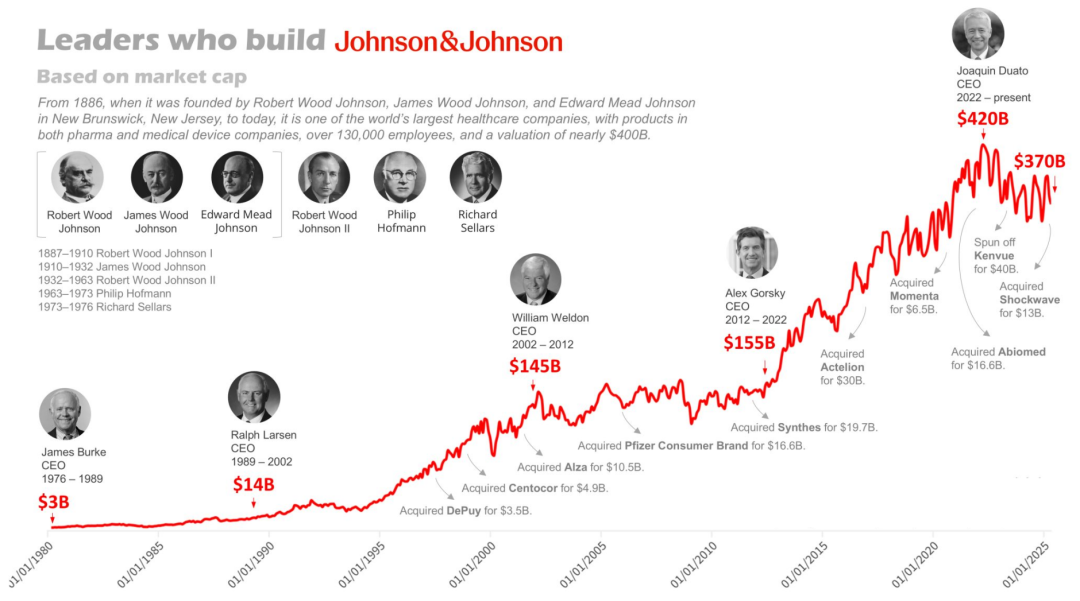
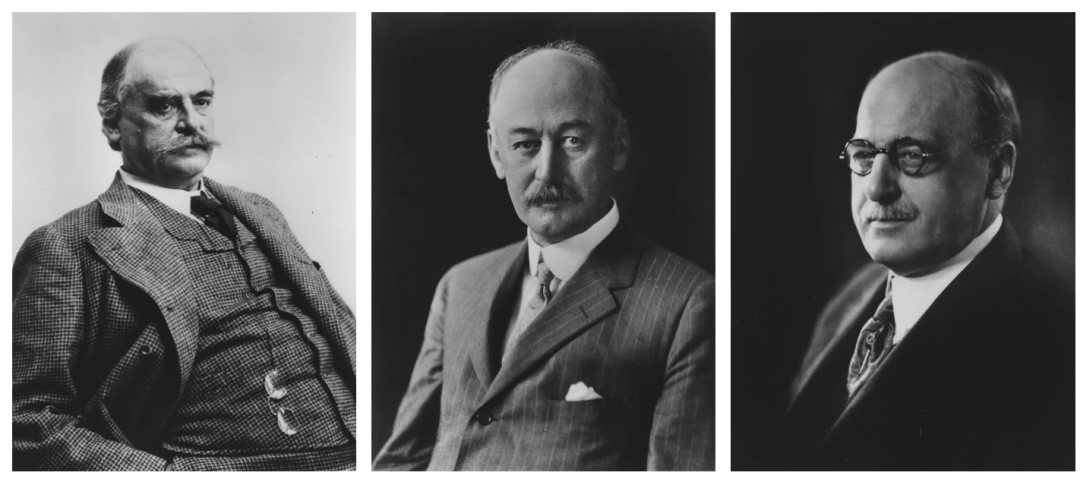
Johnson & JohnsonIt is a global pharmaceutical, biotechnology, and medical technology company, by JohnsonThree Brothers was established in 1886:Robert Wood Johnson, James Wood Johnson, and Edward Mead Johnson. Initially, Johnson & Johnson produced and sold by JohnsonThree brothers developed ready-to-use sterile surgical dressings. Over the next 100 years, Johnson & Johnson gradually expanded through continuous mergers and acquisitions as well as independent research.From a small workshop producing sterile dressings to the world's largest healthcare company. Johnson & Johnson is currently the world's second-largest medical device company and also the third-largest pharmaceutical company globally. Its total sales for 2024 reached 88.8 billion US dollars.
Johnson & Johnson's transformation from a small workshop to the top player in the global medical field is attributed not only to its strong corporate culture but, more importantly, to each CEO of Johnson & Johnson who has injected new momentum, enabling the company to keep up with the times and maintain a strong competitive edge.
【01】Robert Wood Johnson I
Robert Wood Johnson I was the founder of Johnson & Johnson, becoming its CEO in 1887. Under his leadership, Johnson & Johnson became a leader in the medical field and laid the foundation for the company's core philosophy of focusing on healthcare and quality.
James Wood Johnson was also a founder of Johnson & Johnson. He succeeded his brother Robert Wood Johnson I in 1910. Subsequently, he continuously expanded the company's product lines and global business presence, leading the company through World War I, the 1918 influenza pandemic, and the Great Depression.
【03】 Robert Wood Johnson II Robert Wood Johnson II succeeded James Wood Johnson as the CEO of Johnson & Johnson in 1932. During his tenure, Johnson & Johnson experienced explosive revenue growth (increasing by 1500%) and advanced its globalization process.Robert Wood Johnson II continuously expanded the product line during his tenure and completed Johnson & Johnson's greatest acquisition in history—entering the pharmaceutical industry by acquiring Janssen Pharmaceutical.Product market, while acquiring McNeil (which later became Johnson & Johnson's consumer products division). Known for advocating the emphasis on corporate responsibility in "Our Credo,"This programmatic document became the cornerstone of Johnson & Johnson's decision-making for decades.。
With Philip Hofmann taking the helm as CEO, he became the first non-family member to hold the position. Hofmann strengthened the company's international business layout, leading its expansion into contraceptives, vision care, and consumer health sectors. Despite criticisms of lacking strategic foresight, he maintained steady financial growth.Richard Sellars became the CEO of Johnson & Johnson in 1973. His term was very short, but during his tenure, he faced challenges such as the oil crisis and economic stagflation. However, he ensured the stable operation of Johnson & Johnson, allowing the company to smoothly navigate through the oil crisis and economic stagflation.
James Burke became the CEO of Johnson & Johnson in 1976. He drove the company's diversification into pharmaceuticals and high-tech medical devices, achieving revenues of $10 billion and profits exceeding $1 billion. His handling of the famous Tylenol crisis in 1982 restored public trust in the Johnson & Johnson brand and is regarded as the gold standard for crisis management and corporate ethics.Ralph Larsen succeeded James Burke as CEO of Johnson & Johnson in 1989, continuing James Burke's strategic direction. During his tenure, he led the acquisition of several key companies, including DePuy, Centocor, and Alza. He also achieved revenue exceeding $35 billion for Johnson & Johnson, with significant growth in market value.Bill Weldon became the CEO of Johnson & Johnson in 2002. During his tenure, he focused on global expansion, leading the acquisition of Pfizer's consumer healthcare division and Synthes. Although financial performance was strong during his term, the company’s reputation suffered in 2010 due to product recalls, quality issues, and legal disputes, ultimately leading to his resignation.
Alex Gorsky succeeded Bill Weldon as the CEO of Johnson & Johnson. He revitalized the quality control system and public trust, focusing on expanding the global presence. He led the acquisitions of Actelion, Momenta, andCompanies like Abiomed have adhered to maintaining three major business segments: pharmaceuticals, medical devices, and consumer health. During the term, the company's revenue reached 90 billion USD, with a significant increase in market value, further solidifying Johnson & Johnson's leadership position in the healthcare field.
Joaquin Duato is the current CEO of Johnson & Johnson. After taking office, he completed the spin-off and public listing of the consumer health business (Kenvue), maintained the unified structure of the pharmaceutical and medical device businesses, and led the acquisition of Shockwave Medical.