

BeiGene Debuts on 2025 Global Top 50 Pharma List with Strong Commercial Performance
BeOne
Developer of Molecular Targeted and Immune Anti-Tumor Drugs
Johnson & Johnson
Medical Device R&D and Manufacturer

On the evening of June 20,Pharmaceutical Executive's "Top 50 Global Pharmaceutical Companies 2025" List ReleasedThe time is slightly later than before.
The list ranks the top 50 global biopharmaceutical companies based on the sales performance of prescription drugs, documenting their rise and fall—from the long-standing giants of traditional big pharmaceutical firms to the emerging challengers in the biotechnology sector, as well as all companies in between.
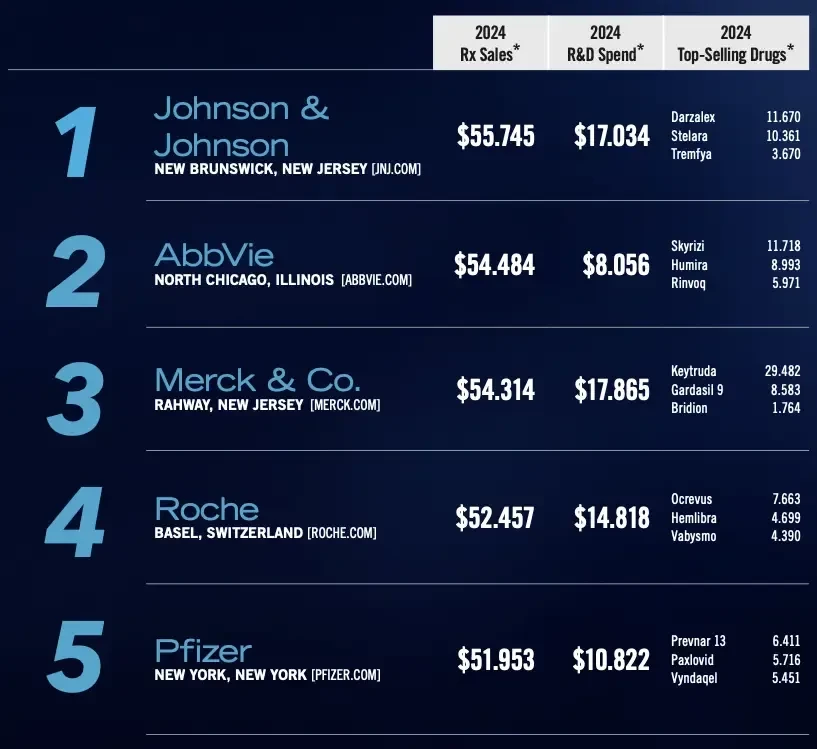
According to the 2024 global sales revenue ranking for prescription drug businesses, the top ten companies this year are:Johnson & Johnson Innovative Pharmaceuticals, AbbottWyeth, Merck, Roche, Pfizer, AstraZeneca, Novartis, Bristol-Myers Squibb, Sanofi, Novo Nordisk。
'%20fill='%23FFFFFF'%3E%3Crect%20x='249'%20y='126'%20width='1'%20height='1'%3E%3C/rect%3E%3C/g%3E%3C/g%3E%3C/svg%3E)
01
Top 10 Global Pharmaceutical Companies
Novo Nordisk on the list
Compared with the 2024 list, the above TOP10 can be seen,
Johnson & Johnson Innovation and AbbVie Once Again Rank First and Second on the "Pharma 50" List.Interestingly, despite the relatively low year-on-year growth rates among the top ten companies (Johnson & Johnson's prescription drug sales grew by 4.3% to reach $55.75 billion in 2024, and AbbVie grew by 3.3% to reach $54.48 billion), their performance remains remarkable.
EspeciallyJohnson & JohnsonJohnson & Johnson's star monoclonal antibody Darzalex, used for the treatment of multiple myeloma, surpassed the $10 billion sales mark in 2024, increasing by 19.8% to $11.67 billion. However, it is worth noting that Johnson & Johnson's long-standing pillar product in the inflammation field, Stelara, saw a slight revenue decline of 0.5%, reflecting the intensifying competition with newly-entered biosimilars.
As forAbbVieIn order to fill the revenue gap, AbbVie's R&D investment reached $17.03 billion in 2024, second only to Merck. Despite its overall solid position, AbbVie has also felt the impact of biosimilar penetration. Humira, a best-seller for many years, finally saw an inevitable decline, with sales plummeting 37.6% to $8.99 billion, dropping out of the top ten from being the world's second-best-selling drug in 2023. However, replacing it is the rapid rise of Skyrizi, a blockbuster drug for psoriasis, with sales surging 51% last year to $11.72 billion (reported to have surged 71% in Q1 2025). Meanwhile, AbbVie’s Rinvoq continued to climb, growing by 50% to $5.97 billion in 2024. This JAK inhibitor has been approved for nine indications and most recently received FDA approval in April as the first oral drug in its class for treating giant cell arteritis. In recent years, AbbVie has shifted its R&D focus to oncology, including targeting solid tumors with antibody-drug conjugates (ADCs), a strategy that is starting to bear fruit (its ADC drug Emrelis received accelerated FDA approval in May for treating adult patients with previously treated advanced non-small cell lung cancer).
For the second consecutive year, Keytruda, the world's best-selling drugMerck & Co., rising from 4th to 3rd place in the latest ranking. The company's prescription drug sales increased by 6.8%, mainly driven by the steady growth of Keytruda (which has now received FDA approval for 40 cancer indications). This PD-1 immunotherapy is likely to remain a top product for at least the next few years. Evaluate predicts that Keytruda’s peak sales will reach $33 billion before the patent for its intravenous formulation expires in 2028; the company is advancing clinical trials for a subcutaneous injection formulation, with plans to launch it as early as this fall. In other efforts to compensate, according to reports earlier this year, Merck reportedly made a bid$3 billion acquisition of MoonLake Immunotherapeutics to strengthen its late-stage pipeline. Several companies, including Amgen, are developing potential future biosimilars of Keytruda, with Amgen's version already in Phase III trials.
The other two companies ranked in the top five of the "Pharma 50" are Roche Pharmaceuticals and Pfizer, both of which rose one place from last year.It is worth noting that,RocheThis company, which has long enjoyed a prestigious reputation in the oncology field, does not have cancer treatments as its three best-selling products. Instead, Ocrevus, a drug for multiple sclerosis, tops the list. In recent years, Roche's strategy of diversifying its investment portfolio has started to pay off. It is projected that by 2024, its prescription drug sales will surpass the $50 billion mark, increasing by 6.8% to reach $52.46 billion.
Despite a significant decline in COVID-19 related business sales in 2023,PfizerRemains stable (Paxlovid's sales reached $5.7 billion last year, providing the company with a steady income stream). Braftovi, part of a combination therapy with Erbitux which Pfizer developed in collaboration with Eli Lilly, received accelerated FDA approval this past December. It became the first biomarker-driven therapy specifically approved for frontline treatment of certain mutation-driven cancers. After releasing new survival data earlier this month, Pfizer is now pursuing full approval for the drug. Additionally, in May, Pfizer signed a lucrative licensing agreement with China’s 3SBio, further strengthening its oncology portfolio (see sidebar for details). This reflects an industry-wide trend of increasing global demand for innovative Chinese assets. However, Pfizer currently lacks a decisive blockbuster product like it had in the past.Two pillar products.
In addition,Eli Lilly(Prescription drug sales increased by 27.8%, rising to 11th place in this year's "Pharma 50") driven by the GLP-1 agonist Mounjaro/Zepbound;Novo Nordisk(Novo Nordisk, as many predicted, entered the top ten, ranking 10th with a 24.9% increase) driven by the GLP-1 drugs Ozempic/Wegovy; andSanofi(Sanofi, with an 8.42% increase, firmly ranked 9th) thanks to its inflammation giant Dupixent. The latter was co-developed and marketed with Regeneron, and its product sales in 2024 ranked third (increased by 22% to 14.1 billion US dollars), only behind Keytruda and Ozempic.
AstraZenecaFrom 8th place to 6th place, it showed the strongest growth among all companies returning to the top ten. Its prescription drug revenue in 2024 increased by over $7 billion, reaching a total of $50.95 billion, marking a 16.3% increase. AZ's two key products — Farxiga, for treating type 2 diabetes, heart failure, and chronic kidney disease, and Tagrisso, a targeted therapy for non-small cell lung cancer — saw sales soar by 28.4% and 13.5%, respectively. Imfinzi, its blockbuster immunotherapy drug, reported an 11.6% sales increase in Q1 2025 due to accelerated demand and new indications approval. Notably, AZ has recently focused on internally driven pipeline development, signing a $200 million agreement with Tempus and Pathos AI in April to design large-scale multimodal deep learning models to advance cancer drug discovery.
The other two pharmaceutical giants in the top ten areNovartisAndBristol-Myers Squibb, ranking 7th and 8th respectively. The former dropped from 3rd place, with prescription drug revenue declining by 4.3% as the company continues to diversify its portfolio (its Q1 net sales increased by 15%, and it raised the full-year guidance for 2025). Bristol-Myers Squibb's prescription drug sales surged 7.7% to $47.82 billion. In terms of R&D, earlier this month, the company signed a licensing agreement, paying $1.5 billion upfront for BioNTech's PD-L1xVEGF bispecific antibody BNT327.
02
The Comprehensive Rise of Chinese Pharmaceutical Enterprises
From the perspective of Chinese pharmaceutical companies, this is the most entries on the list yet, with six companies featured. Among them, BeOne Medicines and Huadong Medicine are newly listed, while CSPC Pharmaceutical Group has returned to the ranking.
Specifically:
Yunnan Baiyao ranks (33) unchanged, China Biologic Products ranks (39) dropped one place, Huadong Medicine ranks (41), BeOne Medicines ranks (44), Hengrui Medicine ranks (46) rose two places, and CSPC ranks (48).
Scrollable images
BeOne MedicinesTaking 15 years to complete the "three-step leap." Medical trends previously predicted that based on its revenue and global influence, it might rank for the first time in PharmExec's annual TOP50 global pharmaceutical companies list next year. Clearly, it has already succeeded ahead of schedule, entering the next phase of the global pharmaceutical journey.
Extended Reading:BeOne Medicines' First Quarterly Report Exceeds Hengrui, Innovative Pharmaceutical Companies Unlock the Next Stage of Survival Challenges
Huadong MedicineAfter the core product in the diabetes and weight loss fields, liraglutide injection (dual indications: type 2 diabetes, obesity or overweight), was approved in 2023, it achieved explosive growth in 2024. According to data from Menet, the productSales revenue growth in China's three major terminals and six major markets reached 1269.71%, becoming theTOP2 enterprises.
cr:https://www.pharmexec.com/view/2025-pharm-exec-top-50-companies