

MDR-001 Emerges as a Strong Contender in Oral Small-Molecule GLP-1 RA Race with Successful Phase IIb Trial

MindRank
AI Drug Developer
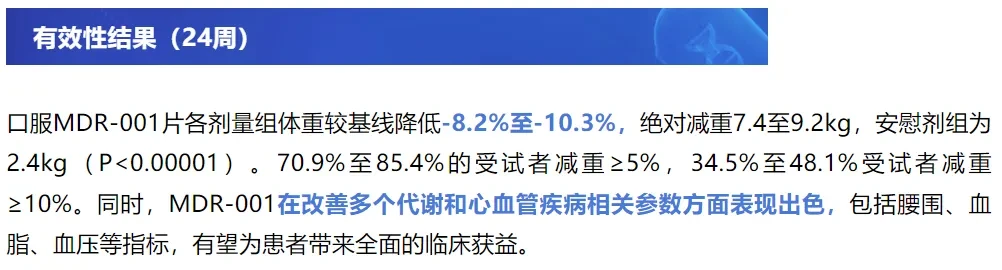
On June 19, 2025, MindRank announced the successful Phase 2b clinical trial of MDR-001, a small molecule GLP-1 receptor agonist. After 24 weeks of treatment, weight loss across different dosage groups ranged from 8.2%-10.3%, with absolute weight reductions of 7.4-9.2 kg, compared to 2.4 kg in the placebo group (p<0.00001). Additionally, MDR-001 demonstrated excellent performance in improving multiple metabolic and cardiovascular disease-related parameters, including waist circumference, blood lipids, blood pressure, and other indicators, showing potential for comprehensive clinical benefits.

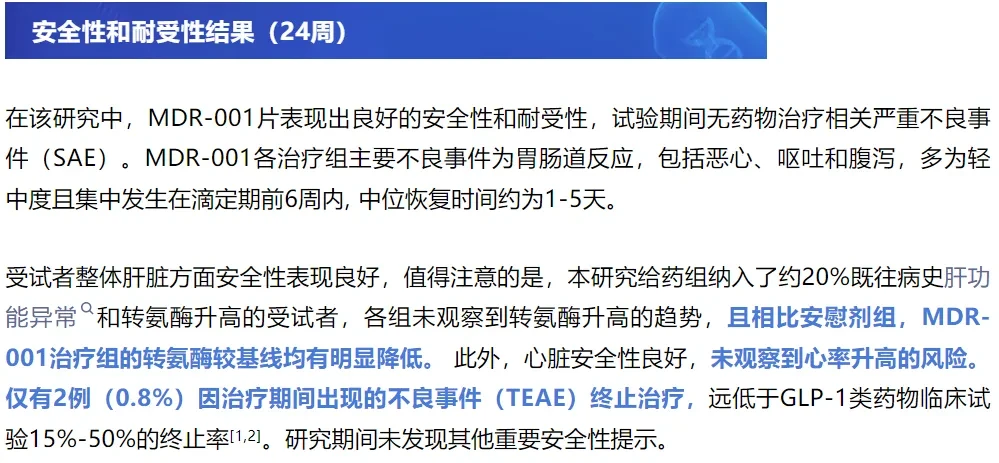
In terms of safety, no drug treatment-related SAE occurred during the MDR-001 trial. The study enrolled 20% of subjects with abnormal liver function and elevated transaminases, and no trend of increased transaminases was observed in any group.Compared with the placebo group, the transaminase levels in the MDR-001 treatment group were significantly reduced from baseline.Moreover, the cardiac safety profile was favorable with no observed risk of increased heart rate. Only 2 cases (0.8%) discontinued treatment due to TEAEs, significantly lower than the 15-50% discontinuation rate seen with similar drugs.
Pfizer and Eli Lilly are pioneers in the development of small-molecule GLP-1 receptor agonists, leading the entire field.
In June 2023, Pfizer abandoned the development of the small molecule GLP-1 receptor agonist Lotiglipron due to safety signals of elevated transaminases observed in early clinical trials, an issue that was not identified at the time in the first-generation Danuglipron.
'%20fill='%23FFFFFF'%3E%3Crect%20x='249'%20y='126'%20width='1'%20height='1'%3E%3C/rect%3E%3C/g%3E%3C/g%3E%3C/svg%3E)
In April 2025, Pfizer announced the termination of the development of Danuglipron, a once-daily small molecule GLP-1 receptor agonist, after one patient experienced severe liver injury, which resolved after discontinuation of the drug. After consideration, Pfizer decided to terminate the development of Danuglipron.
Lilly's Orforglipron announced successful Phase III clinical trials for diabetes this year.
Lilly's Orforglipron is comparable to injectable GLP-1 drugs in terms of safety, with no patients reaching Hy's law criteria for liver injury.
During the treatment with Orforglipron, the mean values of ALT and AST decreased.
Orforglipron in Phase II Clinical Trial for Weight Loss: 12.5%-14.7% Weight Reduction at 36 Weeks (Placebo 2.3%).
Among the main competing products in China, Hengrui Medicine's HRS-7535 announced its Phase II clinical data at this year's ADA meeting, showing a weight loss of 2.99-9.36% after 26 weeks of treatment, compared to -2.5% in the placebo group. In terms of safety, no trend of elevated liver enzymes was observed.
HDM1002, developed by Huadong Medicine, presented its Phase 1b clinical trial data at this year's ADA meeting, showing weight loss of 6.8%, 5.1%, and 4.9% after 4 weeks of treatment, with no observed liver enzyme elevation-related adverse events (AEs).
Wentai/Jixing Pharmaceuticals' VCT220 phase II clinical data for weight loss was presented at this year's ADA meeting, showing a weight reduction of 5.8-9.5% after 16 weeks of treatment, compared to 1.6% in the placebo group. In terms of safety, no liver toxicity-related safety signals were identified.
Summary
Pioneer of Small Molecule GLP-1, Pfizer Terminates Development Due to Liver Toxicity, While Eli Lilly Crosses the Finish Line in Phase III Clinical Trials with Decreasing Trends in ALT and AST. Among Chinese Competitors, Hengrui Medicine, Wentai Medicine, and Huadong Medicine Have Advanced to Phase III Clinical Trials. MindRank’s Recent Phase 2b Clinical Trial Demonstrates Excellent Efficacy and Safety, and It Will Soon Advance to Phase III Clinical Trials. Regarding the Critical Issue of Liver Safety, None of the Companies Have Disclosed Specific Data: Hengrui Medicine States “No Observed Trend of Elevated Liver Enzymes,” Wentai Medicine Describes It as “No Identified Safety Signals Related to Liver Toxicity,” and Huadong Medicine Reports “No AE Related to Elevated Liver Enzymes” (Earlier Data from 1b Phase Treatment at 4 Weeks).MindRank described that "transaminase was significantly reduced compared to baseline." MDR-001 is expected to become another strong contender in the small molecule GLP-1 field.
Comprehensive Review Series of Armstrong Technology
A Comprehensive Review of Complement-Targeted Drug Technologies;
Complement Drugs: An Important Direction in Ophthalmic Treatment;
The Landscape of Novel Macromolecular Drug Development in China;
A Comprehensive Review of China's Bispecific Antibody Technology;
Comprehensive Review of Antengene's Pharmaceutical Technologies;
Comprehensive Review of HBM Technologies; Comprehensive Overview of Rongchang Biotechnology; A Comprehensive Review of Zai Lab's Technologies; Comprehensive Overview of WuXi Biologics; Comprehensive Review of Hengrui Medicine Technology; A Comprehensive Review of Hansoh Pharma's Technology; Comprehensive Overview of Zhengda Tianqing's Technology; Comprehensive Overview of Genechem's Technology; Comprehensive Review of CStone Pharmaceuticals' Technology; Comprehensive Overview of BeiGene's Technology; Comprehensive Review of BeiGene Technologies, 2nd Edition; A Comprehensive Review of Innovent Biologics' Technology; Comprehensive Review of Innovent Biologics Technology, 2nd Edition; A Comprehensive Review of Zhongshan Kangfang Technology; Comprehensive Review of Fuhong Hanlin's Technology; A Comprehensive Overview of Simcere Pharmaceutical Technology; Comprehensive Overview of Junshi Biotechnology; Comprehensive Overview of Genor Biopharma; Comprehensive Overview of ZhiDao Biotechnology; A Comprehensive Overview of Doyle Biotechnology; Full Review of Shangjian Biotechnology; A Comprehensive Overview of Alphamab Oncology Technology; Comprehensive Overview of KeyoMed Technology; Comprehensive Overview of Shoreline Biotechnology; Comprehensive Overview of Lixun Biotechnology; Comprehensive Review of CanBridge Capital Technology; Yu Guoliang's Antibody Drug Layout; Full Review of Quanxin Biotechnology; Comprehensive Overview of An Yuan Pharmaceutical Technology; A Comprehensive Review of 3SBio's Technology; Comprehensive Review of Renhui Biotechnology; Comprehensive Overview of LePu Biotechnology; Comprehensive Overview of Tongrun Biotechnology; Comprehensive Overview of Immunomic Therapeutics; Comprehensive Overview of PegBio; Comprehensive Overview of Mabwell Biotechnology; Comprehensive Overview of Momenta Technology; A Comprehensive Overview of NGM Technology; Comprehensive Overview of Primis Biotechnology; Full Review of Promab Biotechnologies 2.0; Comprehensive Overview of Clover Biotechnologies; Zelgen Pharma Antibody Drug Overview; Hengrui Medicine Antibody Drug Overview; A Comprehensive Overview of Qilu Pharmaceutical's Antibody Drugs; Comprehensive Overview of Antibody Drugs from CSPC Pharmaceutical Group; Hansoh Pharma Antibody Drug Overview; Huahai Pharmaceutical Antibody Drug Overview; A Comprehensive Overview of Kelun Pharmaceutical's Antibody Drugs; A Comprehensive Review of Bio-Thera Technologies; Full Review of Fanensi Technology。