In the increasingly fierce global technological competitionBackground,The scientific research paradigm is accelerating its transformation towards interdisciplinary, intelligent, and high-throughput directions. Shanghai Jiao Tong University is seizing the opportunities of the times, aiming to "reshape the scientific research paradigm" and taking "breaking the boundaries between disciplines, breaking the boundaries between theory and experiment, and breaking the boundaries between scientific research and industry" as the starting point. It proposes to build a world-leading "super scientific research platform."On June 23, Shanghai Jiao Tong University signed a strategic cooperation agreement with DP Technology to promote the launch and iteration of the super research platform based on the AI-X Research Institute.。Sign a strategic cooperation agreement,
Fostering a Collaborative Innovation Ecosystem in Industry, Academia, and Research
At the Platform Launch CeremonyShanghai Jiao Tong University signs a strategic cooperation agreement with DP Technology,Both parties will fully leverage their respective advantages, relying on the AI-X Research Institute, to jointly promote the construction of a production-education-research ecosystem based on fully China-produced, independently controlled AI infrastructure. They aim to build an academic ecosystem with nationwide influence in China, cultivate an industrial ecosystem with global competitiveness, and inject strong momentum into the innovative development and widespread application of artificial intelligence technology. Meanwhile, the Research Institute will focus on key research areas such as training large-scale scientific research models, building intelligent agent ecosystems, and co-constructing AI for Science infrastructure.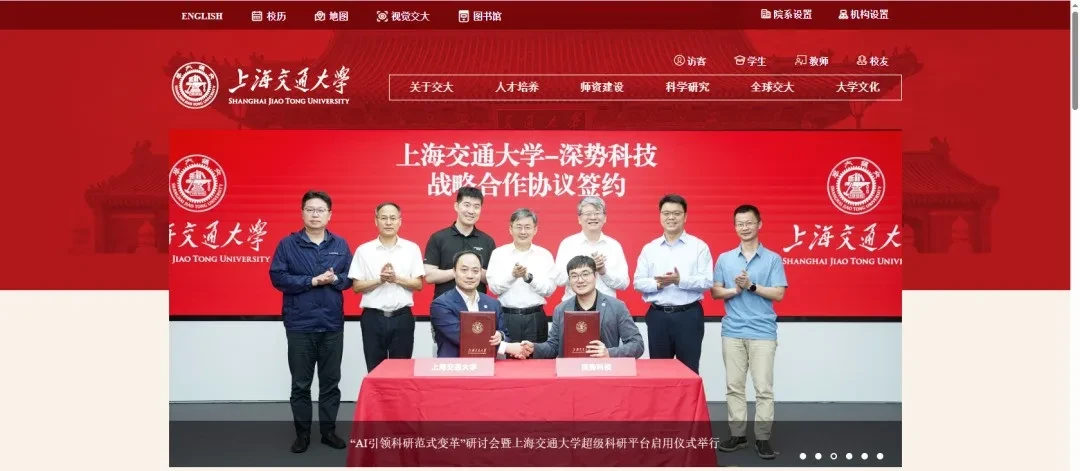 ShanghaiWang Yanfeng, Executive Dean of the School of Artificial Intelligence at Jiaotong University,Weijie Sun, founder and CEO of DP Technology, signed the agreement on behalf of the collaborating parties. Kui Ding, president of Shanghai Jiao Tong University and academician of the Chinese Academy of Sciences, Hong Ding, vice director of the Li Zhengdao Research Institute of Shanghai Jiao Tong University and academician of the Chinese Academy of Sciences, Yongfeng Zhou, dean of the Scientific Research Office of Shanghai Jiao Tong University, Jinhua Cheng, director of the Shanghai Jiao Tong University Library, Guangtao Xue, director of the Network Information Center of Shanghai Jiao Tong University, Feng Chen, director of the Analysis and Testing Center of Shanghai Jiao Tong University, and Linfeng Zhang, founder and chief scientist of DP Technology, witnessed the signing.In the future, the super research platform will become an open and intelligent platform supporting cutting-edge scientific research. It will also serve as a starting point to collaborate with top global institutions, enhancing China's influence in international scientific cooperation and building a bridgehead for such collaboration. Meanwhile, the platform will focus on key industries and emerging fields to establish an incubation base for new productive forces.
Build a Super Research Platform,
Transforming the Paradigm of Scientific and Technological Innovation in Universities
The Super Research Platform is a platform focused on scientific discovery.Target,A full-process, intelligent, large-scale, and distributed scientific research platform. Supported by the "Bohr Research Space Station," the platform will be seamlessly integrated with the university's library, computing center, and analytical testing center, breaking data silos and reshaping the research workflow. It will enable the sharing and flexible allocation of computing power, data, instruments, and equipment across colleges and platforms, creating a dry-wet closed loop and rapid iteration system for literature, computation, and experimentation. By lowering the barriers to scientific research, accelerating the research process, and promoting interdisciplinary innovation, it aims to build a new type of research infrastructure for the platform-based scientific era. The super research platform will provide one-stop processes for investigation, computational simulation, and experimental testing, striving to achieve seamless integration throughout the entire research process. Shanghai Jiao Tong University will use the "Super Research Platform" as a vehicle to drive the transformation of research models from traditional single-point breakthroughs to interdisciplinary, intelligent, and collaborative approaches, providing core support for cultivating new productive forces for the nation.'%20fill='%23FFFFFF'%3E%3Crect%20x='249'%20y='126'%20width='1'%20height='1'%3E%3C/rect%3E%3C/g%3E%3C/g%3E%3C/svg%3E)
Increase investment in AI for Science,
Embrace the Alpha Einstein Moment
At the platform launch ceremony,Professor Ding Hong Delivered a Keynote Speech on "Embracing the Era of Mega-Research: SJTU Super Research Platform." Professor Ding Hong stated that currently, global competition in scientific and technological innovation has entered a new phase driven by artificial intelligence (AI) as its core. AI for Science is reshaping the research paradigm and becoming a key indicator of national technological competitiveness. Against this backdrop, Shanghai Jiao Tong University (SJTU) is focusing on the "Super Research Platform" to build a world-leading AI research ecosystem, propelling China's transition from a follower and peer to a leader.Ding Hong said,AI for Science is an important path to achieve original innovation, and the "platform model" is a crucial link in achieving original innovation today. In 2016, when AlphaGo captured global attention, he once envisioned whether the scientific community would see the emergence of an Alpha Einstein (intelligent scientist). Looking at the present, with the intelligent transformation of the "reading," "calculating," and "doing" processes, the super research intelligence system that combines "dry-wet closed loop and rapid iteration" along with foundational large-scale research models has formed a continuously evolving intelligent system. Alpha Einstein (intelligent scientist) may not be far away. Ding Hong emphasized that the goal of platform construction is to attract more young scientific talent, especially from the technical community, to jointly build a scientific intelligence ecosystem and accelerate research innovation.The "Super Research Platform" of Shanghai Jiao Tong University released this time is centered on the integration, intelligence, and collaboration of Bohr Space Station, reconstructing the entire scientific research process through three major modules.The first major module is the construction of "Intelligent Navigation" for scientific research. For instance, an intelligent library can achieve intelligent retrieval of hundreds of millions of resources, integrating 160 million pre-parsed documents, courses, and databases, supporting personalized recommendations for each individual ("thousand people, thousand faces"). For example, when entering "quantum material design," AI not only returns relevant papers but also automatically extracts methods, conclusions, and data correlations, even recommending potential interdisciplinary breakthroughs. Additionally, scientific navigation acts as a knowledge reproduction hub, dynamically generating personal knowledge graphs that intelligently link course theories, cutting-edge papers, and experimental data. Professor Yan Junchi's course, *Deep Learning and Applications*, has been matched with real-time research cases through the platform, attracting over a thousand students to participate, achieving the integration of learning and research.The second major module is to build a "computing center" for AI for Science. The heterogeneous computing power constructed on the computing center enables the "one-click start" function, and its unique scheduling system can compress the acquisition of computing power from "weekly" to "minute-level." The vision is that in the future, a materials science student will be able to simultaneously utilize the university's internal cluster and cloud supercomputing to complete molecular simulations that traditionally take months. The computing center is also responsible for creating a research App Store ecosystem, providing a modular development platform. It allows easy access to apps such as the modeling app MatModeler, the all-scenario analysis tool Uni-AIMS based on large characterization models, the high-precision protein prediction tool Uni-Fold, and the intelligent electrolyte design tool Uni-ELF. Users can train AI models without coding, reducing development costs nearly a hundredfold. In the future, it will evolve into an AI Agent capable of automatically breaking down tasks and invoking algorithms.
The third major module is the establishment of an "Analysis and Testing Center" for artificial intelligence. For instance, Gao Wenpei's team at the "Intelligent Coating Laboratory" uses AI to control robotic arms, achieving full-process automation from material preparation to characterization and testing; Academician Fan Chunhai’s DNA synthesis platform increases nucleic acid design efficiency by five times. Notably, the Analysis and Testing Center can also achieve the characterization of a "hyper-dimensional world." The under-construction "Characterization Super OS" can automatically analyze electron microscopy and mass spectrometry data, generating 3D models that allow scientists to "instantly perceive the essence of matter."
All PKU Faculty and Students Are Using It! Bohr Scientific Navigation Collaborates with PKU to Lead the AI for Science Ecosystem
Wuhan University Also Uses It! Bohr Scientific Navigation Empowers Smart Luojia Intelligent Teaching and Research Upgrade Again
100,000 University Students from Yibin University City Gradually Move into Bohr Space Station, Scientific Navigation Opens a New Window for the Southwest Industry-Academia-Research High Ground
Bohr's Entry into China Pharmaceutical University: How the New Engine of Intelligent Pharmacy Reshapes the Future of Drug Development
Shenzhen "Tech Superbrain" Implants Bohr AI Chip! Nine Top Databases Achieve Full-Domain Interconnection
DP Technology is globallyAIFor Science Leaders, AI for Science means using AI to learn a series of scientific principles and knowledge, and further solve key problems in scientific research and industrial R&D fields.Relying on deep cultivation in the field of interdisciplinary research, DP Technology has built the "Deep Potential·Universe" AI for Science large model system, further addressing key issues in scientific research and industrial development, and bringing research methods across many disciplines from the "trial-and-error experimentation / computer" era into the "Pre-trained ModelThe "era" has formed the "innovation-implementation" chain and open ecosystem of AI for Science, built micro-scale industrial infrastructure based on AI for Science, empowered "thousands of industries," and created a new generation of R&D systems for the most fundamental biomedical, energy, materials, and information science and engineering research in human economic development.DP Technology is a national high-tech enterprise in China.Specialized and Innovative"Little Giant" enterprises have set up R&D centers in cities such as Beijing, Shanghai, and Shenzhen.The scientific research and technology team is led by an academician of the Chinese Academy of Sciences, bringing together over a hundred outstanding young scientists and engineers from various fields such as mathematics, physics, chemistry, biology, materials, and computer science. Among the company's members, more than 35% hold doctoral or postdoctoral degrees.Core members have won the 2020 Gordon Bell Prize, the highest award in the field of global high-performance computing, and their related work was selected as one of China's top ten scientific and technological advances in 2020 and one of the ten major technological breakthroughs in the global AI field.