

QureGenAI Unveils Quantum-AI Breakthroughs in Drug Design at ISCA-QCCC 2025 and Announces TyxonQ Framework

AceMapAI
AI Drug Discovery Developer
Recently, the International Symposium on Computer Architecture (ISCA) and the 4th International Workshop on Quantum-Classical Co-Design of Computers (QCCC-25) were held in Tokyo, Japan. As the only Chinese team to deliver a contributed speech at this workshop, AceMapAI, in collaboration with China Pharmaceutical University and Ningbo Institute of Technology, presented its cutting-edge research achievements and technological breakthroughs in the field of quantum-classical hybrid computing to experts and scholars from top academic institutions, industry, and national laboratories worldwide.

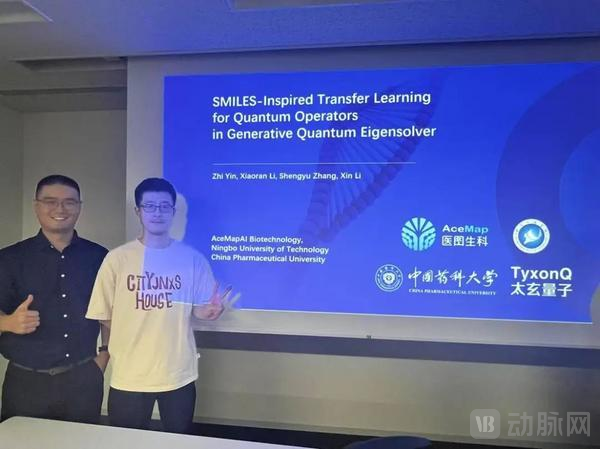
AceMapAI Chief Quantum Scientist Zhi Yin, on behalf of the team, delivered a keynote speech titled "Application of SMILES-Inspired Quantum Operator Transfer Learning in Generative Quantum Eigensolvers." This research introduces, for the first time, a quantum operator representation transfer learning framework that leverages AI technology to accelerate the design of quantum operator circuits, addressing complexity issues in solving the Schrödinger equation. The study highlights the immense potential of combining AI with quantum computing and received enthusiastic feedback from experts at the event.
At this conference, AceMapAI also announced the upcoming release of TyxonQ, the next-generation quantum computing + AI drug design and development framework. TyxonQ aims to significantly enhance the practicality of quantum computing in fields such as drug research and development through its innovative classical-quantum hybrid architecture, optimized quantum compilation capabilities, and efficient cross-hardware facility scheduling. In particular, the QureGenAI platform, built on TyxonQ, has begun offering SaaS services and MCP services for large model integration to users worldwide, demonstrating AceMapAI's leadership in advancing the practical application of quantum computing.
In addition, AceMapAI showcased its AMB-HAE androgenetic alopecia treatment drug pipeline, which utilizes the key TyxonQ technology, now entering the pre-IND research stage. It also launched the world's first quantum-AI Raman spectroscopy system for rapid quantitative modeling of Raman signal characteristics of hard-to-obtain pure substances. These achievements signify that AceMapAI is not only playing a vital role in the global quantum technology revolution but is also a pioneer in defining collaborative paradigms and industrial implementation standards.
As quantum computing reaches a pivotal turning point toward practical application, AceMapAI's outstanding performance at ISCA and QCCC-2025 demonstrates that China is ushering in an era of "computable life," bringing new hope and possibilities to the health sector in China and around the world. AceMapAI's co-founder and CEO, Li Xiaoran, stated that AceMapAI will continue to advance in the field of quantum computing for drug development + AI design. The company will use this conference as an opportunity to further strengthen cooperation with all parties, continuously explore the deep integration boundaries of quantum computing and AI in drug design, improve the construction of the artificial intelligence drug design platform QureGenAI (formerly known as AceMapAI), and accelerate the delivery of novel drug pipelines with global competitiveness.