

Global Surgical Robotics Leaders Unveil First-Ever Technical Guidelines for Remote Robotic-Assisted Surgery

Medtronic
Medical Device Manufacturer

Investment Invitation Notice:The 3rd Global Surgical Robotics Conference
MedRobot
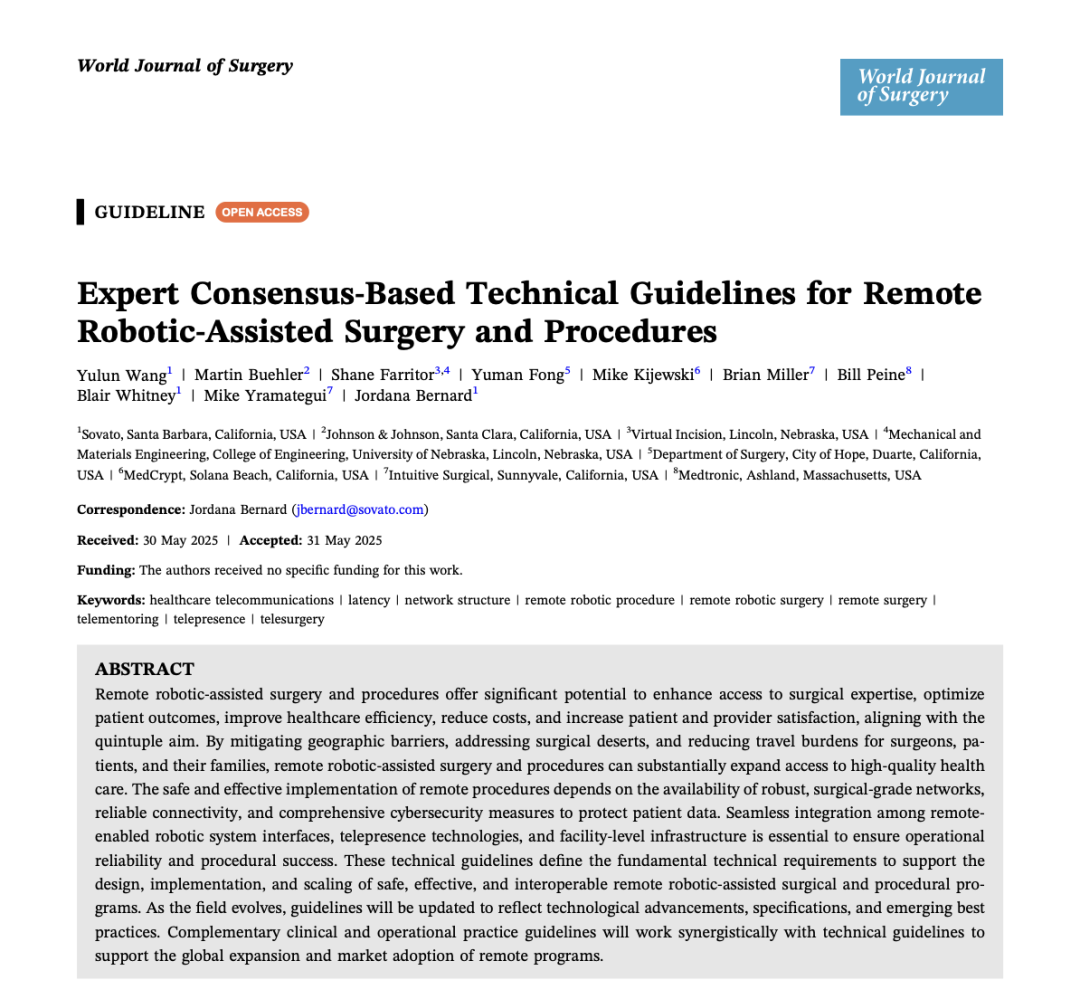
The global surgical robotics industry is witnessing a significant advancement in the field of remote surgery. Recently, the "World Journal of Surgery" officially published an article titled《Expert Consensus‐Based Technical Guidelines for Remote Robotic‐Assisted Surgery and Procedures》The paper. This technical guide, jointly completed by multiple surgical robotics companies, medical institutions, and cybersecurity enterprises, is consideredYesAn important milestone in the industrialization and standardization process of remote robotic surgery.
The main author of the guidelines is from Intuitive Medical.Intuitive, Medtronic, Johnson & Johnson Medical Technologies, Virtual Incision, Sovato, MedcryptWell-known enterprises, as well as several experts in the clinical field. The acknowledgments section of the paper also specifically mentionedNanoflex Robotics、CMR Surgical、LN Robotics、MicroPortCompanies such as Medtronic, demonstrating the extensive industry collaboration and consensus behind the guidelines.
# From Concept to Reality: Why Standards Are Needed for Remote Robotic Surgery
The concept of remote robotic surgery is not new. In 2001, a French surgeonJacques MarescauxIn New York, throughTrans-AtlanticFiber Optic Network Remote ControlDa Vinci Robot, a 68-year-old woman in Strasbourg, France, underwent a laparoscopic cholecystectomy. This is the procedure that has been repeatedly referred to as "Lindbergh Surgery”。
'%20fill='%23FFFFFF'%3E%3Crect%20x='249'%20y='126'%20width='1'%20height='1'%3E%3C/rect%3E%3C/g%3E%3C/g%3E%3C/svg%3E)
Although this operation proved the feasibility of remote surgery, for a long time afterward, remote surgery failed to become a clinical routine. Over the past decade, a series of technological and market factors have brought remote surgery back into the spotlight:
High-speed, low-latency networks (e.g., 5G, dedicated fiber optic networks) have significantly improved data transmission conditions;
Surgical robots themselves continue to improve in precision and response speed;
The COVID-19 pandemic has catalyzed the popularization of telemedicine, and society's acceptance of "remote" has increased.
Globally, the shortage of surgeons is becoming increasingly severe, especially in remote areas and low-resource environments, where remote surgery is highly anticipated.
Research by the World Health Organization shows that more than half of the global population lacks access to necessary surgical medical services. Even in high-income countries, there are significant regional disparities. For instance, in the United States,By 2034, the shortage of surgeons is expected to reach up to 30,200.Remote robotic surgery is considered an important tool to address "surgical deserts" due to its potential to overcome geographical barriers.
However, even with more mature technology, remote surgery still faces a key issue within the industry: the lack of unified technical standards. Without standards, hospitals and regulatory agencies struggle to establish procurement and approval processes, and equipment manufacturers cannot ensure interoperability and security between systems. This is the fundamental reason driving multiple stakeholders in the industry to jointly release guidelines.
# What are the core requirements and reference suggestions proposed in the guidelines?
This guideline, published in the "World Journal of Surgery," is the first systematic review within the industry on the core technical conditions that remote robotic surgery must meet. The main content focuses on five key aspects.(Links to the guidelines are provided at the end of the article)):
First,At the network level, the guidelines propose“Surgical-Grade Network”The concept.This not only means that the network needs to be fast enough, but more importantly, it must possess high stability, redundancy mechanisms, and the ability to handle sudden failures. Remote surgery is different from ordinary video conferencing; it has extremely high requirements for operation latency, video smoothness, and the immediacy of command execution. The guidelines recommend that medical institutions comprehensively evaluate the network environment and conduct various scenario drills before planning for remote surgery, ensuring that the system can quickly enter a safe mode or smoothly switch to a backup line in case of network fluctuations or interruptions, avoiding uncontrollable risks during the surgical process.
Secondly,SafetyThis is the core focus repeatedly emphasized in this guide. Remote surgery extends the operation into cyberspace, inevitably facing a larger surface for cyberattacks. The guide specifically reminds that all data must be encrypted during transmission, not solely relying on traditional methods such as VPNs; at the same time, multi-factor authentication mechanisms should be established at every stage, along with clear emergency response plans to deal with potential hacker attacks, data tampering, or information leaks. For any cybersecurity incidents that could affect patient safety, it is essential to have the capability for rapid detection, isolation, and resolution.
Third,Interoperability Between Devices, is the key to whether remote surgery can be promoted on a larger scale. Currently, there are multiple surgical robot system manufacturers in the market, and each product has differences in interfaces, data formats, and communication protocols. Without interoperability standards, remote surgery would be limited to the same brand or platform, significantly restricting the flexibility of technology application and the choice for hospitals. The guidelines recommend that all parties in the industry should cooperate around unified communication protocols, data formats, and interface specifications, thereby reducing the complexity and potential costs for hospitals in purchasing and deploying remote surgery systems.
Fourth, remote surgery is not only about mechanical operation but also involves the doctor's perception of the surgical environment and "presence." The guidelines point out,Quality of Video and Audio SystemsIt must be high enough to ensure that the remote doctor can not only clearly see the surgical field but also observe the patient's facial expressions, monitor data from various instruments, and even hear details such as the sound of the electrosurgical knife or equipment alarms. These details are often crucial safety cues during surgery. Therefore, any remote surgical system must guarantee rapid alert mechanisms and safety measures in case of disconnection or video lag, preventing surgical risks caused by information loss.
Finally, the guidelines also emphasize that remote surgery cannot be simply performed by setting up a computer in an office. Both the remote physician's location and the operating room where the patient is located must meet strict medical environment standards. This includesAn independent, quiet space with redundant network and power supply, as well as cleanliness and equipment configuration meeting the standards of local operating rooms.Only with such hardware and environmental support can remote surgery truly achieve the same level of safety and medical quality as traditional surgery.
Overall, this guide not only outlines the key capabilities required for remote surgery in the industry but also highlights areas where continuous collaboration and innovation are still needed. The authors of the guide also mentioned in their paper that, to truly integrate remote surgery into routine clinical practice in the future, more specific and detailed operational standards need to be further developed in areas such as legal responsibility, ethical norms, clinical processes, and certification criteria.
# Industrial Significance and Future Challenges
From an industry perspective, the release of this guideline represents not only a technical advancement but also signifies that all parties in the industrial chain are beginning to reach a consensus. For a long time, remote surgery has remained at the stage of individual pilot projects and demonstration initiatives globally. The lack of a commonly accepted standard framework among manufacturers, hospitals, and even regulatory bodies has led to significant obstacles in the actual implementation of remote surgery.
However, even with this guideline, remote surgery still faces many practical challenges before it can truly become a part of everyday medical practice:
In terms of laws and regulations, cross-state and cross-border remote surgeries still exist in a regulatory vacuum, involving complex issues such as practice licenses, patient privacy, and liability attribution.
In terms of ethics and social acceptance, how to establish sufficient trust in "operating without direct contact" for both doctors and patients still requires more clinical practice and social communication.
In terms of infrastructure, there are significant disparities in network environments and medical resources across different countries and regions. Particularly in developing countries, remote surgery may still be considered a "luxury."
It is reported that the multiple companies and expert teams involved in the development of this guideline plan to release follow-up documents within this year.Focus on more detailed clinical operation processes, legal responsibility division, certification and qualification standards, and other issues.。These will be the key steps in determining whether remote robotic surgery can move from "proof of concept" to routine medical application.
# Conclusion
From the transatlantic exploration of the Lindbergh surgery in 2001 to the current joint release of technical guidelines by the global industry, remote robotic surgery has gone through more than two decades of exploration. The technology itself has become increasingly mature, but how to bring this technology to more operating tables while ensuring safety still requires joint efforts in technology, regulations, ethics, and clinical practice.
In the future, how far this road can go depends on whether the industry can implement standards in every operating room and whether the global healthcare system can truly bridge the gap of distance and resources, allowing more patients to benefit from the changes brought by remote surgery.
Guideline Link:
https://onlinelibrary.wiley.com/doi/epdf/10.1002/wjs.12653
Surgical robots already launched in China
▌Endoscopic Surgical Robot
▌Orthopedic Surgery Robot
▌Vascular Interventional Surgical Robot
▌Puncture Surgery Robot
▌Microwave Ablation Surgical Robot
Comprehensive▌Minimally Invasive Robot | Tudao Medical
Endoscope▌MicroPort Medical | Sizherui Intelligent Medical |Surui Robot | Constance Medical
Orthopedics▌Rosunbot |Yuanhua Intelligence | Changmu Valley |Xin Jun Te|Stryker
Puncture Robot▌True Health
Weekly Bid Report | Approved Weekly Report | Industry Weekly Report
Progress of Chinese Surgical Robot Companies | Progress of Overseas Surgical Robotics Companies