

AbbVie to Acquire Capstan Therapeutics for $2.1 Billion to Advance In Vivo CAR-T Platform

AbbVie
Innovative Drug Developer

AstraZeneca
Biopharmaceutical Manufacturer
On June 30, AbbVie announced the acquisition of Capstan Therapeutics, a leading company in in vivo CAR-T, including its potential first-in-class in vivo anti-CD19 CAR-T project, CPTX2309. CPTX2309 is currently in Phase I clinical trials for the treatment of B cell-mediated autoimmune diseases.
Notably, the announcement stated that AbbVie willThe $2.1 billion (approximately RMB 15 billion) payment for this transaction was made entirely in cash., which is enough to show its determination. According to the terms of the agreement, AbbVie will also obtain Capstan's proprietary tLNP platform technology. Based on the mRNA-tLNP technology route, this platform can deliver payloads such as mRNA, thereby engineering specific cell types in vivo.
On March 17, AstraZenecaAt a total price$1 billion (approximately 7.24 billion yuan)Acquisition of EsoBiotec, an in vivo cell therapy company, to obtain its engineered nanobody lentivirusENaBL Technology Platform and Four Clinical Candidate Pipelines, Among Which the ESO-T01 (BCMA CAR-T) for Multiple Myeloma Has Entered the Clinical Research Stage.
From AstraZeneca "$425 million upfront payment +Up to $575 million based on development and regulatory milestonesThe additional payment" to AbbVie "US$2.1 billion all-cash acquisition,"MNC "Shopping Spree"In the bodyEmerging CAR-T companies are gradually increasing their investments and showing a trend of overall acquisitions. After all, whoever can bet on the right Biotech for in vivo CAR-T will be the one to lead the "third wave" of CAR-T therapy the fastest.”。
1Faster, Cheaper, Fewer Side Effects
In Vivo Cell Therapy is a treatment method that directly modifies or reprograms specific cells within the patient's body. Unlike traditional cell therapy (which requires extracting cells, genetically editing or modifying them outside the body, and then reinfusing them), it delivers specific "instructions" (such as Capstan’s mRNA-tLNP, EsoBiotec’s ENaBL) to target cells, enabling them to acquire therapeutic functions directly within the body.
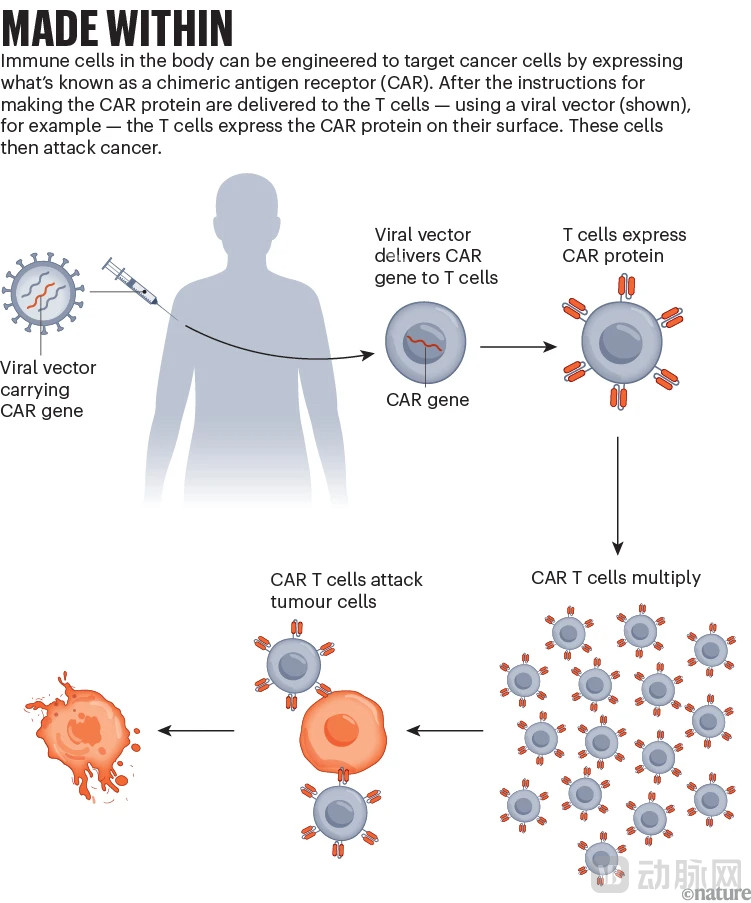 Arie Belldegrun, a veteran in the field of somatic gene therapy, believes that in vivo CAR-T therapy represents the "third wave" of CAR-T therapies. The disruptive innovation lies in addressing the limitations of the "first wave" autologous CAR-T and the "second wave" off-the-shelf allogeneic CAR-T through fundamental technological advancements.
The core advantage is that in vivo CAR-T will significantly simplify the production process and shorten the production cycle.This method eliminates the need to extract T cells from patients for complex in vitro manipulations, bypassing cumbersome steps such as transportation, laboratory genetic modification, and amplification. Instead, CAR-T cells are directly generated and activated within the patient’s body. This not only significantly shortens the production cycle but also reduces reliance on expensive facilities at cell and gene therapy centers, potentially leading to a substantial reduction in production costs.
At the same time, the in vivo CAR-T therapy avoids the necessary chemotherapy pretreatment (lymphodepletion) before treatment, maintaining a complete immune system.Enhance the security and accessibility of the application.In traditional therapies, chemotherapy is used to eliminate unedited T cells in the patient's body, making room for the proliferation of infused CAR-T cells, but this comes with issues such as increased risk of infection and higher treatment costs.。
Taking EsoBiotec as an example, its product belongs to the "ready-to-use" single-dose regimen. Patients do not need to undergo lymphocyte depletion and only require a single intravenous injection, with administration completed within 10 minutes. This significantly simplifies the treatment process, reduces the physical burden on patients, and lowers time costs.
Moreover, some argue that since gene modification is performed directly within the patient’s body, it can better simulate the physiological environment in vivo, allowing the modified T cells to adapt more effectively and attack tumor cells. Consequently, in vivo CAR-TTherapy efficacy is expected to be better with fewer side effects.
Based on simplified treatment processes and optimized delivery preparation, in vivo CAR-T therapy is expected to address the most critical commercialization challenge — the high cost of treatment. Industry forecasts show,The cost of a single treatment may be an order of magnitude lower than currently commercialized CAR-T therapies.
2Two MNCs, Betting on Two Major Technological Pathways
The core technological challenge of in vivo CAR-T therapy lies in how to precisely, efficiently, and safely deliver the CAR construct to the target T cells. The two acquisitions by AbbVie and AstraZeneca are bets on the two current mainstream approaches: lentiviral vector delivery and RNA delivery.
EsoBiotec (acquired by AstraZeneca)’s Engineered Nanobody Lentivirus (ENaBL) PlatformAfter modification,Highly Targeted、Lentivirus with immune shielding propertiesAs a carrier, effectively resist immune system attacks and ensure the precise and error-free delivery of genetic instructions toT cells, thereby efficiently reprogramming T lymphocytes into specific functional cells in vivo.
In addition, research has found that lentiviral vectors can achieve durable CAR expression, with effects potentially lasting for years. However, there may be a drawback of insufficient targeting. On the most critical safety issues, over-activation and proliferation of CAR-T cells in vivo may trigger severe side effects, including cytokine release syndrome (CRS).
Capstan (Acquired by AbbVie) Proprietary Technology Platform CellSeeker™, throughLipid Nanoparticles (tLNP) Carrier, delivering the RNA payload (mRNA or gene editing tools) encoding the CAR protein, thereby reprogramming specific cell types in vivo.
Studies show that since mRNA does not integrate into the genome and only transiently directs CAR protein synthesis in the T-cell cytoplasm (for several days to weeks), the core advantage of RNA delivery lies in its high safety and good controllability — avoiding the risks of genomic integration and permanent genetic alteration, while CAR activity can rapidly dissipate within days after discontinuation of treatment.
It is not difficult to see that, for the research and development of in vivo CAR-T therapy, delivery technology presentsPlatform-based, Holisticcharacteristics. EsoBiotec and Capstan have both emphasized in their platforms"Modular": With high compatibility, it can be adapted to various cell types, widely used in different therapeutic fields, and expand diverse cell therapies.
For this reason, MNCs opt for full acquisitions of in vivo CAR-T companies, with the key objective being to acquire complete technology platforms to pave the way for expanding into a broad range of clinical indications.
3The Debate Over Targets and Indications Begins to Emerge
The key to EsoBiotec and Capstan being acquired lies in crossing the threshold of innovation in underlying technology pathways.The first pipeline has entered the clinical stage, which means that the platform's safety and effectiveness have received initial regulatory approval.From the pipeline layout, the in vivo CAR-T therapy has begun.Compete for popular targets and major indications, and continuously explore uniqueness in efficacy.
In terms of targets, mature and popular targets such as BCMA and CD19 remain the primary targets for CAR-T in vivo. In terms of indications, high-incidence diseases such as multiple myeloma and autoimmune diseases are the main focus.Solid TumorIs a key point of contention.
Relying onENaBL Platform: EsoBiotec has laid out four clinical candidate pipelines.Involved in hematological tumors, solid tumors, and autoimmune diseases.Among them, the first line for multiple myelomaCandidate PipelineESO-T01 (BCMA CAR-T) has entered the clinical research stage.Becoming the first in vivo BCMA CAR-T candidate drug to enter human clinical trials and be administered.
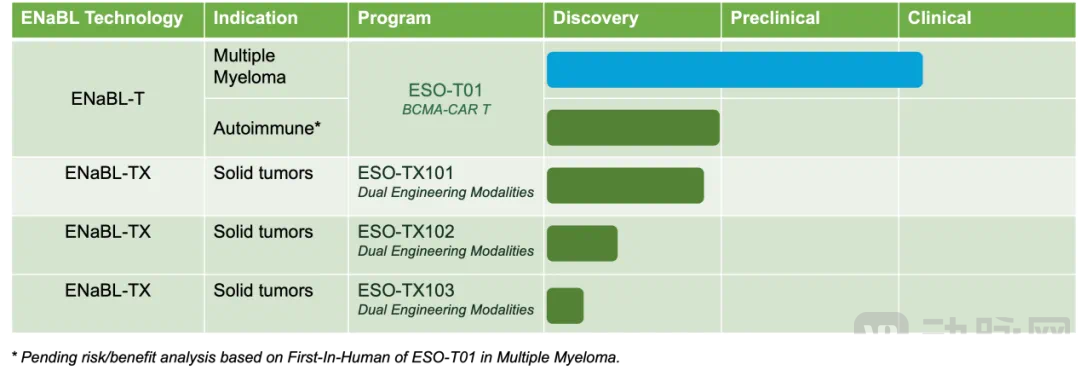 EsoBiotec Candidate Pipeline
January 8, 2025, EsoBiotec announcedLaunched in ChinaClinical Trials of Multiple Myeloma Based on ESO-T01. Preliminary clinical observations indicate that at an initial dose of 0.25E+09 transduction units per patient, the safety profile is favorable and efficacy is encouraging, with pharmacokinetic characteristics comparable to autologous extracellular CAR-T therapy. The first patient received the starting dose of ESO-T01 without lymphodepletion. By day 28, minimal residual disease in the bone marrow was undetectable, and the level of free light chains secreted by tumor cells had returned to normal. No significant adverse events were reported during the treatment process.
In terms of mechanism exploration, EsoBiotec proposed that ESO-T01, as a third-generation replication-defective self-inactivating lentiviral vector, combines the BCMA CAR-T transgene developed by Pregene Biopharma with a robust industrial manufacturing process.Possesses "immune shielding" properties and is resistant to phagocytosis.Therefore, it can specifically reprogram T lymphocytes into highly efficient BCMA CAR-T cells in vivo, accurately identify and tightly bind to tumor cells expressing BCMA, and activate an immune response to kill the tumor.
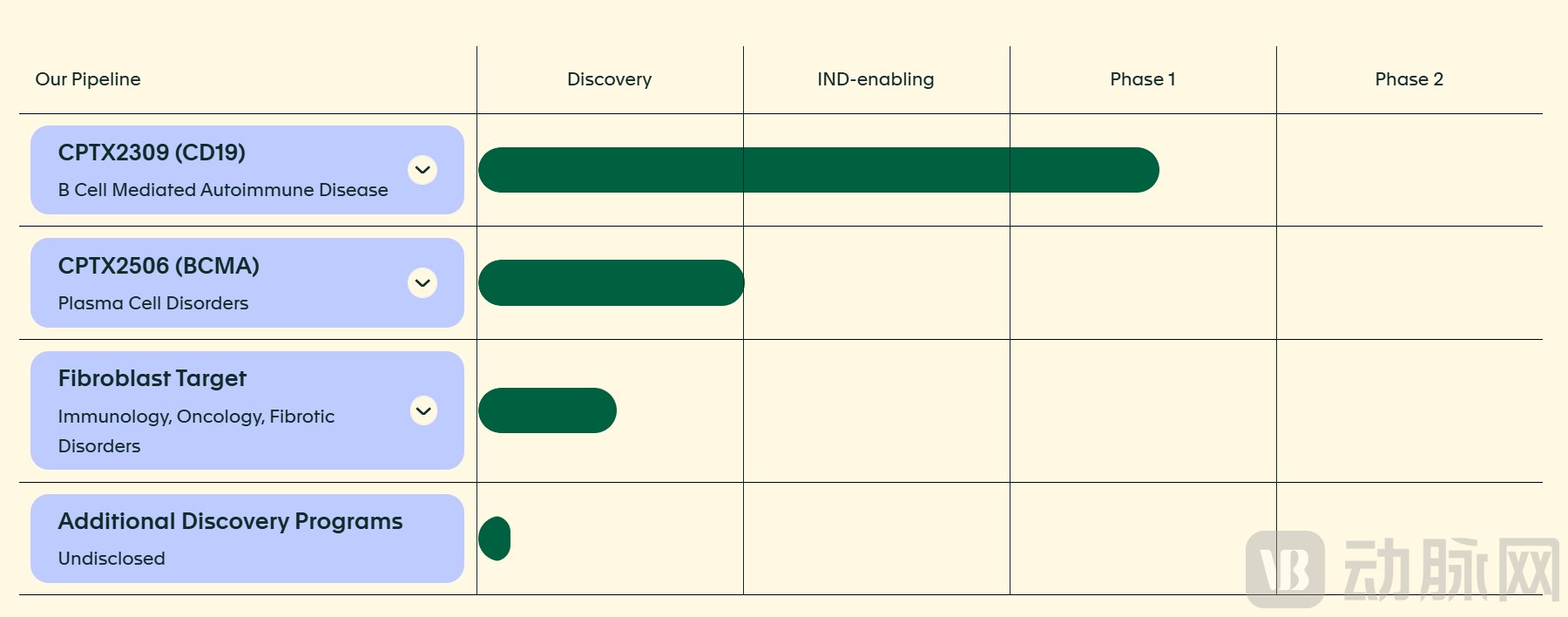
Capstan Candidate Pipeline
Capstan's pipeline layout focuses more on autoimmune diseases, with reserves in oncology and other pipelines.The first pipeline CPTX2309 targets LNP delivery of mRNA encoding anti-CD19 CAR into CD8 T cells.Currently inIn Phase I clinical stage, the target is B cell-mediated autoimmune diseases, such as systemic lupus erythematosus, multiple sclerosis, and rheumatoid arthritis.
In terms of mechanism exploration, on June 19, the research team from Capstan Therapeutics and the Perelman School of Medicine at the University of Pennsylvania published a breakthrough result in the journal Science. Data from rodent and non-human primate (NHP) models showed that this in vivo CAR-T technology demonstrated excellent anti-tumor efficacy; moreover,In autoimmune models, it was observed thatDeep depletion of B cells and led to "immune reset".
Specifically, the engineered anti-CD19 CAR-T cells are transported to the blood and tissues in vivo, rapidly eliminating autoreactive B cells and normal B cells expressing CD19 on their surface.In the blood and tissues This deep elimination of B cells induces an "immune reset":Since CPTX2309 delivers mRNA payloads, the CAR-T cells engineered in vivo are inherently transient, limiting their presence to just a few days. Consequently, once the CAR-T cells are cleared, the blood and tissues begin to repopulate with new, healthy B cells, leading to an "immune reset" within days to weeks.
4Will CGT become a standard feature of MNCs?
Currently, as an old rival in the CGT and oncology fields, AstraZeneca andAbbVieThe Competition for CAR-T in the Body Has Been Decided.
However, there are more players on the chessboard - 2023,SanofiOnce stated that there were three in vivo CAR-T projects in preclinical development;In January 2024, AbbVie announced a collaboration with Umoja to develop in vivo (in situ) CAR-T therapy, with a potential total value of $1.44 billion; in February of the same year,AstellasAnnounced withKelonia Partners to Develop In Vivo CAR-T, Potential Deal Value Exceeds $875 Million;November,NovartisOfficially Announce Collaboration with Vyriad to Develop In Vivo CAR-T Therapy.
The turning point of the in vivo CAR-T competition is when the data and efficacy of traditional CAR-T therapy are recognized, but large-scale commercialization remains difficult to achieve, and widespread application still faces obstacles.Therefore, the ultimate goal of this competitionTo bypass the manufacturing bottlenecks of traditional CAR-T therapy, achieving higher efficiency and cost-effectiveness, More Application ScenariosCell therapy.
However, it cannot be ignored that although some pipelines have gradually entered clinical trials, the maturity of in vivo CAR-T technology still needs time. The most critical safety and efficacy of CGT, as well as the production stability and consistency behind it, which are barriers to mass production and application, still require sufficient human clinical trial data.
References:
VCBeat《$7.24 Billion! This In Vivo CAR-T Pioneer Conducting Clinical Trials in China Acquired by AstraZeneca》
VCBeat "Producing CAR-T Cells In Vivo: Multiple BioTech Companies Are Redefining the Future of Cancer Immunotherapy"
Amino Observation: "The Rapid Rise of In Vivo CAR-T"
Huafu Securities "In Vivo CAR-T — The Global Race Has Begun, Focus on Everest Medicines and CSPC Pharmaceutical Group"