

Philips and Medtronic Deepen Strategic Partnership to Build Integrated Patient Monitoring Ecosystem

Medtronic
Medical Device Manufacturer
Investment Invitation Notice
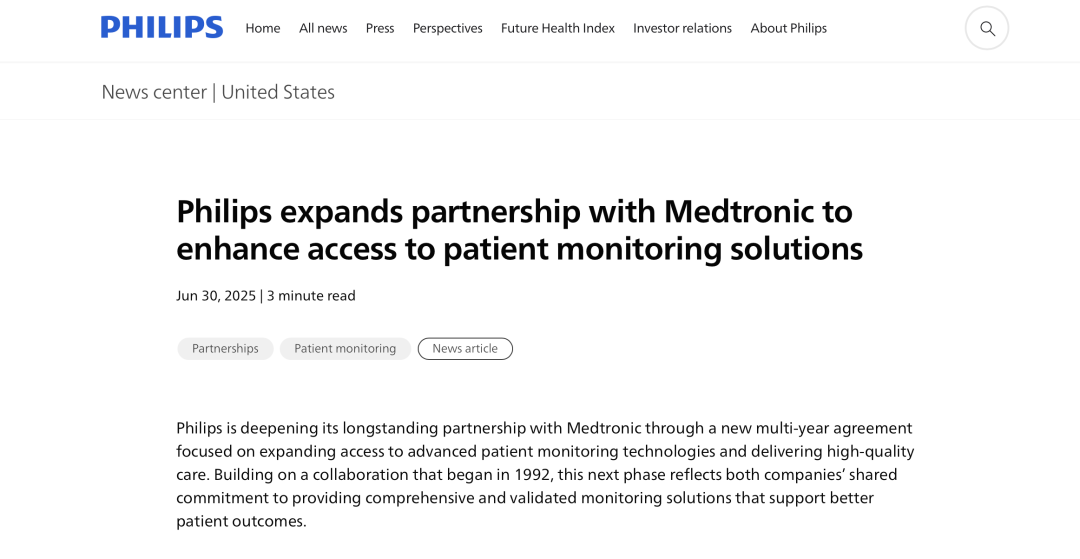
Against the backdrop of global healthcare systems gradually shifting from single-product procurement to integrated solutions,Philips (NYSE: PHG)AndMedtronic (NYSE: MDT)Join Hands Again. The two companies recently announced the signing of a new multi-year cooperation agreement, further expanding the partnership that has lasted for more than thirty years since 1992. This time, the two parties will not only continue their cooperation at the product level but also attempt toEstablish a closed-loop ecosystem in the field of patient monitoring, covering hardware, consumables, devices, and data flow.
The collaboration will initially focus on the North American market, followed by a gradual expansion to other regions worldwide. Philips stated that all integrated technologies will ensure clinical validation, cybersecurity, and alignment with frontline healthcare needs. Medtronic values the "verified, comprehensive, and reliable" solutions jointly provided by both parties, aiming to streamline hospital procurement processes and enhance medical institutions' confidence in device interoperability.
# Three Decades of Collaboration, Moving Towards a "Closed-loop Ecosystem" by 2025
The collaboration between Philips and Medtronic began in 1992, with early efforts primarily focused on single-point technology integration. For instance, Medtronic licensed Nellcor pulse oximetry technology to Philips for integration into hospital monitoring equipment. However, this current collaboration is fundamentally different:
Over the past three decades, the cooperation between the two parties has mostly revolved around individual modules or product lines; whereas the 2025 agreement,Clearly incorporate the monitoring system, core sensor technology, and key consumables into the same sales package for the first time.This marks that the two parties are no longer just supply chain cooperation partners, but are going to jointly build a monitoring platform covering the entire process.
From the perspective of the competitive landscape in the global patient monitoring field, while Medtronic is one of the largest medical device companies globally, its product line in the multi-parameter ward monitoring system market is not as complete as Philips'. Philips offers a comprehensive monitoring solution that covers ICUs, general wards, and operating rooms, whereas Medtronic's strengths lie in several key physiological parameter monitoring technologies widely regarded as industry standards. These include Nellcor's pulse oximetry, Microstream capnography, and BIS brain function monitoring. These modular technologies are often the preferred choice for doctors in high-risk scenarios such as critical care and operating room anesthesia.
'%20fill='%23FFFFFF'%3E%3Crect%20x='249'%20y='126'%20width='1'%20height='1'%3E%3C/rect%3E%3C/g%3E%3C/g%3E%3C/svg%3E)
For Philips, choosing Medtronic as a partner means obtaining a "clinical pass" for the measurement of these key parameters. Once the Philips monitoring host is equipped with Medtronic's algorithms or interface, it can more easily gain the trust of hospital purchasers. This is not only a binding at the product technology level but also a kind of market access ticket. This also explains why Philips has not independently developed all functions but has continued its cooperation with Medtronic for more than 30 years.
Sachin Chaudhari, General Manager of Philips Hospital Patient Monitoring Clinical Applications and Devices, said: "Philips is committed to providing clinicians with the tools they need to deliver better care to more patients. Through our collaboration with Medtronic, we offer a comprehensive monitoring solution that has been validated at all stages, enabling clinicians to use reliable, high-quality products."
# Deep Integration of Technology and Products
At the product level, this collaboration has identified a series of integration directions. Philips stated that its existing monitoring systems, such as the IntelliVue MX750 and MX850 series, will further incorporate several core technologies from Medtronic:
Nellcor Pulse Oximetry Monitoring:Leading global market share, with powerful low perfusion detection capabilities, widely used in critical care and operating room environments.
Microstream Capnography:Suitable for adults, children, and newborns, with particular advantages in the field of non-invasive respiratory monitoring.
BIS Brain Function Monitoring:Provide quantitative indicators for the depth of anesthesia and state of consciousness, assisting clinicians in formulating more precise anesthesia plans.
Another major highlight is that both parties will promote the bundled sales of consumables and equipment.Philips plans to package key consumables such as ECG electrodes, blood pressure cuffs, and batteries together with monitoring devices for supply.This“bundle sales”This model is a typical closed-loop strategy: by locking in the supply of consumables, it reduces the complexity of hospitals purchasing from multiple brands while also building long-term stickiness for the supplier.
# Hospital Procurement Model Faces Turning Point
This shift from product to system, and from standalone sales to bundled sales, represents a profound impact on the procurement and operational methods of hospitals.
First, under the traditional model, hospitals often need to purchase monitoring hosts, sensors, and consumables separately, with contracts involving multiple suppliers. Taking monitoring equipment as an example, a medium-sized general hospital often needs to manage three to five brands simultaneously. Just for consumables such as ECG electrodes, blood pressure cuffs, and pulse oximetry probes, dozens of different procurement agreements may be signed each year.This not only increases management costs but also brings challenges in terms of compatibility between devices and data integration.
Philips' 2025 "Future Health Index" report points out that 83% of U.S. healthcare professionals say they lose an average of 45 minutes of clinical time per shift due to incomplete or inaccessible patient data. This fragmented situation not only affects work efficiency but also potentially impacts the safety of diagnosis and treatment.
By collaborating with Medtronic, Philips aims to streamline the aforementioned processes. The two parties are not only integrating their monitoring technologies at the hardware level but also proposing "integrated procurement" in the supply chain, consolidating consumables, equipment, and software data streams into a single contract. For hospitals, this means:
Improved compatibility between devices, reducing data silos.
Reduce the cost of multi-contract management and auditing.
A simpler procurement process reduces internal procedural resistance.
But from another perspective, this might also raise concerns about the autonomy of hospitals.Large-scale bundled procurement means that hospitals are to a certain extent "tied" to specific manufacturers, and the cost of switching brands in the future will increase significantly.
# Alignment with Industry Trends
Philips and Medtronic's move is not an isolated case. It precisely taps into several profound trends in the current monitoring industry.
First, the global healthcare system is shifting from "single-device procurement" to "data integration platforms." Hospitals are increasingly looking to purchase not just hardware itself, but integrated solutions that include data connectivity, software analytics, remote monitoring, and AI-assisted diagnostics.
Secondly, the patient monitoring market is experiencing rapid expansion. According to a report by market research firm Exactitude Consultancy, the global patient monitoring market size is expected to grow from $11.83 billion in 2025 to $20.65 billion by 2034, with a compound annual growth rate (CAGR) of approximately 8.3%. Particularly in the portable and remote monitoring sectors, demand continues to rise, driven by the wave of healthcare digitalization following the pandemic.
Despite the high hopes for cooperation prospects, the challenges should not be overlooked.
First, data security and the risk of cyberattacks remain sensitive topics that cannot be ignored. As monitoring systems become more deeply integrated, the likelihood of a single device being hacked may decrease, but if the system is breached, the impact could be much broader.
Moreover, the speed of implementation in different global markets will vary in the future. Although Philips and Medtronic plan to promote globally, there are significant differences among countries in terms of regulations, medical insurance payment systems, and market acceptance. This is also an important aspect for the industry to observe the future effectiveness of this collaboration.
# The Monitoring Industry Landscape May Be Reshaped
Whether from the perspective of technology, supply chain, or hospital operations, the deepened collaboration between Philips and Medtronic goes beyond mere product bundling. This move by the two global healthcare giants aims to create a closed-loop ecosystem in the field of patient monitoring through a strategic and comprehensive partnership.
It not only means that the two companies will share profits in the market, but also signifies that the monitoring industry is transitioning from multi-brand competition to integrated platform competition. Whether hospitals will buy in and whether they can truly benefit from the clinical advantages brought by data interconnection will be the key to determining the success or failure of this collaboration.
In the coming years, whether Philips and Medtronic can replicate this model globally, especially whether they can break through regulatory and adoption barriers in different markets, may become an important indicator for observing the global monitoring industry landscape.
SIYU Annual Event Review:The First Global Ophthalmology Conference | The First Global Orthopedics Conference | The First Global Cardiovascular Conference| The First Global Medical Aesthetics Technology Conference
Coming Soon:
July 17, 2025, The Second Global Medical Technology Conference
September 3-5, 2025, The 3rd Global Surgical Robotics Conference