 At this year's EHA conference, Johnson & Johnson announced the Phase 2 RedirecTT-1Dual TCE Bispecific Antibody CombinationLatest Results of the Study. The study evaluates the combination regimen of GPRC5D TCE bispecific antibody TALVEY® (talquetamab-tgvs) and BCMA TCE bispecific antibody TECVAYLI® (teclistamab-cqyv). Data show that this innovative therapy demonstrates a high overall response rate (ORR) and durable efficacy in triple-exposed relapsed/refractory multiple myeloma (RRMM) patients with extramedullary disease (EMD).Extramedullary Disease (EMD) in Multiple Myeloma (MM) is an aggressive and poor-prognosis disease subtype, posing significant treatment challenges.。Traditional therapies (such as proteasome inhibitors, immunomodulators, CD38 monoclonal antibodies) typically result in an ORR of less than 40% in EMD patients, with a median PFS of less than 6 months.,EMD patients are often accompanied by high-risk cytogenetic abnormalities (such as del(17p), 1q21+),Leads to treatment resistance.RedirecTT-1 is the largest scale to dateLarge-scale special research targeting EMD patients.
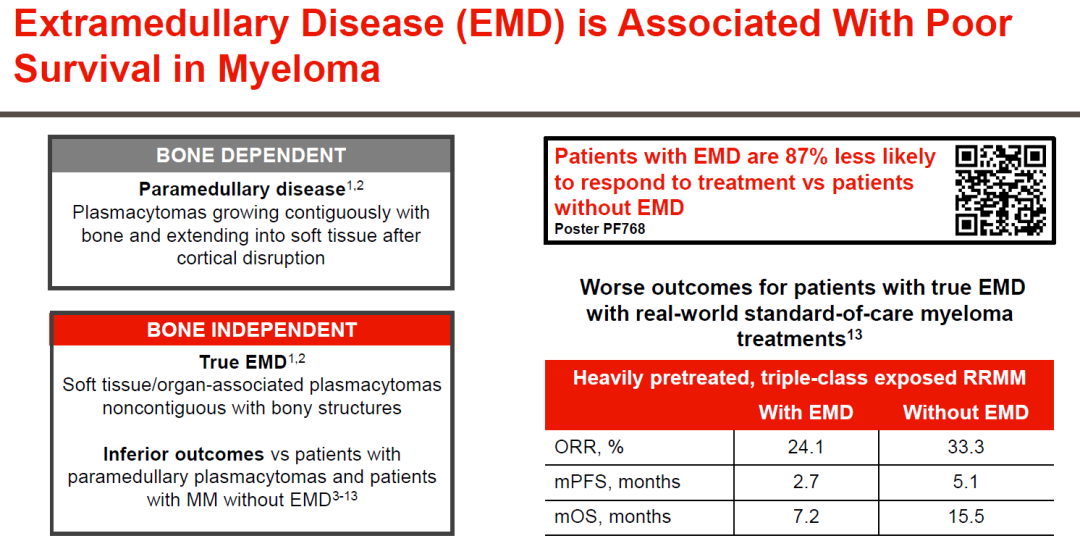 In Phase I clinical trials,The combination of double TCE bispecific antibodies has shown remarkable efficacy inIn EMD patients, 33.3% achieved CR or better outcomes, with an overall ORR of 61.1%.The Phase II clinical dosing regimen is the same as the monotherapy, adopting a step-up dose.Patient baseline is as follows: 20% of patients had previously received CAR-T BCMA therapy, and 8.9% of patients had prior bispecific antibody therapy. Before enrollment, all patients were triple-class refractory, with 56.7% being quadruple-class refractory.Phase II ClinicalIn terms of efficacy:The overall ORR of the dual TCE bispecific antibody combination reached 78.9%, already approaching that of BCMA CAR-T therapy. Seventy percent of patients achieved VGPR or higher, with 54.4% of patients reaching complete remission or even better efficacy.Compared with TCE bispecific antibody monotherapy, combination therapy, regardless of≥CR or≥VGPR has already doubled, among which in≥In terms of CR, it has almost tripled, and the overall ORR has nearly doubled.For triple-exposed relapsed/refractory multiple myeloma (RRMM) patients with extramedullary disease (EMD), the mPFS of conventional standard therapies is less than 3 months, and that of approved bispecific antibody therapies is also less than 6 months. However, dual TCEThe mPFS of the combination therapy has reached 15.4 months.In terms of DOR, the 12-month DOR was 64.1%, with an mDOR of 13.8 months, while for OS, the 12-month OS was 74.5%, and the mOS has not yet been reached.In terms of safety: 77.8% of patients experienced CRS side effects, all of which were Grade 1-2 reactions, and the vast majority occurred during the first two step-up doses. In terms of neurotoxicity: 12.2% of patients developed ICANS, with 1.1% of patients experiencing Grade 3 or Grade 4 reactions.Other side effects, blood toxicity mainlyNeutropenia, Anemia,Thrombocytopenia, rather than hematotoxicity, mainly includesFatigue, fever, weight loss, dry mouth, cough, CRS, etc., overall similar to monotherapy.
The investigational combination regimen of TALVEY and TECVAYLI has demonstrated deep and durable responses in patients with relapsed/refractory multiple myeloma and is now showing significant potential in extramedullary myeloma patients who respond poorly to conventional therapies. By simultaneously targeting GPRC5D and BCMA, this regimen may achieve higher ORR and deeper responses by reducing target antigen escape.
Currently, Johnson & Johnson's layout in the MM field has covered from newly diagnosed first-line treatments to heavily relapsed/refractory RR/MM. In terms of drug formats, they have not missed out on small molecules, monoclonal antibodies, bispecific antibodies, or CAR-T. On this basis, the development of bispecific antibody combinations, bispecific/monoclonal antibody combinations, and even trispecific antibodies will continue to solidify its dominant position in the MM field. It is impossible not to admire Johnson & Johnson’s strategy in the MM field, which is also worth learning and referencing for companies in China.!
Scan the WeChat QR code, add the editor of the Antibody Circle, and those who meet the requirements can join the Antibody Circle WeChat group!Please indicate: Name + Research Direction!
All reproduced articles in this official account are intended to convey more information, with the source and author clearly indicated. Media or individuals who do not wish to be reprinted may contact us (cbplib@163.com), and we will immediately delete the content. All articles represent the views of the author and do not represent the position of this site. '%20fill='%23FFFFFF'%3E%3Crect%20x='249'%20y='126'%20width='1'%20height='1'%3E%3C/rect%3E%3C/g%3E%3C/g%3E%3C/svg%3E)