

Elix and LINC Achieve World's First Commercialization of AI Drug Discovery Platform with Federated Learning, Integrating Data from Takeda and 15 Other Pharma Companies
Elix
AI Drug Discovery Company

Recently, Elix, Inc.ElixIn collaboration with the AI life science organization Life Intelligence Consortium (referred to as "LINC"), it was announced,Achieved the world's first commercialization of an AI drug discovery platform.
The platform integrates multiple AI models, using federated learning to train on data provided by 16 pharmaceutical companies, andOn the AI Drug Discovery PlatformElix Discovery™Implemented on the upper level.
Notably, the machine learning library of this model, developed byElix Collaborates with Kyoto University to Develop Federated Learning LibrarykMoLWas open-sourced and released in 2021.
The development of this AI model is throughIndustry-University-Research Project Led by the Japan Agency for Medical Research and Development (AMED)(DAIIA:Development of a Next-generation Drug Discovery AI through Industry-academia Collaboration)Advanced.
The initial data also comes from 16 Japanese pharmaceutical companies participating in the project, includingEisai, Ono Pharmaceutical, Kyowa Kirin, Takeda PharmaceuticalWell-known pharmaceutical companies such as , followed byThe available data pool will expand.
'%20fill='%23FFFFFF'%3E%3Crect%20x='249'%20y='126'%20width='1'%20height='1'%3E%3C/rect%3E%3C/g%3E%3C/g%3E%3C/svg%3E)
Federal Large Model Solves Data Challenges
The key to AI drug discovery lies in high-quality and sufficiently large datasets.
Pharmaceutical companies are typically limited to using their own proprietary data and public datasets, leading to a severe data shortage, while federatedLearning technology provides a solution to this challenge.
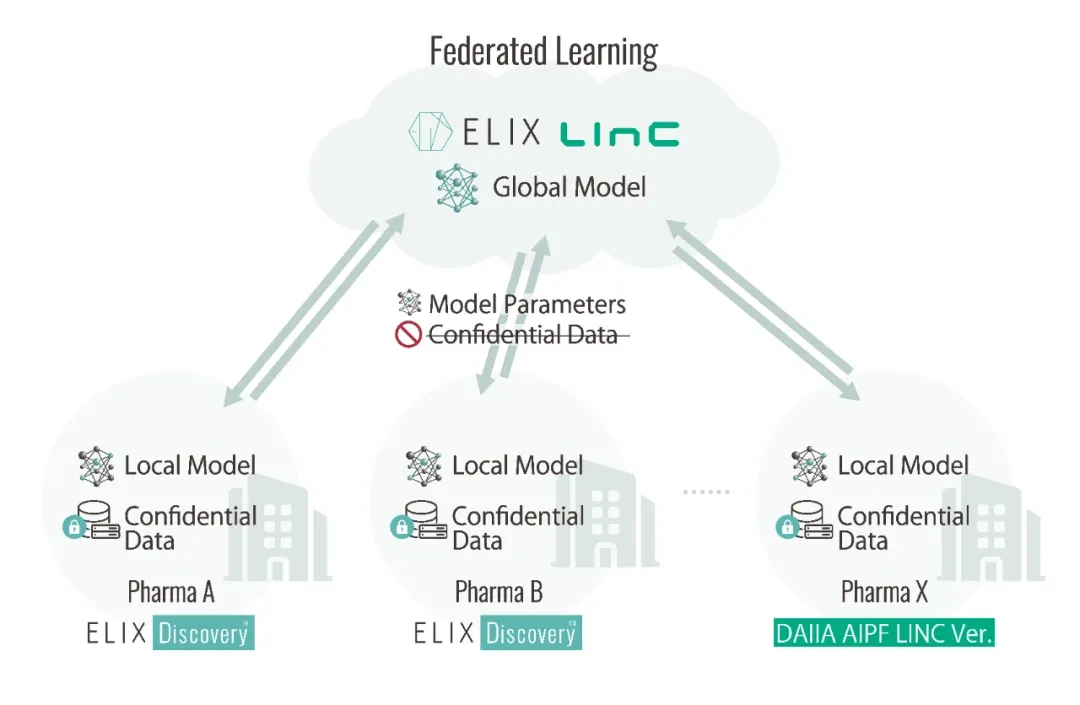
Federated Learning is essentially a distributed machine learning framework that enables data sharing and collaborative modeling while ensuring data privacy, security, and legal compliance.
The core of this technology lies in“Data stays still, models move.", sharing only model parameters rather than the data itself, therebySolved the particularly important issue of data privacy in the medical field。
The AI platform built through this methodElix Discovery™,Trained using structural data from over a million compounds and more than 10 million data points provided by pharmaceutical companies.
The platform has three key modules:
Elix Predict (Property Prediction)By inputting compound structures into an AI model, key information about the compounds can be predicted, such as activity against targets, physicochemical properties, and ADMET properties.
Elix Create (Molecular Design):Generative AI models can create compounds with desired characteristics through algorithms. Molecules can be optimized for many factors, including target activity, physicochemical properties, ADMET, and synthetic accessibility.
Elix Assist (Active Learning):When there is little or no experimental data available, the model can suggest compounds for collecting the next set of experimental data based on optimization algorithms, thereby enabling the training of high-performance models with fewer experiments.
Regarding generative AI, the company plansExtend ChemTS and integrate advanced features such as DyRAMO to achieve efficient multi-objective optimization and improve accuracy and speed. The company has currently partnered with Japan.Kaken (Kaken Pharmaceutical) has reached a cooperation.
What other companies are betting on this technology?
In the commercial field, AI healthcare unicornOwkinHas delved deeply into this technical field,Built around pharmaceutical companies and hospitalsFederal Research Ecosystem, asOne ItemProtecting privacy, traceable, and secureTechnical Framework,Ensure that data within the network is utilized under conditions that guarantee privacy and compliance.
In additionHUAWEI CLOUDAlso has a famous nameForFedAMPPersonalized Federated Learning Integration Algorithm. Focus on personalized features.Sign, CanDetect the model weights of each product party to better distinguish between good quality and poor quality, as well as correctly labeled and incorrectly labeled participants.